



HAGÅTÑA (The Guam Daily Post) — A trio of lawmakers proposed legislation that would ban nuclear power on island. The measure was introduced a day after a town hall meeting regarding plans to build a missile defense system on Guam, which included discussion on microreactors.
The possible installation of these reactors on island raised concerns following news that the Senate version of the fiscal year 2024 National Defense Authorization Act directs a briefing on the potential for using microreactors on Guam.
Bill 151-37, introduced by Sens. Sabina Perez and Chris Barnett and Speaker Therese Terlaje, would prohibit the production and use of nuclear energy on Guam.
“No nuclear fission power plant, small modular reactors (SMRs), or nuclear microreactors shall be constructed, imported, or used, and no radioactive material shall be disposed of on Guam,” the measure states.
Bill 151 also contains a lengthy portion on legislative intent that goes over the challenges with disposing of nuclear waste and examples of major nuclear disasters.
Rear Adm. Gregory Huffman, commander of Joint Region Marianas, has said the planned missile defense project on Guam isn’t considering microreactors as a power source.
‘Appears consistent’
But Leland Bettis, a member of the Pacific Center for Island Security, posited the potential relationship between the missile defense system and microreactors from the DOD’s Project Pele generally “appears consistent.”
He said it seems feasible the missile defense system could utilize Project Pele microreactors as a power source, and that poses a risk in conflict as the reactors would be a target and are intended to be mobile, possibly spreading damage over a wider area.
There are 20 potential sites for missile defense facilities throughout Guam that have been identified by the Missile Defense Agency.
The legislative intent outlined in Bill 151 also comments on the risk of using small modular reactors and portable microreactors on Guam, in terms of both natural disasters and war.
“‘Guam’s location within the typhoon belt makes it prone to tropical storms and typhoons on an annual basis. Our location near the Pacific and Philippine plates also causes the island to experience earthquakes with magnitudes ranging from 2 or 3 to a high of 8.2 on the Richter Scale,’ according to Guam Homeland Security’s website, as well as common knowledge of islander experiences throughout Guam history,” the measure states.
Threats from America’s adversaries also makes nuclear power a riskier proposition for the island, the senators contend in their measure.
“Unfortunately, Guam’s strategic location as a military stronghold leaves the island prone to a relatively high degree of potential for war, in which the missile and artillery shelling of the island, especially in the case that Guam houses nuclear reactors of any scale, could exponentially increase wartime catastrophe and calamity,” the bill added.
Guam doesn’t have any representation in the Senate, but Del. James Moylan, Guam’s sole nonvoting member of the U.S. House of Representatives, has said he is hoping to obtain a seat in the reconciliation process for the House and Senate versions of the National Defense Authorization Act, and he hopes to remove language regarding nuclear power on Guam from the annual military budget measure.

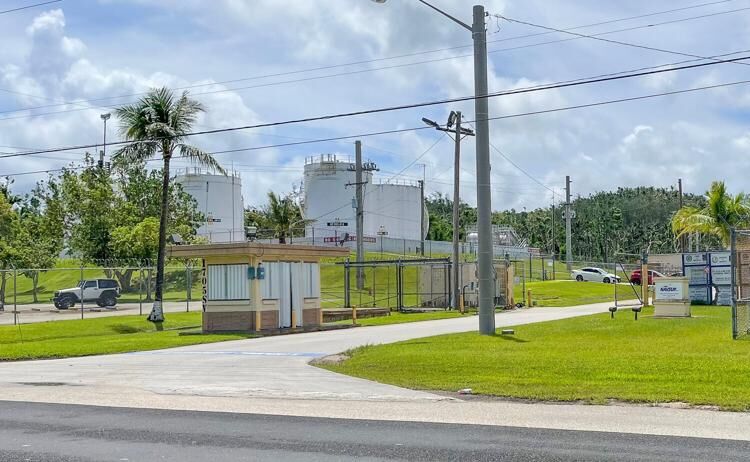
Naval Base Guam Tenjo Vista Fuel Farm in Sånta Rita-Sumai is shown Wednesday, July 19, 2023.
