


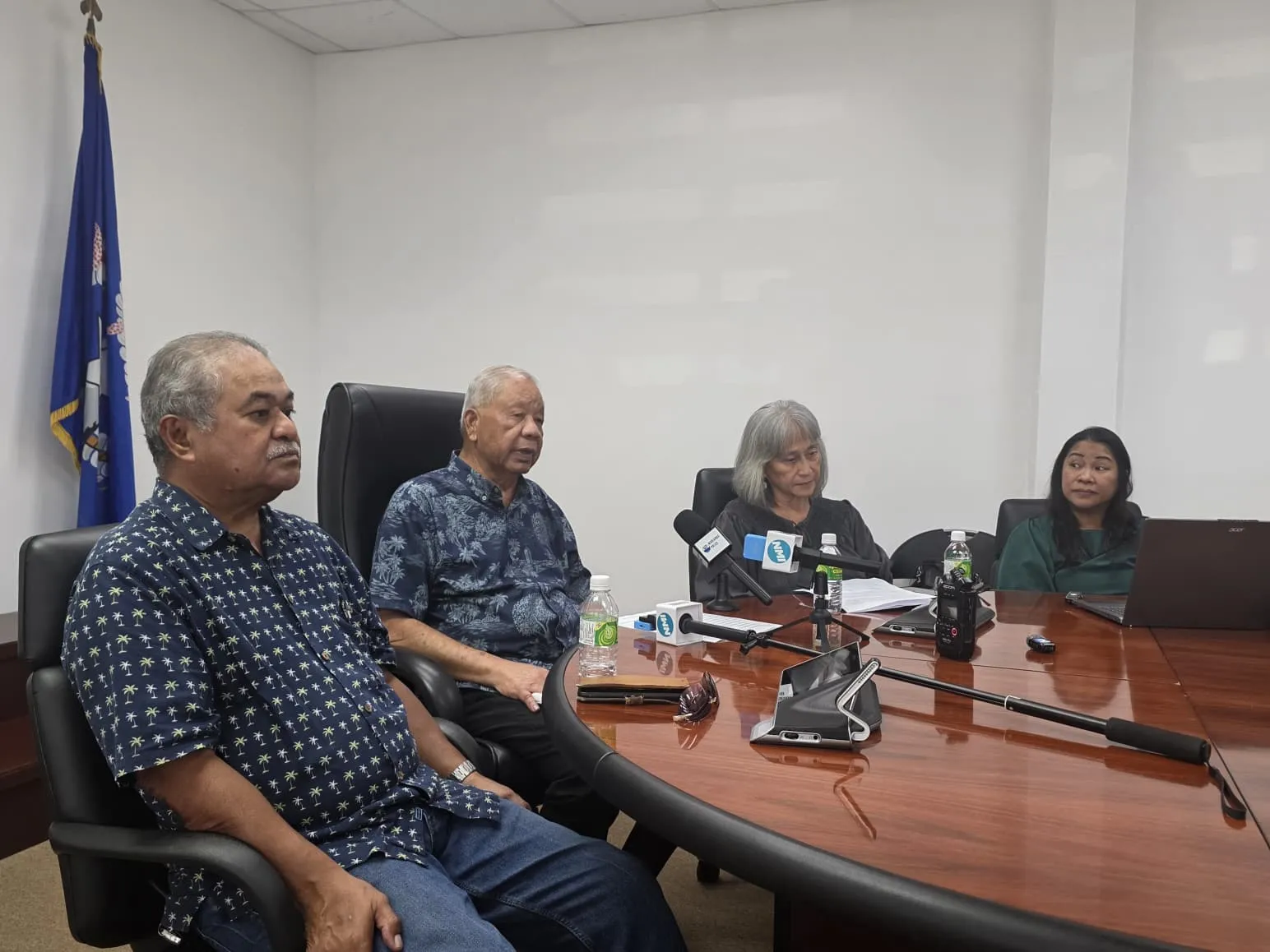





(22nd House of Representatives) — House Judiciary and Governmental Operations Committee Chairwoman Celina Babauta delivered the following remarks in the Senate chamber during the afternoon session Monday, February 28, 2022:
Good afternoon, members of the 22nd Senate. My name is Celina R. Babauta and I appear before you in my official capacity as a duly elected member of the 22nd House of Representatives.
I want to state for the record that I denounce the proposed rules adopted and passed by the Senate joint committee of Executive Appointments and Governmental Investigations, and the Committee on Judiciary, Government, Law and Federal Relations, respectively chaired by Sen. Francisco Q. Cruz and Sen. Karl King-Nabors, in their joint committee meeting held last Friday in this chamber, and further state that these proposed rules are not congruent with the applicable statutes and a complete betrayal of the CNMI constitution.
The Open Government Act mandates that the public be afforded the right to make oral comments during the public comment period. Written comments are not sufficient. Even if Covid-19 concerns were applied, the CDC guidelines and the House and Senate policies allow for public comments (in the lobby for example). These proposed rules were adopted in violation of the letter and spirit of the open government act law which states:
TITLE 1: GOVERNMENT
DIVISION 9: MISCELLANEOUS PROVISIONS
§ 9904. Meetings Declared Open and Public.
“All meetings of the governing body of a public agency shall be open and public and all persons shall be permitted to attend any meeting of the governing body of a public agency, except as otherwise provided by this chapter. The governing body shall afford all interested persons an opportunity to submit data, views, or arguments, in writing, on any agenda item. The governing body shall also afford all interested persons an opportunity to present oral testimony on any agenda item. The governing body may provide for reasonable administration of oral testimony by rule.”
Furthermore,
TITLE 1: GOVERNMENT
DIVISION 9: MISCELLANEOUS PROVISIONS
§ 9907. Ordinances, Resolutions, Rules, Regulations, etc., to be Adopted at Public Meetings; Sanction; Notice.
“No governing body of a public agency shall adopt any ordinance, resolution, rule, regulation, order, or directive except in a meeting open to the public and then only at a meeting, the date of which is fixed by law or rule, or at a meeting of which notice has been given according to the provisions of this chapter. Any action taken at meetings failing to comply with the provisions of this chapter shall be null and void.”
The Open Government Act expressly prohibits this lack of transparency that was exhibited in the passage and adoption of the Senate Rules on Friday, February 25, 2022, during the Joint Committee meeting. These proposed rules were handled as if they were a threat to national or Commonwealth government security or some trade secret and were treated as secret document. The fact that a recess was called to accommodate Sen. Justo S. Quitugua’s request for a copy of the final amendments to the rules during the joint committee meeting last Friday, demonstrates that the final proposed rules were kept secret from him as well and he is a member of not just one but both committees. He was not provided an advance copy to any of the final amendments of these proposed rules. Because of this willful violation of the Open Government Act, there can be no other interpretation than the rules that were adopted by the joint committee are, null and void pursuant to the law. This body cannot adopt and pass these proposed rules because it is not properly before this body.
In addition, when the joint committee adopted and passed these rules last Friday, they violated the Constitutional provision that the Legislative Bureau is the only entity tasked to assist the Legislature. It is their raison d’être.
ARTICLE II, Section 17
“(b) The director shall employ all necessary staff, other than personal staff of the members of the legislature, pursuant to budgetary allocations. The staff members shall include legal counsel and other administrative staff.
“(c) The bureau shall provide all required services to the legislature in connection with duties and responsibilities during sessions and committee meetings. It shall maintain all records, files, library and other documents of the legislature.”
The fact that a Special Counsel was specifically hired to draft up these rules and personally participated as the joint committee’s counsel during their meeting last Friday instead of the 2 very capable Senate Counsel, is contradictory to and is a betrayal of our Constitution. Why even have a constitution if the Senate can arbitrarily subvert its democratic principles?
There is no ambiguity in the Constitution that the Bureau counsel should never be replaced by a private attorney in its role of assisting any Senate Committee and private counsel should not be utilized as the official Counsel in any official Senate or committee meeting. Even during the JGO hearings, we respected the Constitution and utilized only House Legal Counsel, no one else. The question I ask is who is providing direct or indirect funding for Special Counsel Joe McDoulett? Is it the Governor? The Mayor of Tinian? Or the Senate leadership?
As to Rule 1. Definitions.
“(k) ‘House Impeachment Record’ means:
“(3) a copy of each document, audio recording or other material the House Committee(s) declined to accept as a part of the official record.”
Telling the House to include items previously declined is improper infringement on the House’s authority to establish its own record. The Senate cannot dictate how the House of Representatives conducts their business.
As to Rule 7:
“Appointment of Impeachment Prosecutor. The House Speaker who authorized the impeachment inquiry shall serve as the Impeachment Prosecutor.
“(2) If the House Impeachment Committee Chairperson is unable to serve because of death or incapacity, or declines to serve as Impeachment Prosecutor by written notice to the Senate President detailing why he/she declines to serve as Impeachment Prosecutor, then the Senate President shall select a House member to serve as Impeachment Prosecutor.”
The Senate cannot infringe on the ability of the House of Representatives to select its own House prosecutors. The Senate’s attempt to dictate the number and identity of the House Prosecutor in the proposed Rule violates the CNMI Constitution by usurping the powers of the Speaker of the House of Representatives, and House’s sole ability to prosecute the Governor in front of the Senate by unreasonably dictating the manner in which, the House prosecutes the Governor.
Additionally, limiting the House Prosecutors is unreasonable because the House has the burden to prove its case and according to these proposed rules will be allowed only one prosecutor. In contrast, the Governor who has no burden of proof whatsoever, has no limitations on his counsel.
The House Prosecutor is not an attorney, and even with the assistance of two House Counsel, only the House Prosecutor can ask questions, raise objections, make motions, and make the opening statement and closing argument. The Governor’s counsel will be an attorney with training and experience to ask questions, raise objections, make motions, and make opening statements and closing argument.
The Senate President not only unconstitutionally claims the right to name the House Prosecutor, he also unconstitutionally claims the sole authority to name a substitute if the Speaker or the House Impeachment Committee Chairperson is not willing or able to.
As to Rule 9 Record of Articles of Impeachment.
“(e) In transmitting the House Impeachment Record to the Senate Clerk, the House Clerk shall certify that the record is timely, complete and contains all documents and materials required by these impeachment rules.
“(2) If the House Clerk fails to submit the appropriate certification within the forty-eight (48) hour period, then the House Impeachment Record shall be automatically stricken and the impeachment matter shall proceed in the Senate without an impeachment record and the Impeachment Prosecutor shall not be allowed to appear or participate in the Senate proceedings and the Senate hearing in any manner whatsoever. The Articles of Impeachment shall be presented to the Senate for final verdict and judgement in accordance with Rule 26 (Final Verdict and Judgment).”
This proposed rule is unconstitutional because any technical failure will result in the House losing its ability and authority under the applicable statutes and the CNMI Constitution to prosecute the case before the Senate.
As to Rule 9 (g)(1) and (2):
“The certified written request to either strike or supplement shall contain a copy of each document, audio recording and other material that the Impeached Official would like to have included or excluded as part of the House Impeachment Record together with a detailed explanation of why it is appropriate.”
Ni månu na demokrasia yan sisteman gobietnamento este na areklamento ni ma susesede na I ma inbestitiga, I ma akukusa, guiya para hu ayik yan hu detetmina hafa na dokumentu siha malago’ña para hu ma inklusu komo ebidensia gi anai guiya ma kokotte?
As to Rule 12. Impeached Official’s Appearance and Answer.
“However, neither the Impeached Official, nor the legal counsel for the Impeached Official, shall be allowed to appear or participate in any of the Senate proceedings. The Articles of Impeachment shall be presented to the Senate for final verdict and judgement in accordance with Rule 26. If the Impeached Official, or legal counsel for the Impeached Official, appears and admits to any of the grounds for impeachment, then, without further proceedings, judgment shall be entered removing the Impeached Official from office.”
This proposed rule appears to provide that a failure on the Governor’s part to file an answer within the required time, means the Governor or his counsel cannot participate in the Impeachment Hearing and the next step is to automatically go to Rule 26 – Closing Arguments.
This unconstitutionally and expressly denies the House Impeachment Prosecutor to present its case if he or she so chooses especially since the failure to answer by Governor Torres is automatically deemed to be a denial of all the charges enumerated in the House Impeachment Resolution. Moreover, this proposed automatic default judgement to a denial of any charges by Governor Torres is the opposite presumption in courts where the failure to respond is deemed to be more of an admission or guilt — hence default judgements are declared against the party that fails to answer.
Moreover, there is nothing in the proposed rules that seem to hold the governor to any standard of accountability. His written reply to any charges are not mandated to be submitted under penalty of perjury and the fact that the Senate President has chosen only one person as an Impeachment prosecutor is taken directly from Governor Torres’ demands upon the JGO last December 10th wherein he wanted to select who he gets to investigate him, didn’t want to be put under oath, and he wanted to select where and when his investigation will take place.
These rules are so lopsided and unreasonable that they violate the fundamental tenets of due process. These rules are intended to preclude the House of Representatives from having adequate opportunity to plead its case on the merits. Åntes de hu fatto magi I hayi para hu presenta I kausa ginen I sanpapa’ na guma’ esta en hiluk lapesña, en titik papetna, en gedde kannaiña, ya en tape pachotña. Pot para en fan libiano, para hafa båsta en gåsta tiempon miyu para en na’ guaha Senate hearing. Para hafa?
Only a cheater afraid of the rules of the game stacks the deck with five aces. It is clear that this Senate body will prosecute Governor Torres on a set of rules that are unlawful, unconstitutional and more importantly, slanted in his favor. The fix is in. And to think that these rules are to be used as a template for future proceedings is preposterous. Rule 7 is so problematic as it is an infringement on sole constitutional prerogative of the House of Representatives to initiate Impeachment proceedings and causes a chilling effect that it will deter any future Speaker to initiate Impeachment proceedings knowing that he will have to serve as an Impeachment Prosecutor.
The burden of proof is left unstated in both National and Local impeachment proceedings because ultimately, it is left to the individual conscience of the respective body. The burden of proof should be nothing more than common sense!
Whatever former Gov. Benigno R. Fitial did nine years ago pales in comparison to the amount of money that Gov. Ralph DLG Torres and Mrs. Diann Tudela Torres have squandered from the CNMI Treasury.
These rules basically create a theory of how Governor Torres is not guilty and then work backwards from there, creating such arbitrary nuisances such that if the House Clerk does not paginate the documents, or if he or she fails request for and get the permission of the Senate President in order to submit paper evidence, can possibly terminate the entire proceeding in order to fit your predisposed conclusions.
Si Yu’us Ma’åase’ yan buenas dias.

Celina Babauta
