




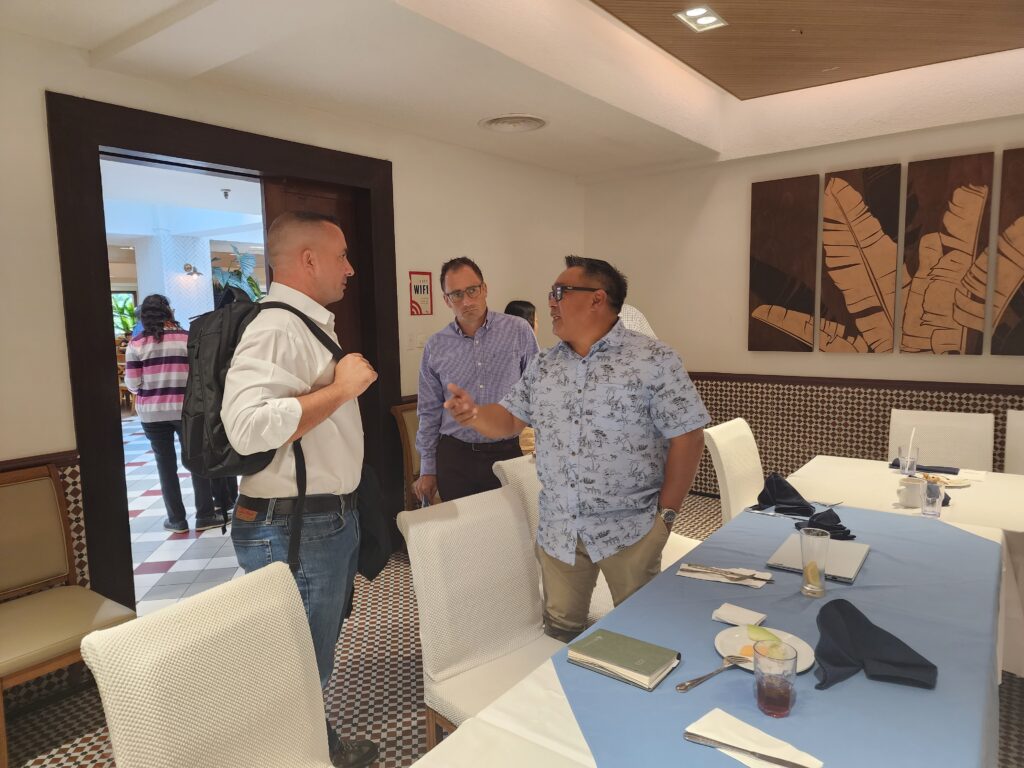
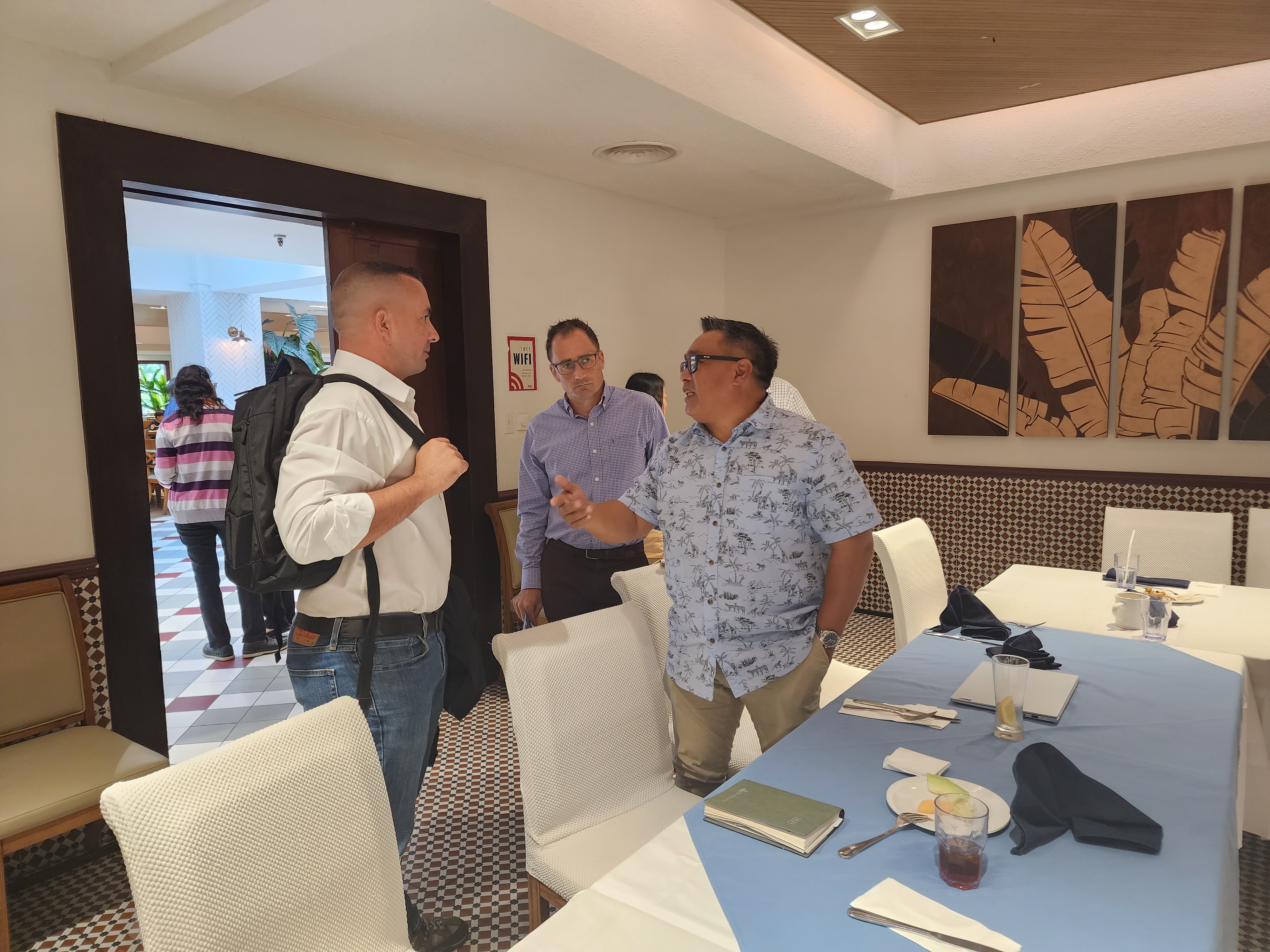
Hotel Association of the Northern Mariana Islands Chairman Ivan Quichocho, right, talks with Triple J Marketing Manager Brad Ruszala after a HANMI meeting at the Pacific Islands Club on Thursday
EVEN as the tourism industry picks up steam, “we continue to face challenges and rough seas [on] the horizon,” Hotel Association of the Northern Mariana Islands Chairman Ivan Quichocho said on Thursday.
He told reporters that HANMI members met to discuss issues, such as the CW-1 “touchback” provision, manpower, facility renovations, a potential increase in the BGRT, essential air service, road improvement projects, and crimes against tourists.
“Between a potential increase in taxation, even if we still haven’t fully recovered, [and] a shortage of key staff — these stack up,” Quichocho said. “It can be pretty devastating for the industry…expecting tourists to come back and yet we don’t have the manpower,” he added.
“Quite frankly we don’t want to see a touchback,” Quichocho said.
The CNMI Department of Labor has said that September 2023 may see the largest number of departures of CWs because of the “touchback” provision.
Quichocho hopes that more local residents would choose to work for hotels which are currently operating with skeleton staff.
He said they are also hoping for the early completion of the Garapan revitalization and Beach Road improvement project.
“It’s supposed to be our main tourist area, so it’s tough — we are going [into] peak season, and then there’s construction. We hope the construction is completed sooner than later…. We learn the completion was going to be [at the] end of August,” Quichocho said.
“It’s progress — the Beach Road improvement project, but that’s not what we sold to our visitors when enticing them to come…. Maybe we should put up [a] sign: ‘Please pardon our progress.’”
Quichocho noted that the Beach Road project is supposed to be completed next year.
“We need access to construction [companies]; we need to improve our products, and our facilities require renovations, but all construction business is now being diverted to Tinian and Guam,” Quichocho said.
Airlines
Air service is another issue, he added.
“We don’t know if the Commonwealth Ports Authority is going to get funding support from the Federal Aviation Administration,” Quichocho said.
“What would that mean for the airlines serving our route? What is that going to mean for ticket prices or airline operating costs? One thing you’re not hearing much [about] is that if the airport does not secure funding, the fees come September are going to be crazy expensive. That is going to be passed onto the airlines. Two things can happen: they pass it on to the customers, or decide [that] they [the airlines] can afford it….. It really calls [into] question the viability of the route,” Quichocho said.
He said HANMI also wanted to talk to the Zoning Office about the island’s blighted properties. “Maybe try to cover them up,” he added. “It does not look good [to] our tourists.”
“We obviously have to work on our tourist sites,” he reiterated.
“I saw a video on YouTube — some guy visited here in 1994 and he went to all the sites: Suicide Cliff, Bird Island, Banzai. In that 1994 video, the sites looked exactly the same as today…. Maybe a facelift, a new upgrade, is needed,” Quichocho said.
Crimes against tourists
He said HANMI and the Marianas Visitors Authority have met with the Department of Public Safety to discuss crimes against tourists.
“Tour vans have been burglarized at the Bird Island Lookout, and rented cars are burglarized at Banzai Cliff. A couple’s car in the Hyatt parking lot was burglarized. Customers playing golf at COP…get out of a golf cart to hit the next shot, they come back and find somebody [has] stolen their stuff from the golf cart. And then a taxi driver was assaulted in front of tourist passengers,” Quichocho said.
But “we are now seeing more police in tourist areas,” he added. “We are also seeing more police bike patrols. We want to see more of them at night, at turns or blind spots — their presence will be really appreciated at night.”
He said tourists “take back to their home country their bad experiences here. We spend money to attract them, but [even] one incident…can cost thousands of dollars in damage to the CNMI’s image.”
Tourism is the islands’ lone industry.
