







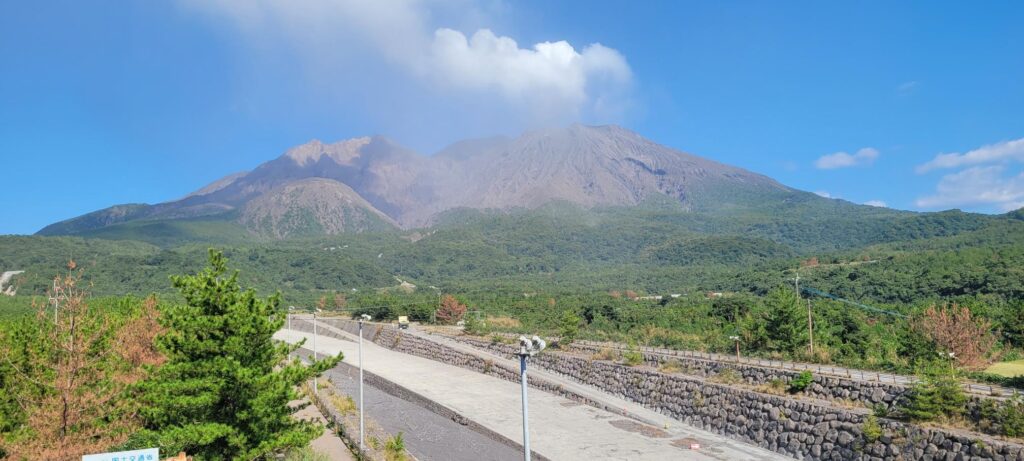
KAGOSHIMA CITY, Japan — Faced with the imminent danger of a massive volcanic eruption, people living at the foot of Sakurajima, which is both an island and the name of one of Japan’s 111 active volcanoes, remain resilient, adapting to life with an unpredictable, and on occasion, deadly neighbor.
During a massive eruption in 1914, smoke rose 60,000 feet. It belched copious amounts of pumice, and buried many of the village’s traditional thatched roof houses in ash. Anyone who survived the fallout ash faced another danger: a Magnitude-7 earthquake that caused tremendous damage on the shoreline, ultimately resulting in numerous casualties. With their houses buried under the pumice and volcanic ash, and lava filling the strait, it was fight-or-flight for the people of Sakurajima.
More than a century later, roughly 3,500 people remain. Volcanic eruptions sometimes occur scores of times a day, and are part of everyday lives, along with measures in place to safeguard the public. Those include: annual evacuation drills, and maps with updated evacuation routes.
Kagoshima City Crisis Management Division chief Tomohiro Nakashima said the city hopes to be the global model for volcanic disaster prevention. The city collaborates with the Japan Meteorological Agency, Kyoto University Disaster Prevention Research Institute and the national government’s Ministry of Land, Infrastructure, Transport, and Tourism to study the volcano’s activity. Municipal officials use this data to form guidance, forecasts, and advisories to the general public.
Speaking to visiting journalists from the Caribbean and the Pacific Islands, Nakashima said in the event of high volcanic activity, residents are well-prepared. Children must wear safety helmets to and from school, and older residents are encouraged to use umbrellas to protect their heads, and handkerchiefs as filters. Should an eruption be forecast, people are evacuated in advance, tapping into the various drills conducted over the years. They are temporarily relocated to a neighboring city outside of the hazard zone, and typically return to their homes within three days.
Utilities are shut off and the roads are cleared as the volcano continues to emit smoke, pumice, and ash. With each passing day, the skies begin to clear, signaling an impending return home for the city’s residents. Once the “all-clear” is sounded, municipal workers begin cleaning up the debris and preparing for the public’s homecoming.
In that sense, Sakurajima provides a beacon of hope for other communities adapting to natural threats, such as low-lying Pacific Islands that deal daily with the consequences of rising sea levels. In the face of such challenges, some may ask, “Why not just move?” With the right measures in place, as in Sakurajima, those who remain could confidently say, “Because this is my home.”

Sakurajima is one of Japan’s 111 active volcanoes.
