






SENATOR Francisco Q. Cruz is urging the House of Representatives to act on Senate Bill 22-22 which proposes to amend the homestead law to protect homesteaders’ lot permits from revocation by the Department of Public Lands.
The bill would prohibit DPL from revoking a village or agricultural lot permit after the permit is approved and issued to a homesteader who has complied with all requirements even if the permittee has acquired “interest in land” in the CNMI after the village or agricultural lot permit has been approved.
The measure would also allow agricultural homesteads on Saipan.
According to the bill, there are homesteaders who have spent labor and money to stay in compliance with the regulation, but their permits were revoked after three years because they have “subsequently acquired interest in land in the Commonwealth.” This revocation is “unreasonable and unjustified,” the bill added.
On Sept. 14, 2021, the Senate passed the bill.
In a statement on Tuesday, Cruz said the legislation, as originally drafted, aimed to assist village homestead recipients who have lost their assigned homestead lots after acquiring land through marriage; have received a deed of land from a parent or an estate; or purchased real property.
Before passing S.B. 22-22, the Senate amended it to include provisions pertaining to agricultural homesteads on Saipan, noting that the “agricultural homestead program is available on Rota, Tinian, and the Northern Islands but not available on Saipan.”
Cruz said his bill in its current form “intends to prohibit the Department of Public Lands from revoking a village or agricultural homestead permit from an individual who met and complied with all necessary requirements, including not having any interest in land at the time the permit was approved.”
S.B. 22-22 is Cruz’s second attempt to push his proposal. His first attempt was when he introduced S.B. 21-36 in the 21st Legislature. It passed the Senate in December 2020 and was transmitted to the House for action. Unfortunately, Cruz said, no further action was taken by the House, which prompted the bill’s reintroduction in the 22nd Legislature.
Cruz said S.B. 22-22 was referred to the House Committee on Natural Resources on Oct. 1, 2021, but to date, he added, no further action had been taken by the committee.”
“For the benefit of our people throughout the Commonwealth, I hope the House will look into this matter soon so that we can finally help our residents who may lose their homestead lots,” Cruz said.
Major concerns
Asked for comment, House Natural Resources Committee Chair Sheila Babauta said DPL and the Office of the Attorney General have major concerns with the bill.
In his written comment to the Senate Committee on Resources, Economic Development and Programs, Attorney General Edward Manibusan said, “It is unclear whether those who have received a village homestead but were divested of their interest through a divorce decree would remain eligible to apply for a new homestead as provided in subsection (a)(4) of the section.”
He said the Senate should make clear that the exception in subsection (a)(4) is not affected by the new amendment.
Subsection (a)(4) of the S.B. 22-22 states that an “applicant or his or her spouse must not own or have any possessory interest in any village lot or have been a recipient of a village homestead lot.”
According to the AG, “In determining the term ‘interest in a village lot,’ the proposed amendment provides two factors to be considered but does not indicate how those factors would be used in determining whether an interest in a village lot exists. The proposed definition would also allow an applicant to acquire an interest in other land after the application has been approved.”
As for the proposal to allow agricultural homesteads on Saipan, the AG said the reason for re-establishing the Saipan agricultural homestead program is not provided in the bill.
He noted that the dwindling size of public land on Saipan resulted in the cessation of the agricultural homesteading.
He said the Senate should review the land use plan that the DPL commissioned, and whether the plan considered the re-implementation of the agricultural homestead program in Saipan.
DPL opposes the bill
Marianne Concepcion-Teregeyo, who was the DPL secretary at the time, did not support the bill.
In a written comment she submitted to the Senate committee, she said:
“Including eligibility to a second homestead land if the applicant leased his or her original homestead land is unfair and unjust to any remaining applicants that have not had an opportunity to acquire their homestead lot. It is an unfair economical advantage to those that choose to utilize the intent of the homestead land as a permanent place of residence for his or herself and or his or her family. This idea of allowing individuals who have ‘divested’ their interest via a lease to be eligible for a second homestead lot fails to account for the actual available land within the public land inventory and implies that there is an overabundance of land. We disagree with this insertion and request that this be reconsidered and removed, so as to properly maximize and not over exploit public land…which belongs to people of Northern Mariana Descent, collectively.”
She noted that “there is a moratorium for new [homestead] applications,” adding that her department “will caution…lifting the moratorium, and disadvantaging those that have never had land.”
Regarding S.B. 22-22’s definition of “interest in land,” DPL had this to say:
“This contradicts the original intent of the creation of homesteads under Article XI [of the CNMI Constitution]… Allowing recipients to be deemed eligible after leasing their land would certainly defeat its intent.”
The then-DPL secretary also said, “We also have concerns with respect to the establishment of a Saipan Agricultural Homestead Program. The availability of public land in Saipan for village and agricultural homestead is almost nil, unlike Tinian and Rota. Saipan also has a more dense population than Tinian and Rota. Based on the recent CNMI comprehensive land use plan Saipan is challenged with identifying available public lands for village homestead subdivisions, let alone for agricultural homestead.”

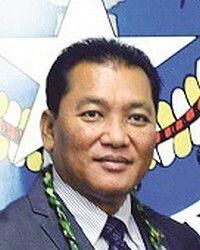
Francisco Q. Cruz
