







THE House version of the fiscal year 2023 budget bill allocated $20 million in American Rescue Plan Act funds that are no longer available, the Republican Senate leadership said in a press conference Tuesday.
According to Secretary of Finance David DLG Atalig, the $20 million was used for the second stimulus for CNMI residents that was also supported by the House, the Senate leadership said.
The Democrat-Independent House leadership claims that lawmakers can appropriate ARPA funds, but the Republican Torres administration disagrees.
The Senate has made “significant amendments to reverse many of the proposed provisions of the House in both the administrative provisions and attached schedules for the budget plan for FY 2023.”
On Tuesday, the House, by a vote of 15 to 4, rejected the Senate version of the bill.
Without a new balanced budget bill enacted into law on or before Oct. 1, Saturday, there will be a partial government shutdown affecting thousands of non-essential employees, the administration said.
80/20 and FTEs
Senate Committee on Fiscal Affairs Chair Victor B. Hocog on Tuesday reiterated the panel’s concern over the House proposal to reverse the allocation of ARPA funds to support personnel costs.
The House version sourced 80% of personnel costs from ARPA funds and 20% from local revenue.
“Such action places CNMI government and employees in a detrimental financial risk should ARPA funds are no longer available to fund 80% of personnel costs,” Hocog said.
He quoted Finance Secretary Atalig as saying that the House action “is actually putting a hamper on the total availability [of funds] for provisions of government for FY 2023.”
“Therefore,” Hocog said, the Senate…committee agreed to restore personnel costs funded at 20% ARPA and 80% local revenue.”
The Senate leadership also said that the House eliminated 2,103 full-time equivalent or employee positions funded under ARPA: 293 on Rota, 273 on Tinian, and 1,537 on Saipan and the Northern Islands.
The senators said the House cut 94 FTE positions under local revenue: 32 from Rota, 31 from Tinian, and 31 from Saipan and the Northern Islands.
“The biggest concern was the House’s total disregard to properly identify which positions and salaries were cut,” the Senate leadership said. “Mayors of Rota and Tinian are left with no guidance as to which positions will no longer be available for renewal come Oct. 1. Furthermore, there is no clear indication on whether these cuts were only made to exempted service employees or civil service employees.”
The Senate leadership said “the families that depend on their salaries during this trying time in our community will be left without any means of income. This action is inexcusable and unacceptable. It is the intent of the Senate to restore these positions to ensure the livelihood of our residents across the CNMI.”
Retiree pension
As for the 25% retiree pension benefits, the Senate leadership said the House allocated $13.6 million despite being told that Gov. Ralph DLG Torres and Finance Secretary Atalig have already identified funds for the first quarter of FY 2023.
“The Senate, in line with the governor’s commitment, ensures to continue supporting the retirees’ pension benefit. Through the reprogramming authority of the governor, pursuant to 1 CMC §7402(b), the Senate is confident that every effort will be made to identify funds for the remaining three quarters of FY 2023,” the Senate leadership said.
Unconstitutional
The Senate leadership also noted that the House proposed to allocate $1,629,869 in Compact-Impact funds for affected agencies in the CNMI.
“The Legislature has no authority to appropriate such funds,” the senators said. “The percentage of funds allotted to the affected agencies is formula based. The Senate amended Section 802(b) to ensure that the allocation of Compact Impact funds correspond to the data submitted by the state on the impact of affected agencies in the Commonwealth”
The House also included provisions to increase the tobacco tax and establish a new tax for sugar sweetened beverages in the House version of the FY 2023 budget.
The House claims that pursuant to 1 CMC §7204, the Legislature has the authority to increase revenue and appropriate additional revenue within the budget.
But Senate legal counsel Jose Bermudes said the House took 1 CMC §7204 out of context.
Moreover, the senators said the House ignored Article II, Section 5(b) of the CNMI Constitution which states that “a bill shall be confined to one subject except for bills for appropriations or bills for codification, revision, or rearrangement of existing laws. Appropriation bills shall be limited to the subject of appropriations. Legislative compliance with this subsection is a constitutional responsibility not subject to judicial review.”
The Senate leadership said the proposed taxes are “riders in the FY 2023 Budget Plan,” adding that the Analysis of the NMI Constitution clearly explains that “the budget document is a plan for collection of revenue and expenditure of funds. It does not constitute legislation with respect to raising revenue, to authorization or to appropriation of Commonwealth funds.”
“Based on the House’s position, it is evident that the House did not consider the Analysis of the NMI Constitution,” the Senate leadership said.
They added that pursuant to Article II, Section 5(b) of the NMI Constitution, it is clear that “revenue bills…are passed separately from the budget.”
Quoting Black’s Law Dictionary, they said “revenue bills are ‘bills that levy or raise taxes.’ ”
“Therefore, the House incorporating the proposed sugar sweetened beverages tax and tobacco tax provisions as a rider on House Bill 22-116, HD2 is unconstitutional,” the Senate leadership said. “Through the guidance of the Senate legal counsel, the Senate agreed to delete both provisions in its entirety….”
Unfair
A minority bloc member who voted in favor of the Senate version of the budget bill, Sen. Edith Deleon Guerrero told Variety that she felt it was unfair to prioritize the retirees’ 25% benefit over current government employees’ pay.
“I believe what essentially happened was that some of the FTE salaries, obviously, were taken to support the retirees’ 25% pension…. That made me feel uncomfortable in a way because you cannot consider one group more important than the other,” she said.
“Everybody has a livelihood to tend to. We have the retiree group’s annuity, which is a guaranteed income, versus active government employees who are still working toward that point in life where they want to achieve retirement,” she added.
“So, taking away funded positions to finance, basically, another target group who has a fixed income as an annuity, and then trying to take [from the] budget [that] support the active employees’ livelihood and salaries, knowing that ARPA would expire at a certain time period…if you look at it carefully and analyze it, you’re going to run into the same issue where one target group eventually would be holding the shorter end of the stick,” the senator said.
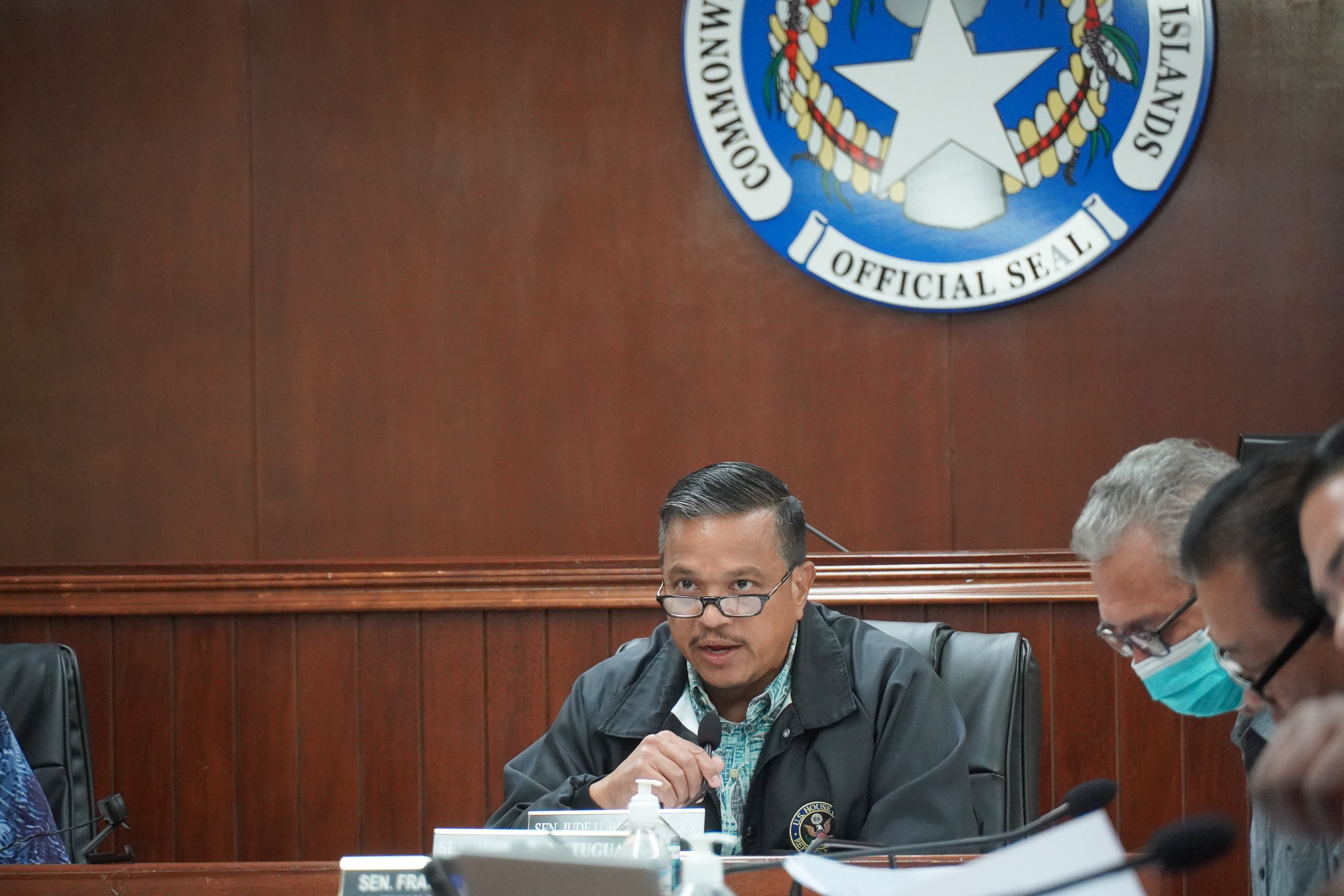
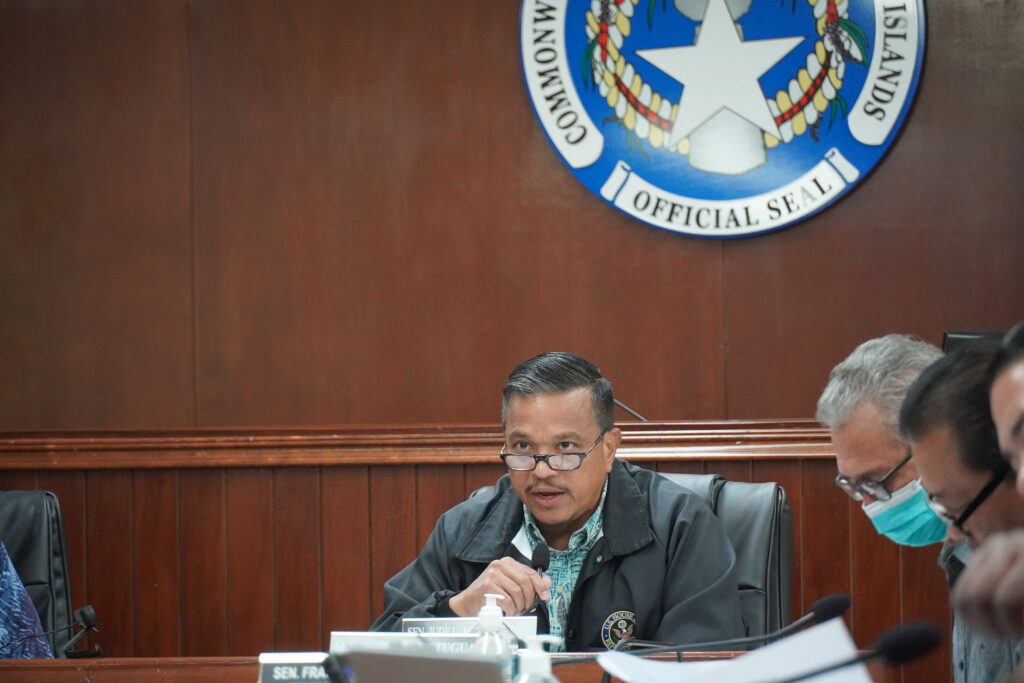
Senate President Jude U. Hofschneider speaks during a press conference on Tuesday in the Senate chamber.
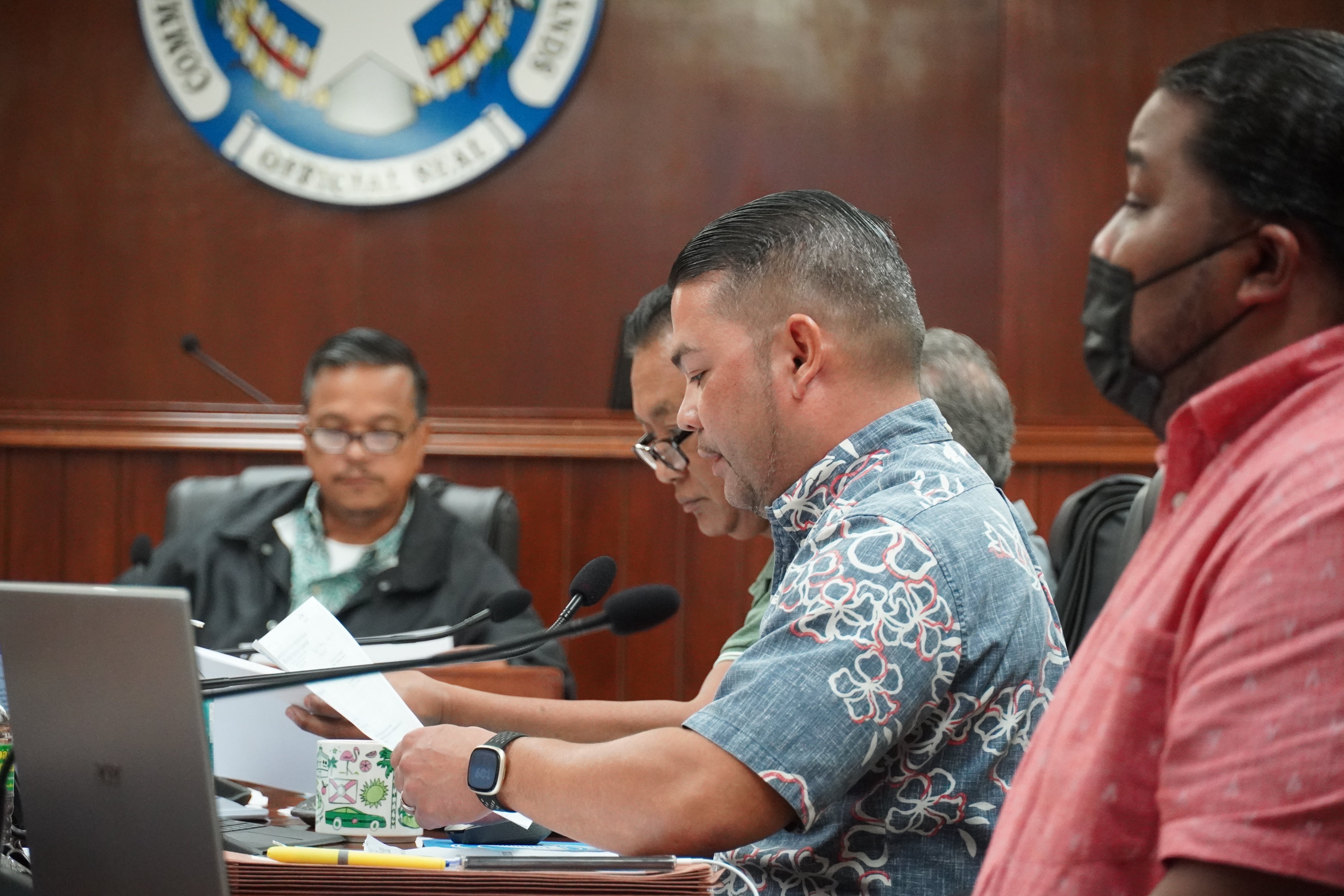
Senate Floor Leader Vinnie F. Sablan talks about the Senate version of the fiscal year 2023 budget bill.
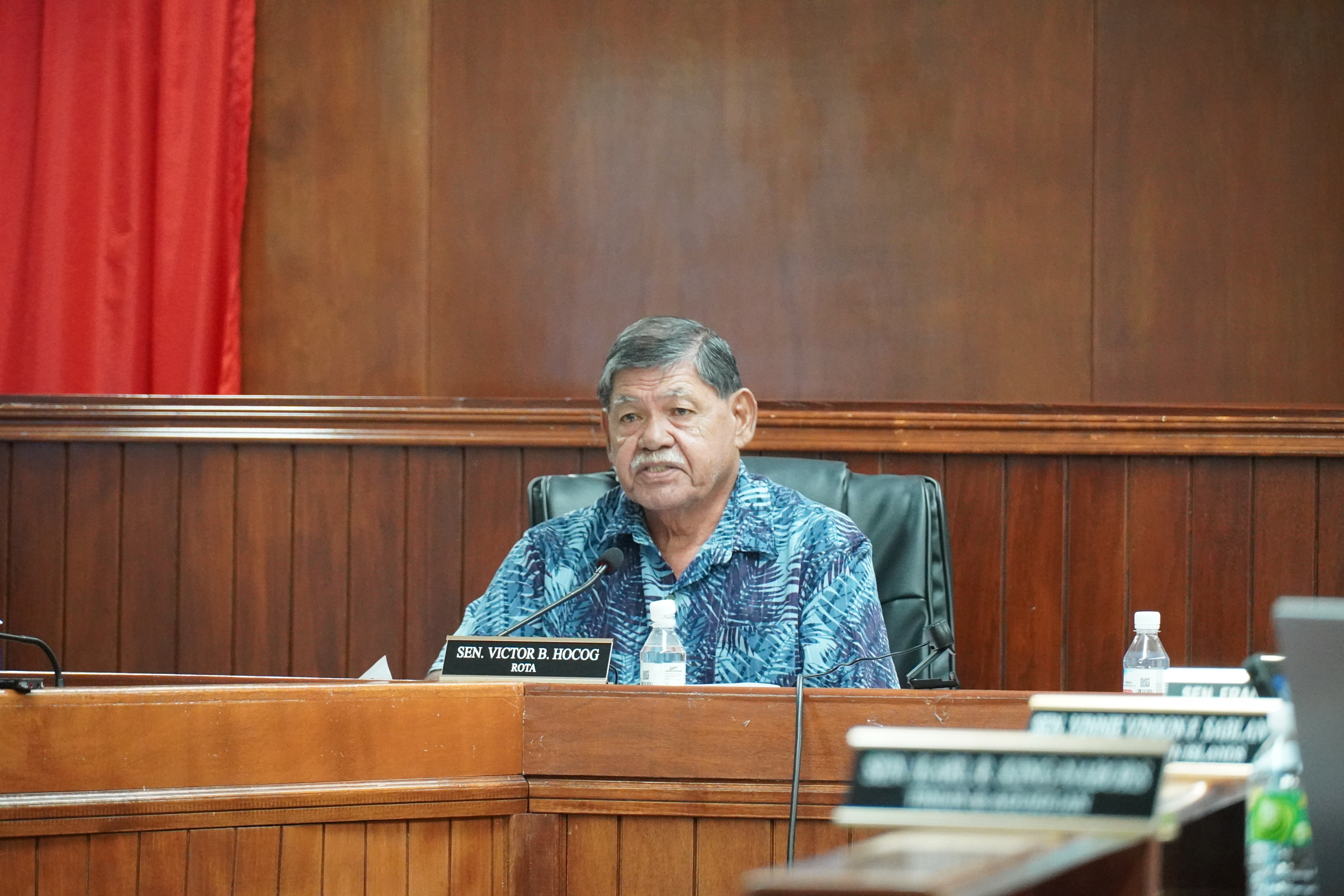
Senate Committee on Fiscal Affairs Chair Victor B. Hocog discusses some of the provisions of the FY 2023 budget bill.
