



By John O’Connor
For Variety
HAGÅTÑA (The Guam Daily Post) — The Federal Emergency Management Agency placed all grants awarded by FEMA Region 9 to the government of Guam on restrictive drawdown status on May 12, meaning agencies must submit supporting documents for review and approval prior to the release of any grant funding.
The federal agency announced the restriction in a letter to the governor’s chief of staff, adding that it was due to “longstanding and significant concerns” regarding GovGuam’s management of federal grants.
FEMA cited yearslong restrictions on the Emergency Management Performance Grant and Homeland Security Grant Program due to findings for fiscal years 2016 through 2018. During that period, Guam substantiated costs for less than 5% of EMPG funding, according to the agency. Restrictions have been in place since 2019.
FEMA also cited a 2023 audit from Premier Audit Group Services Inc., which identified tens of millions of dollars in questioned costs and 11 compliance issues, and the 2025 indictment of Guam Homeland Security/Office of Civil Defense officials on charges stemming from two 2024 audits as additional rationale for the decision to place grants on restrictive drawdown.
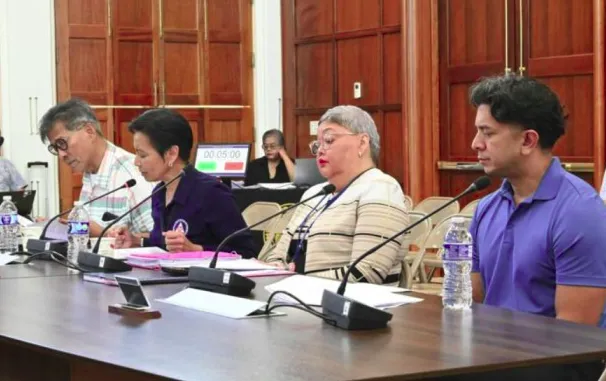
Sen. Shawn Gumataotao, head of the legislative committee on emergency management, raised the issue as he called for an oversight hearing on GHS/OCD earlier this month. The hearing took place Monday.
Guam Homeland Security Adviser Esther Aguigui said FEMA approved a corrective action plan in January and placed grants on restrictive drawdown a few months later in May, but added that the actions “are not contradictory.”
“The first is a judgment that our plan is sound. The second is a control mechanism that keeps federal funds flowing while we prove that soundness over time,” Aguigui said Monday.
To lift the restriction, FEMA requires three consecutive years of clean monitoring and a sustained low-error rate across multiple testing cycles, according to Aguigui.
“So, the relevant question this morning is not whether the restriction is lifted. It is whether the corrective actions within our control are being done — they are,” Aguigui added.
She said timekeeping procedures and pay-period audits have been running since 2023, and grants management staff completed federal grants management course certification in August 2025. She added that quarterly internal audits of transactions, procurements, travel and disbursements have been in place since the middle of last year.
The Office of the Chief of Staff also established a grants monitoring committee in December 2025, Aguigui said.
The corrective action plan was developed alongside FEMA, with specialists from the federal agency offering dozens of recommendations. FEMA also granted an extension when GHS/OCD needed more time, according to Aguigui. She added that this was “not the posture” of a regulator that had given up on the local emergency response agencies.
“It is the posture of a partner rebuilding trust alongside us,” Aguigui said.
But she also acknowledged that the Premier audit found real weaknesses, and “we have not minimized a single one.”
“But the honest measure of this government is not the existence of findings; it is what we have done since. The documentation is complete, the controls are operating, and the federal relationship is active and collaborative,” Aguigui said Monday.
Gumataotao asked what specifically triggered FEMA to place all of its grants to GovGuam on restrictive drawdown status when, about three months earlier, it had approved Guam’s corrective action plan. However, he added that FEMA’s approval letter for the plan expressed confidence in GHS/OCD’s commitment but not its compliance.
Aguigui said there could be a number of reasons for the decision, but explained that a restrictive drawdown does not deobligate funds or assert new violations.
But she also said this was nothing new, adding that GHS/OCD “have always been” under restrictive drawdown conditions since she took up her position in 2023.
“This is the way we have been operating on the grants we have been awarded,” Aguigui said.
In addition to findings in the Premier audit, the Office of Public Accountability issued significant findings in June 2024 that discussed overtime issues and highlighted grant-funding issues at GHS/OCD.
The OPA found that GHS/OCD owed $8.4 million to the general fund despite claiming to be 100% federally funded.
GHS/OCD officials stated at Monday’s oversight hearing that about $500,000 of the $8.4 million has been received from FEMA, which Gumataotao called “unacceptable” in a written statement published after the hearing.
“Strengthening Guam’s existing all-hazards warning system, establishing or building up individual and family disaster supplies, scheduling school, workplace and communitywide drills, and other preparedness efforts require resources and coordination. Our partnership with FEMA remains critical to our preparedness efforts, and therefore it is imperative that the government of Guam does its part to demonstrate good stewardship of local and federal taxpayer funds,” Gumataotao stated.
There was also discussion Monday about the status of Charles Esteves, who served as the Civil Defense administrator. Esteves was one of the officials indicted in 2025, but he was also accused of assaulting an ex-girlfriend, with whom he has a child, and threatening to kill her family while the two were in a hotel room in Washington, D.C., in March 2025.
He pleaded not guilty in the former case, which remains pending, but was found guilty of simple assault and destruction of property in the latter.
Gumataotao said Monday that the governor permanently transferred Esteves to the Department of Public Works in January, but the governor’s office rescinded that transfer in mid-April. Then, on May 11, the governor rescinded her Oct. 24, 2025, detailing of the homeland security adviser to serve as the acting OCD administrator, according to Gumataotao.
The OCD administrator is a classified position, and Gumataotao noted that personnel rules prohibit unclassified or contract employees, such as the homeland security adviser, from being detailed to a classified position.
When asked who is in charge of the Office of Civil Defense at this point, Aguigui said she is in charge of OCD and GHS.
While she is not the OCD administrator, Aguigui said the governor had given guidance that she is in charge of the agency.
Gumataotao said a document submitted to his committee on May 19 listed Aguigui as the OCD administrator alongside Esteves. That would have been eight days after Aguigui’s detailing as acting OCD administrator was rescinded.
Aguigui explained that at the time the document was created, they were operating under the direction that Esteves would retain his title as administrator, but added that his “presence” is “still unknown” at OCD.
