








By James Sablan
[email protected]
Variety News Staff
IN the world of sports, headlines are usually dominated by athletes who cross the finish line first, lift the heaviest weights, or score the winning points. But behind every champion stands a foundation built on decades of quiet, tireless dedication.
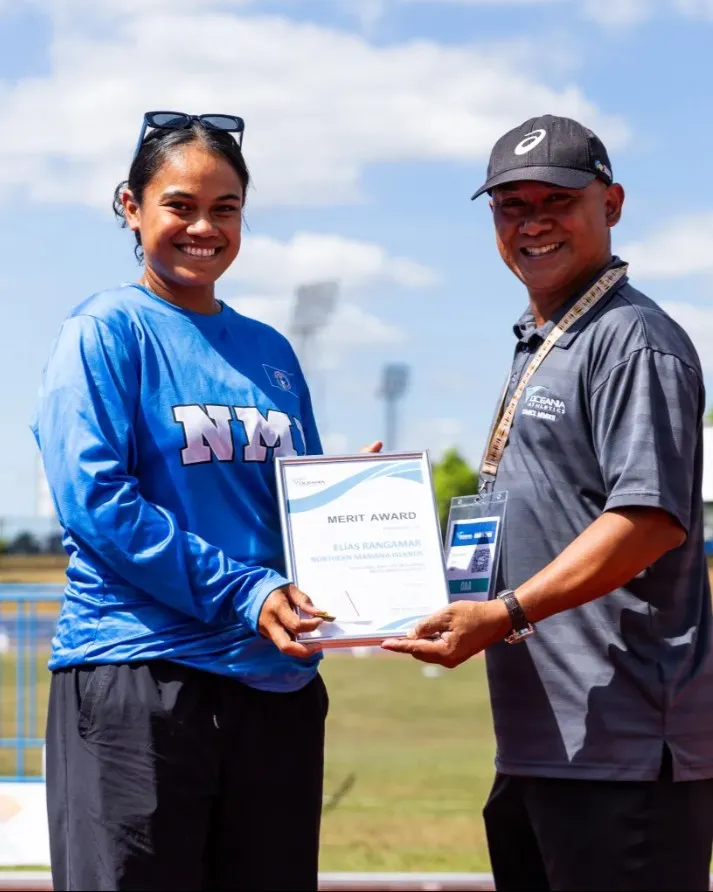
On June 1, that foundation received well-deserved recognition as legendary mentor Elias Rangamar was honored by the Oceania Athletics Association with a Merit Award, recognizing his lifetime of service to athletes across the islands and the broader Oceania region.
In an interview with Variety following the announcement, Coach Rangamar, who is also a member of the CNMI House of Representatives, reflected on a lifetime spent in the trenches of athletic development, the evolving landscape of youth sports, and why trophies are the last thing on his mind.
For a man who has dedicated most of his life to the track, field, and court, the announcement came as a sudden shift in perspective. When asked about his initial reaction to the award, Rangamar chuckled, displaying the trademark humility that has made him a beloved figure in the community.
“To be honest, I was not expecting it, but at the same time I wasn’t entirely surprised,” Rangamar said. “When you’ve been doing something out of passion for most of your life, time has a way of flying by. You don’t really keep track of the years, the number of athletes you’ve worked with, or the places the journey has taken you. Awards and accolades are honestly the furthest thing from your mind.”
Rather than viewing the award as a personal victory, Rangamar redirected the spotlight to the broader network of support behind regional sports. He noted that his first reaction was one of profound gratitude for the coaches, officials, volunteers, administrators, parents, and athletes he has worked with over the decades.
“Any recognition I receive is really a reflection of the collective efforts of countless individuals who have dedicated themselves to sports development in our islands and throughout Oceania,” he said.
Ever grounded in the realities of his community, Rangamar also used the moment to highlight ongoing recovery efforts following a recent natural disaster. “While I am honored by this recognition, my thoughts remain with many families still recovering from the recent typhoon. Their resilience and determination are far more deserving of attention right now,” he said, adding that the award serves primarily as a reminder of his ongoing responsibility to serve local youth.
When asked what the award means to him personally, Rangamar joked, “Awards like these are often reminders that you’re getting old.”
Shifting to a more serious tone, he acknowledged that the accolade serves as validation that decades of work have made a difference in regional communities. However, according to Rangamar, the true measures of his career cannot be captured on a plaque.
The real rewards of coaching, he said, are seeing young athletes gain confidence, watching former athletes become successful adults, coaches, teachers, parents, and community leaders, and knowing that sports helped shape their lives in a positive way.
Having observed the sporting landscape evolve over multiple generations, Rangamar has had a front-row seat to major structural improvements. The single greatest advancement, he said, is access.
“When I first started, training facilities were limited, equipment was scarce, and information was not readily available,” he recalled. Early coaches relied on personal experience, isolated clinics, and whatever limited resources they could access. Today’s landscape is dramatically different, with advanced training venues, sports science, educational resources, and the vast information-sharing power of the internet.
Yet with these advancements comes criticism. Rangamar pushed back against the narrative that today’s technology-driven youth are less disciplined or motivated than previous generations.
“I respectfully disagree,” he said. “Kids have always been kids. Every generation says the same things about the next generation. Young people today are just as capable, talented, and driven as those from previous generations when they are nurtured properly and provided the right environment.”
Rather than blaming smartphones or video games, Rangamar pointed to a deeper systemic challenge facing today’s youth: the changing pressures on modern families.
With many parents working long hours to provide for their households, they often return home exhausted. In these environments, mobile devices can become a practical way to keep children occupied while parents manage the demands of daily life.
“I don’t say this to criticize parents,” Rangamar clarified, emphasizing the pressures families face. Instead, he described it as a call for stronger parenting support, mentorship, and community involvement.
As the interview concluded, Rangamar reiterated the importance of sports as a pillar of society. Athletics, he said, remains one of the best tools for teaching youth discipline, teamwork, resilience, respect, and social skills.
He added that the key to unlocking the potential of the next generation does not lie in banning technology, but in strengthening the “village” around young people. When parents, coaches, schools, and communities work together, youth will thrive in any era.
“The potential of our youth has never changed,” Rangamar said in closing. “Our responsibility as adults is to provide the guidance, opportunities, and support that allow that potential to flourish.”
James Sablan has been a sports reporter for Variety since 2013. He was a liberal arts student of Northern Marianas College and covers all local sports.
