



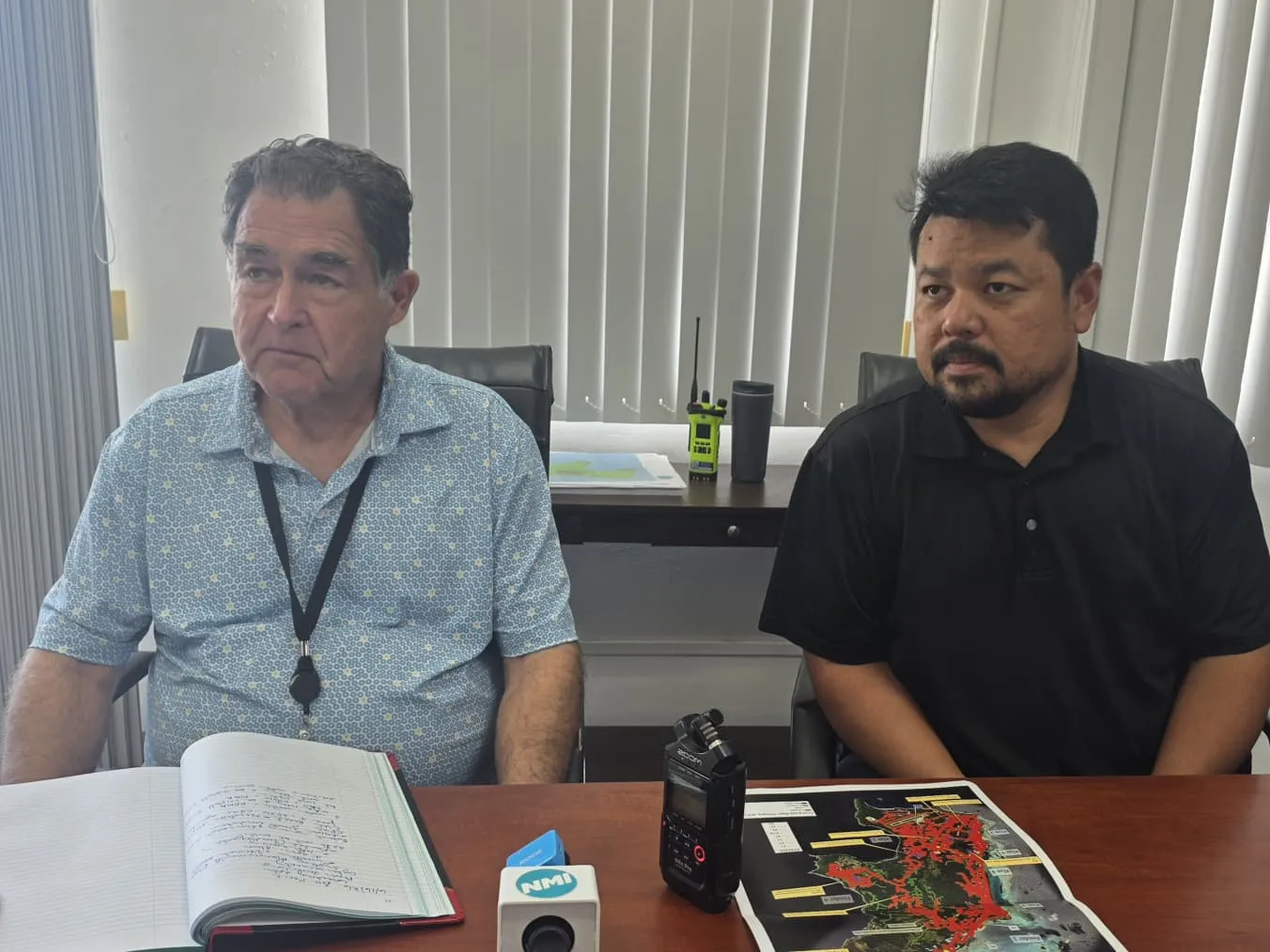


THE governor’s authorized representative for the Covid-19 pandemic, Patrick Guerrero, on Friday said although contracts for recovery efforts were well over $100 million, the billed expenses were much less.
Referring to social media posts with photos of the complete list of contracts for operations, Guerrero said it is “an accurate list…of all contracts that have been signed by the government in the response efforts. However, [there is a] big difference in what the total expenses actually are versus the contracts that were signed.”
He said the list “probably showed well over $100 million in expenses related to the Covid-19 response, but in actuality, we don’t use that number. We look at the number of what is actually billed at the end of the day. Many times, we sign contracts and they are open amount contracts [in case] we use all that service. So, from over $100 million, the actual expenses to date are under $80 million. It’s $78 million, to round it off.”
Of this amount, almost $30 million has been awarded to the CNMI by the Federal Emergency Management Agency just for the response, Guerrero said.
FEMA has also awarded the CNMI funding for lost wages assistance a few months ago.
“There’s still another $20 million in FEMA’s review, and the rest of it under my office is [also under] review,” he said.
Citing Lt. Gov. Arnold I. Palacios’ testimony before the House Committee on Judiciary and Government Operations on reimbursements for unused rooms at government quarantine sites, Guerrero said currently, all contracts for quarantine sites, whether it’s Kanoa or PIC, are charged per room.
“So whatever we occupy is eligible for reimbursement under the FEMA public assistance program,” he added.
In the early days of the CNMI’s Covid-19 response, Guerrero said “it was hard to even get a hotel. Everyone had shut down. Everyone went home. Employees didn’t want to even show up to work, so [there were] contract negotiations with Kanoa the first week, and by the second week, we were also at PIC. We negotiated contracts to rent the entire facility.”
Guerrero added, “Are they all reimbursable? The truth is, not every single dollar is reimbursable…[but FEMA] did reimburse most of that for the first 90 days, and everything after that was on a room-to-room basis, so we’re covered at 100% moving forward and continuing.”
In May, Guerrero said the CNMI had an $11.7 million contract with Pacific Islands Club Saipan and a $14.2 million contract with Kanoa Resort.
In June, he said, there were 224 rooms available for use at Kanoa, and 308 at PIC.
But the CNMI did not get billed for the full amounts for either of the two contracts, Guerrero stated.
He said under $7 million was billed to the CNMI government by PIC and around $8.5 million by Kanoa.
At present, Guerrero said Kensington Hotel Saipan is being used as a hybrid quarantine facility under the Marianas Visitors Authority travel bubble program.
He added that in the early days of the island’s Covid response, a request for proposals was issued when the former Mariana Resort was first utilized as a government quarantine site with Kensington providing management services on a short-term basis.
Guerrero said while the quarantine site — the former Mariana Resort — is owned by the government, the government is not in the business of running a hotel, and so it had to outsource “all the little details of running a hotel.”
As for the current condition of the quarantine rooms, Guerrero said:
“We’ve reached the point where we were getting quite a few [positive Covid-19 cases] from Guam… Kanoa was starting to get ‘full’… [as] we had to keep these individuals longer than the five days. We weren’t able to check them out and at the end of the day, we had to scramble every day in trying to accommodate [new arrivals]. We did not want to jeopardize the safety and sanitation of these rooms, [either]. So, it doesn’t mean that when we went to PIC, we needed 500 rooms every day. We needed some rooms ‘offline,’ to use the term of the hospitality industry, so that they can have time to properly clean them, make sure that everything’s working, and make sure that everything is right with the room before we occupy it,” Guerrero said.

