







SPEAKER Edmund S. Villagomez broke the tie by voting again in favor of House Bill 22-33 which would require legislative appropriation for the $515 million in American Rescue Plan Act funds that the CNMI will receive from the federal government.
The vote on H.B. 22-33 was 10 in favor and 10 against with House Floor Leader Ralph N. Yumul joining the minority bloc in voting no.
Because the House had not adopted the new House rules, which include a one-man one-vote rule in passing bills, the House leadership applied the interim rules which allowed the speaker to break the tie even after he had already cast his vote. The bill now goes to the Republican-led Senate.
It was not known if a public hearing was conducted on the bill, which was introduced by Rep. Donald Manglona, or if there was a committee report drafted to endorse its passage.
Rep. John Paul Sablan of the minority bloc expressed dismay with the House leadership’s decision to act hastily on contentious legislation before adopting the new House rules.
The House leadership said the measure calls for “accountability and transparency” in spending the $515 million federal funds.
But the minority bloc pointed out that the American Rescue Plan Act itself mandates the governor to submit a spending plan.
House Minority Leader Ivan Blanco brought the leadership’s attention to the letters submitted by Finance Secretary David DLG Atalig, Deputy Attorney General Lilian Tenorio and Public Auditor Kina Peter regarding the bill. They all have concerns about H.B. 22-33.
Blanco said the House Ways and Means Committee, which Manglona chairs, should hear from the agencies that have concerns about the measure.
Rep. John Paul Sablan asked, “What is the sense of urgency in passing this legislation?”
Windfall
Rep. Tina Sablan, a majority bloc member, said “this incredible and historic windfall of half a billion dollars in Coronavirus State and Local Recovery Funds is coming to the Commonwealth through the American Rescue Plan Act. That’s five times our current annual budget. And we have two years to spend it.”
“Do we have the legal authority to pass legislation to appropriate these funds and exercise oversight on how they are spent? The answer is yes,” she added.
“We are the Legislature. Our authority is in the Constitution. It’s in the Planning and Budgeting Act. It’s been done before. It’s being done now, in other states and territories. We are not the only ones considering taking action like this.
“So this bill, H.B. 22-33, really, in many ways, turns on two issues: One is the willingness of this Legislature to assert its power of the purse as a coequal branch of government. And the other is trust.”
She added, “Should one person, the governor, be the sole decision-maker for how half a billion dollars should be distributed? If your answer is yes, my question is why? We are the Legislature. We are the representatives of the people. We answer to our constituents and they expect us to act like we represent them, like we are in fact a separate and coequal branch of government. We have an urgent responsibility to proactively assert the power of this Legislature, the power of the purse in determining the distribution of these fiscal recovery monies. We should all have a seat at that table. We should all have an interest in providing checks and balances.”
To go back to the issue of trust, she said, “consider the track record of this administration for extravagant waste and abuse of public funds: Illegal first-class travel. Questionable sole-source contracts and reimbursements. Unlawful overtime and double compensation for top officials. Four straight years of deficits. We still haven’t seen the expenditure report for the CARES Act — and we asked for that months ago.”
She said in the previous Legislature, she and other members of the then-House minority bloc “reviewed thousands of pages and found multiple violations of law and abuses of public money by this governor in travel, reimbursements, official representation, and other expenditures. Given this history, given what we have learned and the work there is still to do to provide accountability for the people’s money, of course there are issues of trust in how this administration will spend half a billion dollars. Let’s not turn a blind eye. Let’s not give a blank check. We are the Legislature. Let’s do our jobs.”
Accountability
Sen. Edith Deleon Guerrero, a Democrat, also spoke in support of H.B. 22-33 during the public comment portion of the House session.
She said accountability and transparency in spending federal money are very important.
“We have to be a responsible government. We need to approve and pass H.B. 22-33 because we have to be accountable,” she added.
Florence Sablan, speaking as private citizen. also urged the House to pass H.B. 22-33. “Hear the voice of the people out there, especially the mothers. I think all of us here are Catholics. Some of the things we are asked to do during Lent is to examine your conscience. All of us here…know what is right and what is wrong…. You are here representing our people. Not your party, not your governor. This is not our money, so use it wisely.”
She said corruption in the government must stop. “We’ve got to set a good example to our children. Honestly, the people out there, maybe you did not hear all of them, but they are frustrated. They are tired.”
Retire deficit
Finance Secretary David DLG Atalig, in his written comment, said there is a “need to retire the outstanding cumulative deficit of the CNMI government.”
He said “the nature of this crisis, and the unknown and evolving situations that bring rise to serious health and public safety concerns, require flexibility to respond to needed expenditures and adjust as situations change.”
“As you may know,” he added, “the CNMI remains under a state of emergency as we continue to navigate through this tumultuous period in our small island history.”
He said as reported by the governor to the Legislature, “the present crisis caused a large fiscal deficit…. The appropriated amount provided by the U.S. Congress…may seem vast to our community, but when placed into the perspective of the magnitude of costs already incurred to respond to this pandemic, the purpose and availability of this new resource is limited. The resources provided under the American Rescue Plan fill the currently unfunded and large component of the CNMI’s long-term deficit.”
He noted that the CNMI Constitution requires the government “to retire its deficit during the second consecutive fiscal year following the year.”
Atalig said many of the CNMI government obligations “left outstanding have been previously appropriated by the Legislature, but left unmet due to the fiscal constraints caused by the pandemic.”
He said further authorization or appropriation for the American Rescue Plan Act “is unnecessary, therefore, the Department of Finance is not in support of this legislation at this time.”
He said while “oversight, and cooperation in the adequate expenditure of these resources are welcomed, the fact of the matter remains that the purpose of the available resources has already been identified for Covid-19 Public Health Emergency, Offset Revenue Loss, Bolster Economic Recovery, and Provide Premium Pay for Essential Workers as outlined on the accompanying provision of the American Rescue Plan. Additionally, these funds are accompanied by rigorous reporting and oversight mechanisms within the federal government, and are locally monitored by the CNMI Office of the Public Auditor, thus [it will be] treated as a grant governed by the accountability procedures already in place under CNMI and federal law.”
Political rhetoric
Press Secretary Kevin Bautista, for his part, said the political rhetoric during the debate of the bill fails to take into account the accountability provisions already outlined in the federal law itself.
“Let’s be clear about the facts of this federal appropriation bill. There are already accountability provisions outlined within the [American Rescue Plan or] ARP regarding the funds allocated to states and territories. Each state and territory will be required to certify its spending plan to the U.S. Treasury in a similar manner as the CARES Act last year, and each spending plan is spearheaded by each state and territorial governor. The Treasury Department will not release funding until it receives required certifications from the governors. Each state and territorial government is also required under the ARP to provide periodic reports to the Treasury Department about the use of these federal funds, so there are already strict accountability measures in place. This bill is unnecessary.
“The governor and lt. governor will be announcing their spending plan of the funds this week, which will outline several key priorities that will include the retirement of longstanding government deficits, the cancellation of the reduction-in-force and the return of government employees back to an 80-hour pay period, and funding for our ongoing and successful Covid-19 response.”
“The Democratic-led House majority continues to talk about trust and accountability to the people and continues to perpetuate a false narrative through their disinformation campaign on social media. This administration understands trust and accountability, and has made sure that federal funds under the first stimulus package are properly accounted for and expended for their intended purposes.
“The Democrats fail to recognize the strict accountability measures in place on these federal funds, which do not require local appropriation from the Legislature.
“The Democrats’ false narrative that the decision to expend these funds falls on one person is also misleading.
“The governor, lt. governor, their cabinet heads, their policy team, and the Covid-19 Task Force who have been a part of this Covid-19 operation since Day One have all worked together on a responsible and proper spending plan of these funds.
“This is an administration with a proven track record of successfully protecting our community from Covid-19.
“The other side is choosing to politicize this issue, while this administration has been putting in the hard work of identifying priorities, working within the legal authorities, and consulting with our federal partners on the proper implementation of this funding for our people.”

Rep. Tina Sablan speaks during the House session on Friday.
Photo by Emmanuel T. Erediano
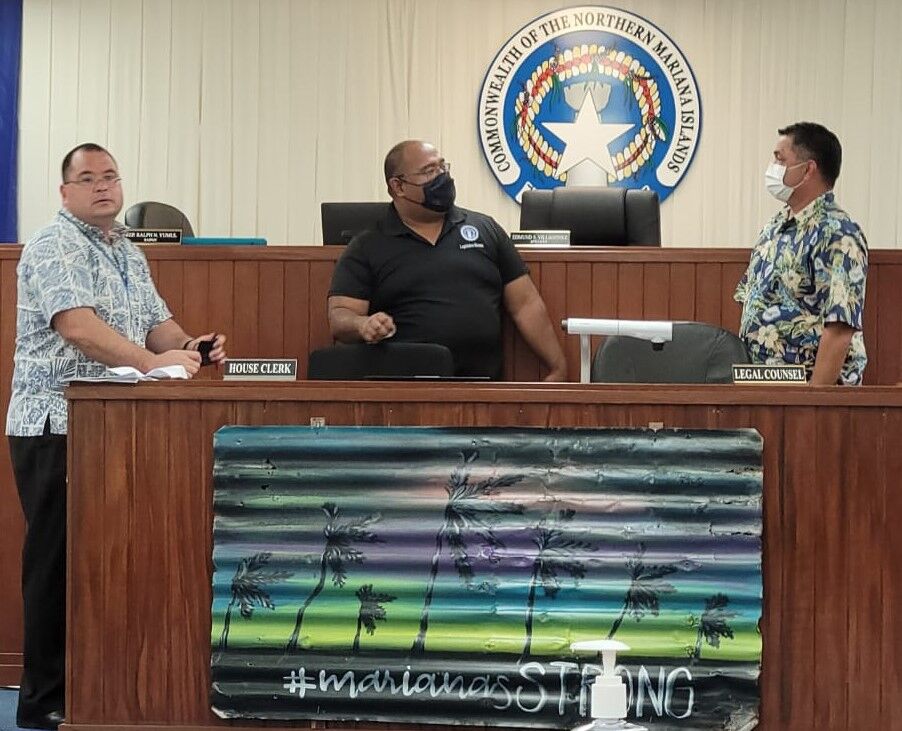
Speaker Edmund S. Villagomez, left, looks on as House Floor Leader Ralph Yumul, right, confers with House legal counsel Joe Taijeron during a break from the House session on Friday.
Photo by Emmanuel T. Erediano
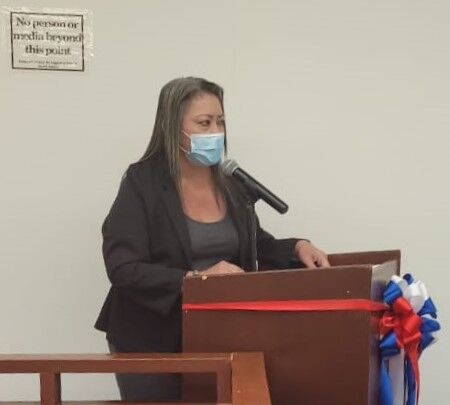
Sen. Edith Deleon Guerrero speaks during the public comments portion of the House session on Friday.
Photo by Emmanuel T. Erediano
