


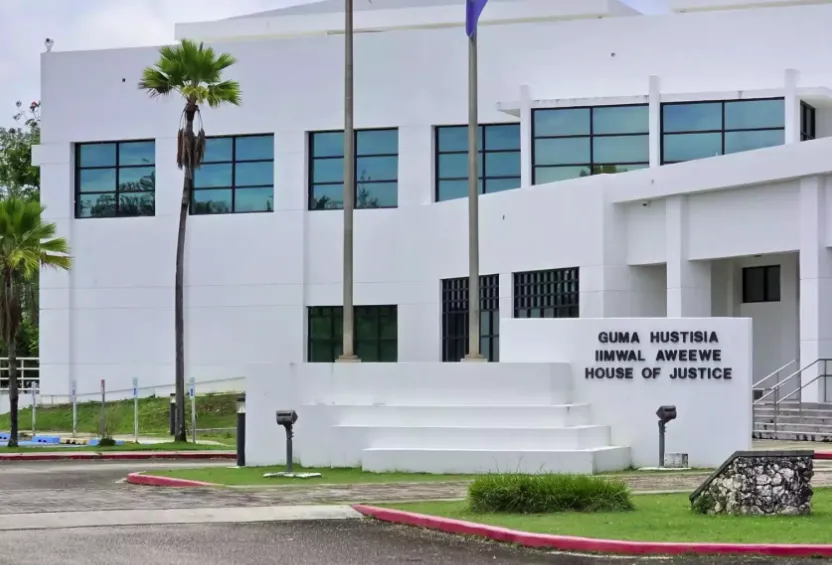


On Tuesday, Nov. 9, the U.S. District Court for the NMI will conduct an evidentiary hearing on the motion of Villagomez, his sister Joaquina V. Santos and her husband, former Commerce Secretary James A. Santos, “to ascertain whether the record should reflect that the courtroom was closed to the public during jury selection.”
Visiting Federal Judge Mark W. Bennett of the Northern District of Iowa will be on island to hear the evidentiary hearing, such as to receive evidence in the form of testimony from trial observers.
“The existing record reflects no such closure, and no participant attempted to make it a part of the record at the time,” said Assistant U.S. Attorney Eric S. O’Malley, the prosecutor, in his memorandum of law regarding standard of proof.
“But relying on Federal Rule of Appellate Procedure…, the court has granted defendants an opportunity to provide new evidence, a sufficient quantum of which might convince the court that the record should reflect a closure of the courtroom,” O’Malley said.
The U.S. government, the prosecutor further said, “submits that because the claim was brought late, because it will require a judge other than the trial judge to decide, and because it will be based on testimony of persons who observed, but did not participate in the trial, the standard of proof be higher that a preponderance of the evidence.”
Villagomez and the Santos couple were convicted of bribery, theft and wire fraud charges in April 2009.
They have appealed their conviction to the U.S. Court of Appeals for the Ninth Circuit.
Villagomez, 48, is serving his sentence of seven years and three months in Tucson, Arizona.
Mrs. Santos, 51, and her 49-year-old husband each received a sentence of six years and six months in prison.
She is an inmate in Dublin, California while her husband is in jail in Atwater, also in California.
O’Malley argued in his written motion that “a high standard should apply because the record will be ‘settled’ by a judge other than the trial judge, with evidence presented by non-participants.”
The trial judge was a neutral observer, O’Malley said, “one who spent decades observing trials, and was trained to spot potential legal issues.”
“If he cannot settle the record himself, his testimony should at least be afforded more weight than extrinsic witnesses whose names are not even in the record,” O’Malley said.
He went on to say that “a higher standard should apply because [the motion] is a belated attack.”
“The testifying witnesses will be remembering events from more than 19 months ago,” the federal prosecutor added.
“Memories are fallible even in the best of times, but more so in times of duress. Even with honorable motives, few people can prevent wishful thinking from invading, or even overwhelming memories that related to loved ones. The record in this case was certified long ago; it is presumed accurate and complete. A party attempting to overcome that presumption should have to supple ample proof that it is not. The evidence should, at a minimum, be clear and convincing,” O’Malley said.
Judge Munson will testify via videoconference.
Villagomez, his sister and her husband have waived their right to be present at the hearing.
The U.S. Marshals Service would have spent “roughly” $60,000 for transporting them from federal prison facilities in the U.S. to Saipan.
