



That has certainly been the case here in the Commonwealth of the Northern Mariana Islands, where almost every policy failure since 1978 has stemmed from a perverse belief that the role of government is to please everybody. To put it simply: we expect our government to do more than it can or should do. In the end, we get the government we deserve, one that is spread too thin, one that is crumbling under the weight of expectations, and one that is heading nowhere. As Ronald Reagan once put it, “In this present crisis, government is not the solution to our problem; government is the problem.”
This crisis, however, could be our wake-up call. Just as a heart attack can force a man to live a healthier life, our current crisis can force us to learn from our mistakes and do better next time.
So, what exactly have been the mistakes? What have been the major policy failures since 1978? I believe that the main failure has been the establishment of a welfare state that doles out one entitlement after another.
To begin with, let us consider the CNMI’s tax structure. Established by Public Law 1-30, the CNMI’s tax structure remains one of the most generous tax systems in the world. In addition to being exempted from many federal taxes and paying only minimal local taxes, taxpayers in the CNMI receive a 50 to 90 percent rebate on their local taxes. These rebates are essentially welfare checks that deprive our government of revenue it needs to provide essential services.
But tax rebates are not the only entitlement program in the CNMI. There is also the NMI Retirement Fund. Since its establishment by Public Law 1-43, the NMI Retirement Fund has degenerated into one of the most burdensome liabilities in the commonwealth. Gov. Benigno Fitial summed it up best in his 2009 State of the Commonwealth Address when he said that the Retirement Fund was “a financially untenable system that was way too generous, that promised benefits that exceeded our government’s ability to pay, and that could not possibly be sustained with falling revenues.”
In fact, the government’s liability to the fund has gotten so bad that in 2009, Judge Kenneth Govendo ruled that the government owed the fund more than $230 million. That’s $230 million that might be taken from education, health care, and public safety, for the sole benefit of retirees that have withdrawn more from the fund than they ever contributed.
Another entitlement program, and one that is more relevant to my generation, is the CNMI’s scholarship system, which doles out over $3 million worth of financial assistance every year. Are those funds spent wisely? How many stories have we heard about college students using their scholarship money to buy clothes, video games, or beer?
Of course, one could argue that scholarship spending is a worthwhile investment toward an educated workforce, but many scholarship recipients either never return to the islands or never pay back what they owe.
So, whether it be scholarship programs, the Retirement Fund, or a generous tax structure, these entitlement programs are policy failures that have helped build a welfare state that doles out money as if it grew on trees.
But money is not the only thing doled out by the CNMI’s welfare state. Other policy failures dole out services and jobs that are abused and exceed the government’s financial capacity.
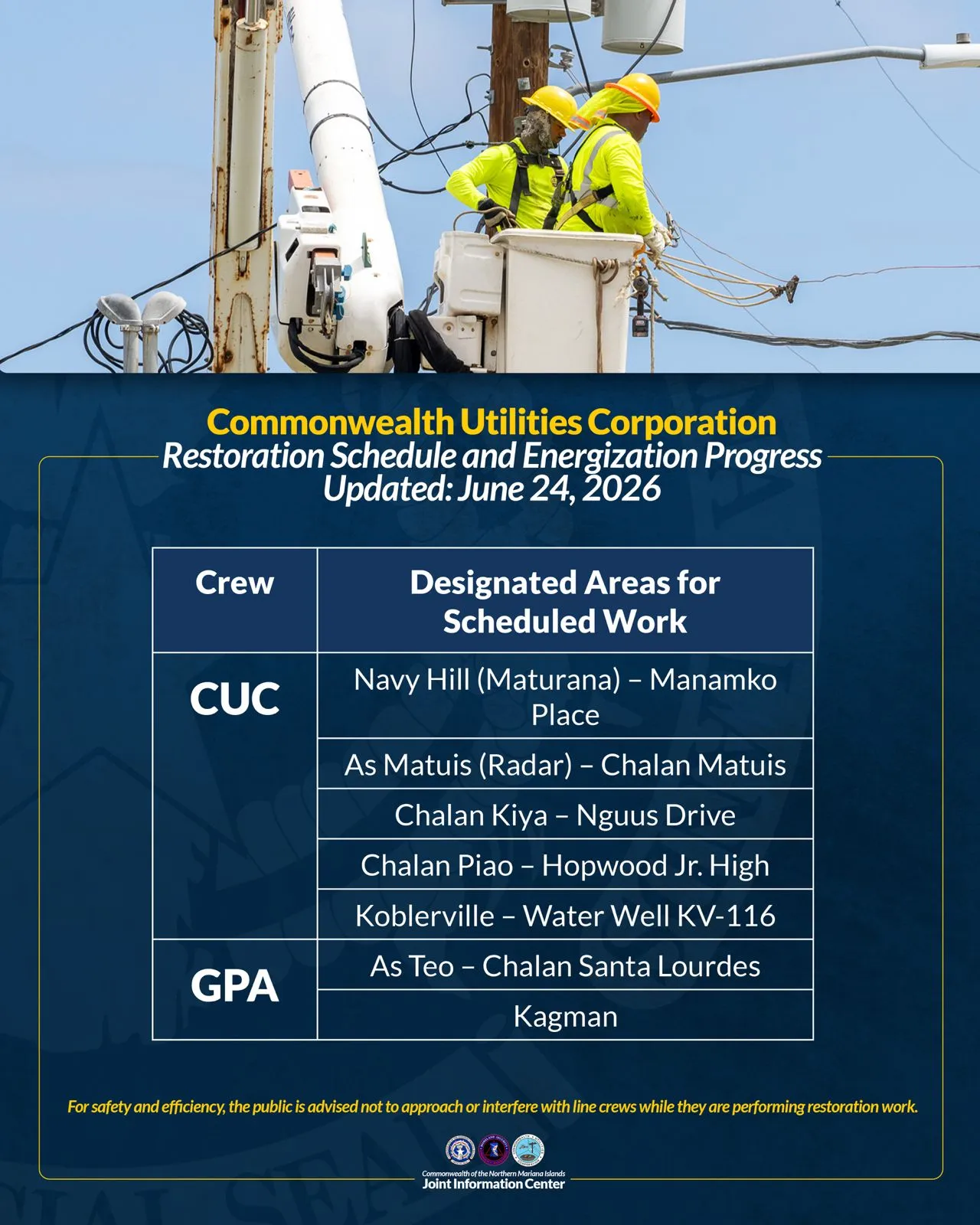
Take for instance the Commonwealth Utilities Corp. Established as a public utility by Public Law 4-47, CUC has fallen prey to the whims of a fickle public that wants first world service at third world prices. In the end, though, we get what we pay for — unreliable power, one hour of water a day in some villages, and a utility corporation that is prone to abuse and corruption.
But perhaps the most egregious of all entitlement programs is the government itself, which has metastasized like a cancer into the largest employer of local residents in the commonwealth. In particular, since Gov. Froilan Tenorio’s Executive Order 94-2 reorganized the Office of Personnel Management under the Executive Branch, the CNMI government has grown so much that, per capita, it is six times bigger than the entire Japanese government!
This has resulted in what I call parasitic politics. We see this with every campaign season, when politicians trade votes for jobs. Politicians are parasites that feed off of voters, and voters are parasites that feed off of politicians.
And our foreign labor market and minimum wage laws have only made things worse, with many local residents opting for high paying government jobs, while foreign workers slum it as construction workers, housemaids, and garment workers.
Speaking about this, business leader Tony Pellegrino wrote, “Today we are as strangers walking our streets. We don’t plow our fields; we don’t build anything. We merely consume as parasites.”
An overly generous tax structure.
An untenable retirement fund.
An abused scholarship system.
A crippled utilities corporation.
A bloated government.
And I haven’t even touched on discretionary funds, tents, picnic tables, and chenchule that politicians offer as a “community service.”
I could go on and on about the many failed entitlement policies of the past 30 years, but what they all have in common is that they have festered into a welfare state plagued by a culture of dependency. Indeed, our commonwealth suffers from a cancer of parasitic politics. And just like a cancer, we need to stop treating the symptoms and start treating the disease itself. If there’s any lesson to be learned from these failed policies, it is that we have come to expect more from government than it can or should do. This is an unsustainable political pathology in which we have abdicated our responsibility and our power to a dysfunctional government. It is simply not how you do things.
So that’s what’s wrong. But how do we apply these lessons learned to ensure a more successful future for our commonwealth? How do we cure our cancer?
While there is no real cure for cancer, there are two ways to treat it.
One treatment is chemotherapy. We all know that the government lives way beyond its means. As Saipan Chamber of Commerce president Douglas Brennan noted recently, it is alarming that the cash-strapped CNMI government will spend beyond $150 million despite the need for austerity measures. This needs to stop. We need to conduct a desk audit across the board to find the cancerous offices and positions, and eliminate them. If the private sector is going lean, then so should the government.
This kind of fiscal chemotherapy, however, is not enough. We also need a second treatment, a lifestyle change. Just as cancer can be avoided by living a healthier lifestyle, the commonwealth must learn to live a healthier political lifestyle. To do that, I offer a modest proposal: We must expect less from government, and give more as citizens.
To expect less from government means more than just asking less of our leaders. James Madison had it right in Federalist Paper #51: “If men were angels, no government would be necessary. If angels were to govern men, neither external nor internal controls on government would be necessary.” Well, contrary to their egos and campaign promises, our politicians are no angels. That is why we must limit their terms, limit their expenditure authority, and ultimately, limit their power.
After all, the best way to expect less from politicians is to give them less to work with.
But it is not enough to expect less from government. We must also give more as citizens.
We must give more in taxes to pay for the actual cost of essential government services. If we want better schools, better utilities, better health care, and better public safety, then we must be willing to pay for it. Either we cut the current tax rebate, as House Bill 17-50 proposes to do, or we add a new tax, such as a property tax or a sales tax. One way or another, we need to pay for the actual cost of these services, and stop shortchanging ourselves.
We must also give more in personal responsibility. Rather than relying on the government for jobs, handouts, and a better economy, we should take it upon ourselves to learn more, work hard, and generate the kind of productivity that will improve the economy for everyone. We cannot wait for the government to generate economic prosperity. We must do it by ourselves, for ourselves.
Lastly, we must give more in civic engagement. As Tina Sablan put it in her now famous Commonwealth Manifesto, “Elected officials only have as much power as we give them, and it is up to us to demand the representation we deserve… as ordinary citizens we are more than capable of mobilizing to achieve tremendous success when we are focused, determined, and undaunted.” Democracy is not a spectator sport. It requires, as Thomas Jefferson once wrote, “eternal vigilance.”
That kind of focused, determined, undaunted, vigilant work will not be easy. Treating our cancer will be very, very hard work, and results will not happen overnight. But it is work that must be done. Nothing short of our future is at stake.
It is a future that calls on all of us to live up to the immortal words of John F. Kennedy:
“Ask not what your country can do for you — ask what you can do for your country.”
To bring those words home to the CNMI, I say:
Ask not what your government can do for you — ask what you can do for yourself, what you can do for your community, what we can do for our commonwealth.
(This was the winning speech of Mt. Carmel School student Ryan E. Ortizo at the recently held AG’s Cup competition.)
//
