

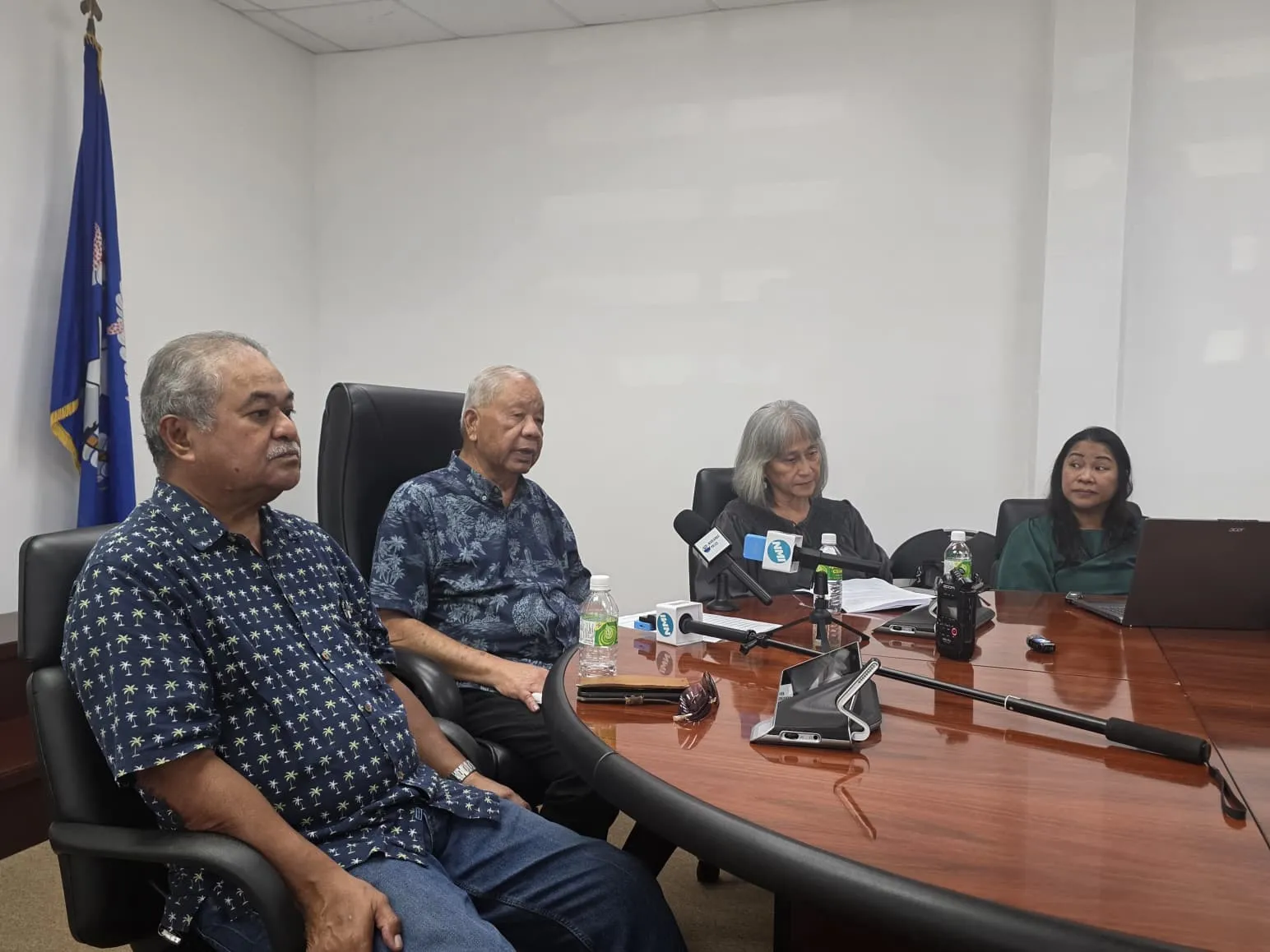






CUC chief financial officer Charles H. Warren said the government’s failure to pay has no bearing on what CUC is asking for.
He said the government’s delayed payments have complicated CUC’s ability to pay its bills on a weekly basis but it does not impact its overall operation.
Dan V. Jackson of Economists.com, CUC’s rate and financial consultant, said there’s a very significant difference between income and cash flow.
The $5.8 million receivables represent the $1.9 million in power, water and sewer bills of the Public School System from September to March; $125,000 of Northern Marianas College which is in arrears for two months now; and the central government’s $3.6 million, from November to March.
Warren said the CNMI government promised to pay at least $1 million every month.
Yesterday, the government paid $550,000 only.
The central government is billed at an average of $800,000 a month; PSS, $250,000 to $350,000; and NMC, $50,000 to $60,000.
Alepuyo asked why CUC failed to disconnect delinquent government offices.
Warren said CUC disconnected some government offices in December but others were spared because of legal and practical considerations.
“The practical reality is there’s a huge social impact if we keep letting them go without paying but there’s a larger social impact if we switch them off and disconnect them all,” Warren later told reporters.
He said the government doesn’t tell CUC not to disconnect government offices.
CUC, he added, is now initiating a program that will allow them to efficiently collect from the government each month through the installation of prepaid meters.
During yesterday’s hearing, Economists.com said ratepayers are paying electric charges composed of the base rate and the levelized energy adjustment clause, or LEAC rate.
The base rate pays for the day-to-day operations, personnel and construction and repair of CUC’s system while the LEAC pays for the cost of diesel fuel oil needed to generate electricity.
CUC has more control over the base rate because it involves operation cost, unlike LEAC which is based on the price of oil.
The current electric base rate is $0.0160 per kwh for the first 500 kwh usage rate; $0.0660 per kwh for 501 to 1,000 kwh; $0.0860 per kwh for 1,001 to 2,000 kwh; and $0.1270 for 2,001 and more. And then there is a $5.60 monthly customer charge.
The proposed base rate increase is $0.0190 per kwh for the first 500 kwh usage rate; $0.0780 per kwh for 501 to 1,000 kwh; $0.1020 per kwh for 1,001 to 2,000 kwh; and $0.1500 per kwh for 2,001. The monthly customer charge will be $6.62.
Economists.com said the affordable rate or lifeline rate for low-income residential customers will amount to $13.60 a month if they maintain power usage at 500 kwh or less.
However, the lifeline rate increases if the usage exceeds 500 kwh.
Warren said CUC is now working on the regulations for the lifeline rate.
Under CUC’s proposal, the monthly commercial base charge will see an increase of $35.39 for 2,000 kwh monthly usage, and $65.39 for 4,000 kwh usage every month.
CUC also proposed a LEAC charge of $0.34426 which represents $0.32691 in fuel and lube oil element; $0.01635, volatility percent of fuel and lube; and $0.00100, regulatory/technical support.
The current LEAC is $0.28125.
If both the base and LEAC rates are increased as proposed by CUC, the residential user of 500 kwh will pay $34.03 more each month for power.
A commercial user will see an increase of $159.41 each month for 2,000 kwh, and $317.43 for 4,000 kwh.
CPUC is expected to announce its decision on CUC’s hike proposal this Friday.
