




By Bryan Manabat
[email protected]
Variety News Staff
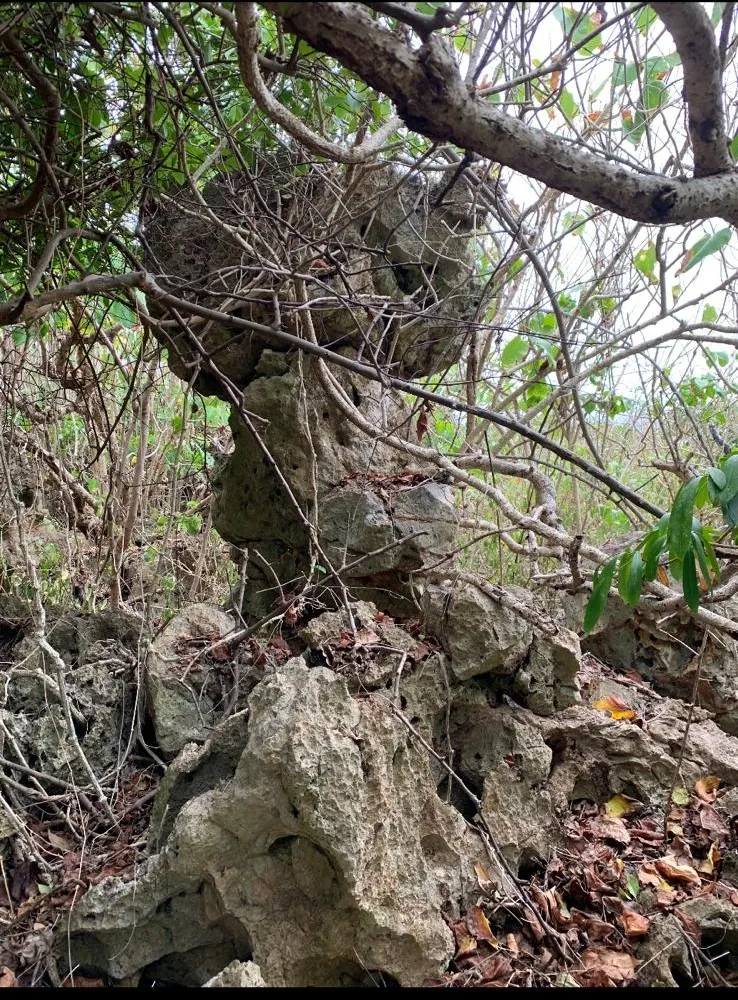
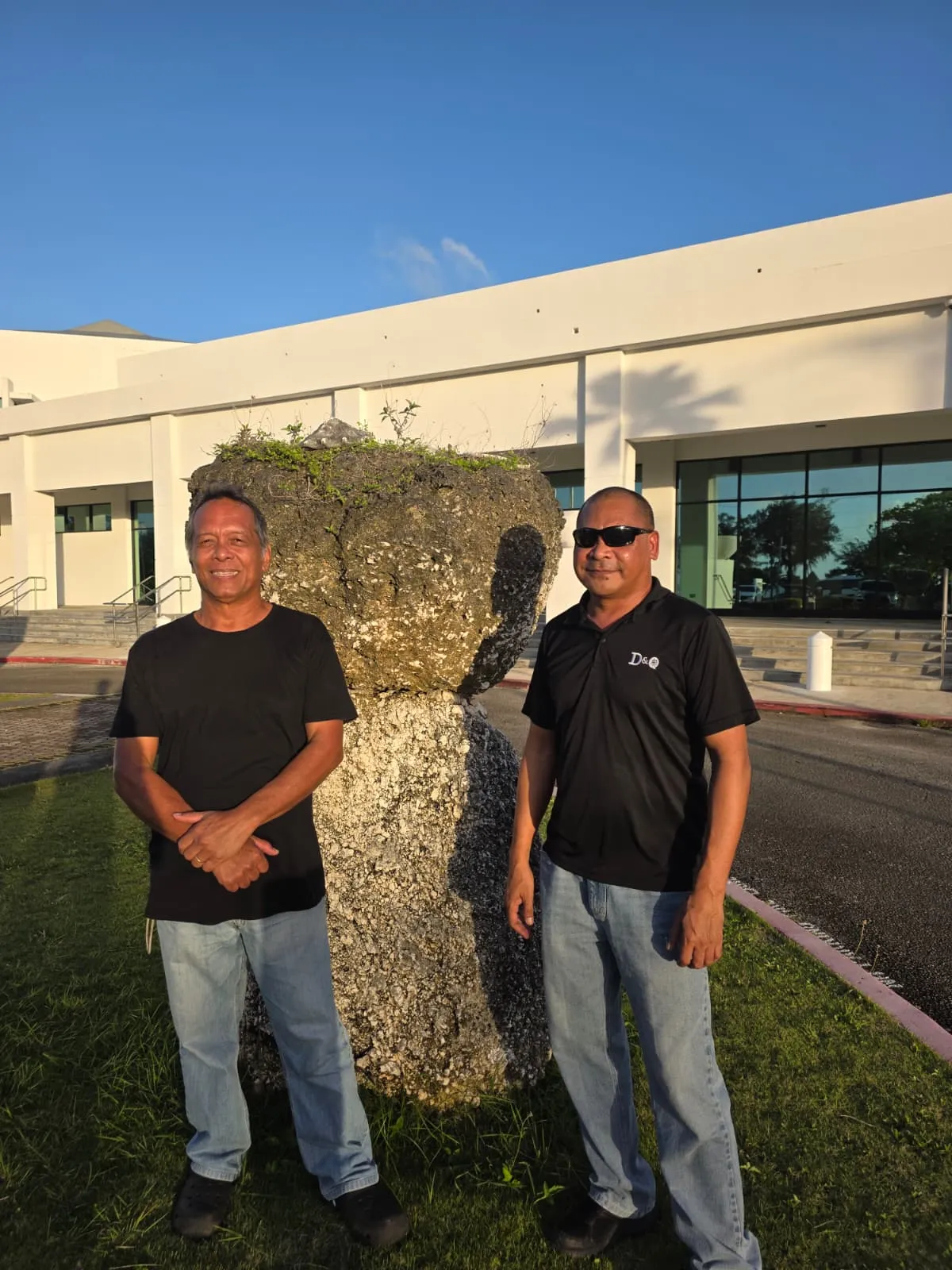
TWO experienced hikers say they discovered what appeared to be an undocumented latte stone deep in Marpi last year, but they refrained from sharing their find with the public out of concern for vandalism and damage to the site.
Fred Camacho and Ian Otobed, both well-known in Saipan’s hiking community, said they came across the stone on March 1, 2025, during one of their scheduled treks.
“I see this familiar figure right in front of us,” Camacho said. “I’m looking at it and I’m going, ‘Ian… what does that look like?’ And it looked like a latte. It looked authentic.”
Camacho, who has previously assisted archaeologists and anthropologists in locating cultural sites, said he later checked with the Historic Preservation Office but found no record of a latte site in the area.
“That led me to believe this latte stone has never been recorded,” he said. “Maybe it has been seen but never really put into the records.”
Otobed said the stone’s size and shape immediately stood out.
“As soon as we saw it, we knew,” he said. “Even though it’s different from what we normally see, the shape — it does look like it.”
The pair also reported finding slingstones and other rocks nearby, which they believe may indicate a former village or lookout point.
Camacho said neither of them touched the stone.
“We sat maybe 20 feet away and just looked at it,” he said. “Even today, thinking about it, I still feel something. That tells me there’s more to it than just a latte stone.”
Both hikers said they intentionally avoided posting the discovery on social media.
“Because I believe they are meant to be kept, preserved,” Camacho said. “A lot of places on the island are now vandalized. You’ve got graffiti, trash, artifacts missing or broken. That reduces the preservation efforts we’re trying to put out there.”
He cited Kalabera Cave as an example of a site that suffered damage after becoming widely known.
“I don’t want to walk up to this latte site and find out it’s been chipped, dug around, or painted,” he said. “That’s desecration.”
Otobed, who began hiking more frequently during the Covid‑19 pandemic, said the experience has deepened his interest in the island’s cultural history.
“Very interesting because I never really learned history,” he said. “Now I’m with a friend who knows more about the island’s past, and it sparked my interest to go out there, explore, and see what’s out there.”
The two said they have also found other sites that they believe merit further study, including a large cave they refer to as “The Cathedral.”
Camacho said he expects more people to contact him once the discovery becomes public.
“Now I’m gonna try to ignore my phone and try to ignore all the messages,” he said. “I’ve been avoiding a lot of ‘Can you take me there?’ and ‘Where is it?’”
Both hikers urged others to respect cultural and natural sites.
“When you’re out there, you have to give respect to the area,” Otobed said. “Bring out what you bring in. We’re seeing a lot more trash now when we revisit places.”
Camacho, who has explored more than 300 caves on Saipan, said the island still holds many undiscovered sites.
“People say there’s nothing to do on this island, but I say there’s a lot to do,” he said. “When you go out there, leave your footprints. Leave your sweat.”
Cultural significance
Latte stones are among the most important cultural symbols of the Chamorro people of the Mariana Islands. Traditionally, latte stones consist of a stone pillar (haligi) topped with a capstone (tasa) that served as foundations for ancient houses and community structures dating back more than 1,000 years.
Beyond their architectural function, latte stones are believed to have marked clan areas, significant pathways, and ceremonial spaces. They are considered sacred cultural heritage and remain central to Chamorro identity in both the Northern Mariana Islands and Guam.
Because many latte sites have been damaged or looted over the years, preservation advocates emphasize the importance of protecting undocumented or remote sites from vandalism, unauthorized digging, and removal of artifacts.
Bryan Manabat was a liberal arts student of Northern Marianas College where he also studied criminal justice. He is the recipient of the NMI Humanities Award as an Outstanding Teacher (Non-Classroom) in 2013, and has worked for the CNMI Motheread/Fatheread Literacy Program as lead facilitator.
