







By Emmanuel T. Erediano
[email protected]
Variety News Staff
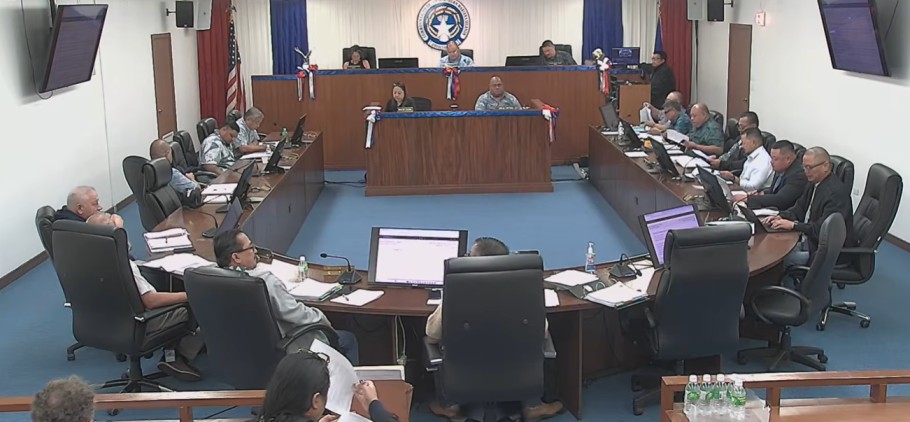
THE House of Representatives on Wednesday voted to override Gov. David M. Apatang’s line-item vetoes on several provisions of Public Law 24-20, the revised fiscal year 2026 budget that appropriates $138.9 million for government operations and personnel.
The Senate must also override the line-item vetoes for the provisions to become law.
On Dec. 23, 2025, the governor signed P.L. 24-20 with line-item vetoes that, he said, “are a necessary step toward building a stronger, more resilient future for our Commonwealth.” He added that by upholding constitutional principles, ensuring fiscal responsibility, and protecting the separation of powers, “we lay the foundation for lasting stability and progress.”
Prior to the roll call on the motion to override the governor’s vetoes, House Ways and Means Chair John Paul Sablan said the bicameral budget committee deliberated for over four weeks on the items the governor vetoed. He then made the motion to override several provisions in the revised budget law, saying, “These were the exercises and deliberations conducted over four weeks by the bicameral committee on the revised budget.”
Speaker Edmund S. Villagomez noted that the override requires a two-thirds vote, or 14 members of the House.
Rep. Ralph N. Yumul said the override does not mean the House completely disagrees with the governor. “They simply chose to override certain provisions,” he said, noting that committees from both the House and Senate discussed the governor’s line-item veto thoroughly.
He added that the House was not challenging the authority of the governor but disagreed with “a lot of what the attorney for the executive branch recommended.”
All 17 members present voted to override the governor’s line-item veto on P.L. 24-20. Reps. Denita Yangetmai, Roy Ada, and Julie Marie Ogo were excused.
The House overrode the vetoes on the following provisions:
• Section 203(d): Requires the Finance secretary to report revenues in excess of $200,000. The governor said this duplicates reporting requirements in the Planning and Budgeting Act.
• Section 602: Prohibits new or vacant positions in the executive branch. The governor said it violates the separation of powers.
• Section 603: Caps government officials’ salaries at the level of the original FY 2026 budget submitted on April 1, 2025. The governor vetoed this because it freezes appointed officials’ salaries and requires legislative approval for adjustments.
• Section 609: Closes out any position that becomes vacant. The governor vetoed this because it retroactively reverses salary increases, impairs valid contracts, and undermines employee trust.
• Section 612: Requires Solid Waste Management to pay $179,691 in hazardous pay owed to employees on Saipan, Tinian, and Rota.
• Section 703: Allows the Supreme Court chief justice and Superior Court presiding judge to adjust the Judiciary’s work schedule and operating hours consistent with available funds. The governor vetoed this because the Judicial Branch, like other branches, may be subject to proportional cuts under the Planning and Budgeting Act.
• Section 704: Provides for the budget of the legislative branch. The governor vetoed this on the same grounds as Section 703.
• Section 709: Funds “other programs,” including stipends, airfare, and lodging for patients and escorts in inter-island medical services. The governor vetoed this, saying the Health Network Program appropriation is insufficient to cover such costs.
Emmanuel “Arnold” Erediano has a bachelor of science degree in Journalism. He started his career as police beat reporter. Loves to cook. Eats death threats for breakfast.
