






By Walter Ulloa
For Variety
HAGÅTÑA (The Guam Daily Post) — Island leaders are pushing back hard after the Trump administration dramatically expanded the ocean area near the Marianas it wants to open for deep-sea mining, this time as close as 46 miles from Guam’s shores.
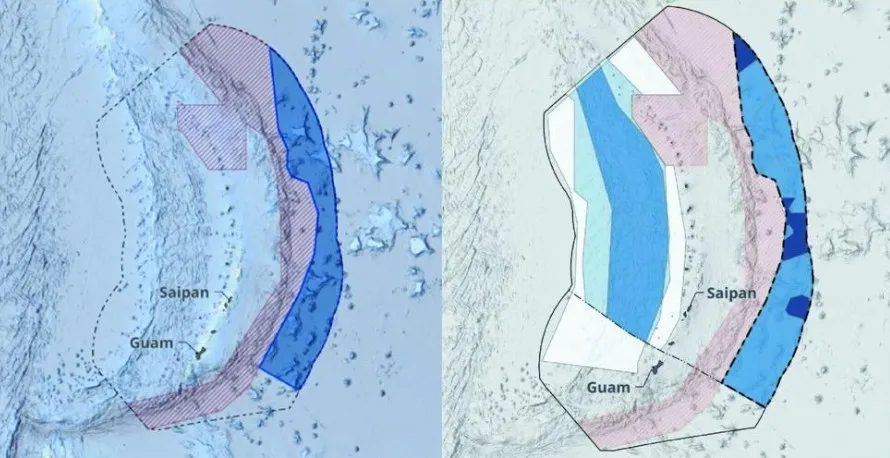
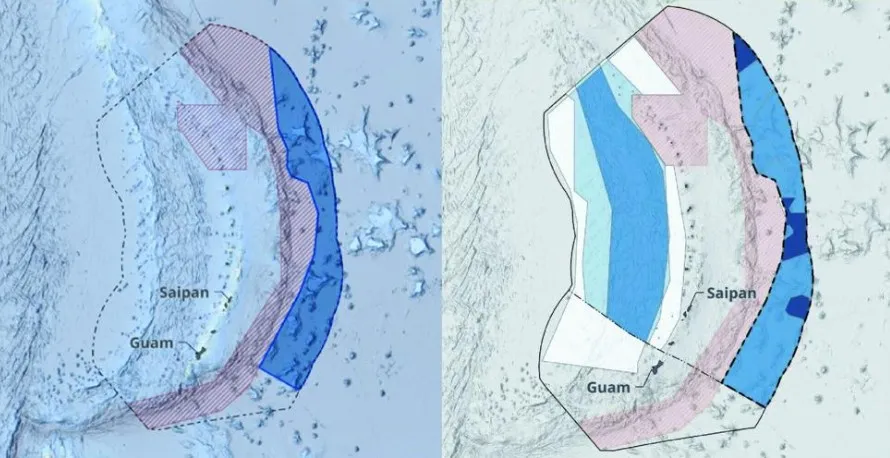
A memorandum signed March 13 by the Bureau of Ocean Energy Management’s Pacific Regional Director recommends carrying forward roughly 69 million acres near the Commonwealth of the Northern Mariana Islands for further leasing consideration and environmental review for seabed mineral extraction. That nearly doubles the original 35.5 million acres east of the Mariana Trench Marine National Monument that BOEM first proposed in its November 2025 request for information. The added western zone was driven by industry interest, and now puts the potential mining footprint on both sides of the Marianas archipelago.
BOEM expanded the proposed area to include waters west of the CNMI after several companies expressed interest in that region, particularly for polymetallic sulfide deposits, according to the agency’s decision memo. Officials said the addition of the western tracts, where scientific data is more limited but hydrothermal vent systems suggest mineral potential, ensured that all areas identified by industry as commercially viable were carried forward for environmental review. The memo does not name the companies that expressed interest.
Gov. Lou Leon Guerrero and Lt. Gov. Josh Tenorio say they are not standing down.
“We are disappointed that, in all our attempts to engage with BOEM throughout this process, they have not considered and have ignored the very people who are most affected by their actions,” Gov. Leon Guerrero said in a press release Thursday. “We will show up on every front to make sure that our concerns are heard and that our oceans are protected.”
Tenorio, who attended a Feb. 26 meeting with BOEM officials, said the agency failed to answer key questions, including whether the lease area might expand the way it had in a similar process near American Samoa.
“BOEM’s moving ahead with doubling the lease area despite public objections and concerns only demonstrates how much of a flawed process this is,” Tenorio said in the release. “The total disregard for our traditions, livelihoods, and resources is deeply troubling.”
The administration said it will pursue every avenue available, including engaging other affected jurisdictions and pushing to establish a joint state and federal task force. BOEM is expected to return to Guam for further meetings, likely in May.
The expansion came despite a flood of public opposition. BOEM received 65,585 comment submissions before its Jan. 12 deadline. Of those, the agency identified only 326 as substantive, the ones it actually reflected in its report, even as tens of thousands of people worldwide weighed in against the proposal.
Angelo Villagomez, a senior fellow for conservation policy at the Center for American Progress, called it the most ambitious deep-sea mining plan in American history and said it disregarded the voices of those most affected.
“This decision to advance the largest seabed mining proposal in U.S. history ignores the overwhelming concerns voiced by the people and local governments,” Villagomez said in a statement immediately following the memo’s publication. “It pushes forward an industrial experiment in one of the most biodiverse and culturally significant ocean regions on Earth. Deep sea mining poses irreversible risks to fragile ecosystems, fisheries that sustain our communities, and the cultural heritage of the CHamoru and Refaluwasch peoples,” he added.
Sen. Therese Terlaje said the decision violates international law and dismisses the communities that stand to bear the consequences.
“This decision by BOEM to double the mining area is in direct contradiction to international law, and completely ignores meaningful concerns raised by the community that will be directly and adversely impacted,” Terlaje told The Guam Daily Post.
She said scientists, legal experts, environmental advocates, cultural practitioners, and everyday residents have consistently warned about the potentially irreversible damage deep-sea mining could inflict on marine ecosystems, public health, and the economy. Guam’s response, she said, must now extend beyond its own borders.
“It is even more essential that our Governor, our Delegate, and all our leaders are unified, consistent, bold, and creative in efforts to avoid the harm of deep sea mining on our community,” she said. “Efforts to prevent any additional harm to Guam should be raised to a higher level including other federal agencies, the State department, and international entities.”
Terlaje also challenged the assumption that mining offers clear economic reward. “The economic benefits of deep sea mining remain uncertain, while the environmental risks are significant and, in many cases, irreversible,” she said. “The ocean is central to our identity and heritage, our food security, and our economic ability to sustain life on Guam for future generations. BOEM and the Department of Interior should be made to listen to our people who will bear the harm without guarantee of revenue or other benefit.”
Sen. Sabina Perez said the geography of the new western zone makes the threat direct and immediate for Guam.
“What began as a roughly 35 million-acre area has now expanded to over 69 million acres, effectively doubling the potential deep-sea mining footprint in our region,” Perez told the Post. “Even more concerning is that the newly added western area brings potential activity as close as about 46 miles from Guåhan.”
She said the memo acknowledges transboundary risks, including sediment plumes, noise, and ecological disruption that can cross jurisdictional lines, and called for a moratorium, a regional environmental impact statement, and meaningful consultation. “Expanding the area under consideration, despite those concerns, signals that we are still not seeing the level of responsiveness or deference to island communities that is required,” Perez said.
Sen. William Parkinson called the move one more instance of federal agencies treating the Marianas as expendable. “The most offensive part of this process is not just the environmental risk, though that risk is profound. It is the absence of meaningful consent,” he said in a press release. “The people of Guam and the CNMI did not ask for this. We did not invite this. We have spoken against this, and yet the federal government continues to move it forward anyway.”
Delegate James Moylan gave his remarks to the Post on Friday explaining the expansion underscores how much is at stake and how much work remains to secure the region’s interests.
“During the hearing, I asked for clear communication lines between federal agencies and our island communities, and my position remains the same today: those lines must be firmly established to ensure that appropriate guardrails are in place, environmental impacts are fully understood, and any potential economic benefits for Guam and the region are not overlooked,” Moylan said, referring to a Congressional hearing in January examining regulatory barriers to seabed mining.
“This is a critical window for our people — our leaders, scientists, cultural practitioners, and residents — to make their voices heard through formal comment channels and ongoing dialogue,” he added.
Vice Speaker Tony Ada said Guam must have a seat at the table as these discussions evolve to protect its resources while evaluating any potential economic or energy opportunities. He called on island agencies and stakeholders to seek formal federal briefings and strengthen regional coordination.
Perez said the process is still moving, and that is exactly why engagement cannot wait. “The Area Identification decision is not the final step, but it sets the direction,” she said. “Our voices matter at this stage, especially in shaping the environmental review, defining what protections are required, and ensuring that our region is not treated as a testing ground for extractive industries without consent.”
