






By Bryan Manabat
[email protected]
Variety News Staff
GOVERNOR David M. Apatang’s three nominees for key positions in the CNMI Judiciary appeared on Thursday before the Senate Executive Appointments and Government Investigations Committee during public hearings on Rota.
The committee first convened at 10 a.m. to hear testimony from Presiding Judge Roberto C. Naraja, the governor’s nominee for associate justice of the Supreme Court. A second session, held at 1:30 p.m., featured Associate Judge Joseph N. Camacho, nominated to serve as presiding judge, and attorney Joey Patrick San Nicolas, nominated as associate judge.
Throughout both sessions, committee members questioned the nominees on their judicial philosophy, professional experience, and approach to decision-making.
Two decades of judicial service
In his opening statement, Naraja offered a detailed reflection on his 20 years of service at the Rota Centron Hustisia, emphasizing humility, fairness, and the rule of law.
“For the past 20 years, I have presided over the criminal, juvenile, and traffic dockets, and at times, civil and family court matters here at the Rota Centron Hustisia,” he said. “I have conducted jury trials, bench trials, arraignments, hearings, and conferences.”
Naraja said he has always sought to carry out his duties “with humility and fairness” and to serve the people of Rota “with professionalism, kindness, dignity, and respect.” He added that he strives to treat everyone in the courtroom — including counsel, clients, witnesses, clerks, jurors, marshals, and police officers — with “respect, dignity, courtesy, and kindness, regardless of the circumstances.”
He also discussed the responsibilities of the Supreme Court and the importance of appellate guidance for trial judges. “If confirmed as an associate justice of the Supreme Court, my duties will include serving as the final interpreter of Commonwealth law,” he said. “A well-written appellate opinion provides clarity for trial judges in resolving complex legal questions.”
Naraja noted that as a young jurisdiction, the CNMI frequently encounters issues of first impression, making the Supreme Court’s role especially significant. “Our Supreme Court has a duty to uphold the rights of the people as enshrined in the Constitution of the Northern Mariana Islands, as well as rights under the U.S. Constitution where applicable,” he said. “This duty also includes preserving the indigenous traditions of the Chamorro and Carolinian peoples.”
He added that his service on the Judiciary Council has given him “a broader perspective on the judiciary as a whole” and a deeper understanding of operational challenges facing the courts. “It has reinforced my commitment to thoughtful rulemaking, responsible administration, and ensuring that our courts remain fair, accessible, and effective for the people we serve,” he said.
‘Context matters’
During the afternoon session, Camacho thanked Governor Apatang for the nomination and acknowledged families, friends, and community members who submitted letters of support and attended the hearings.
He emphasized the importance of context in judicial decision-making. “Without proper context and background, it is difficult for a judge to make a well-informed decision,” he said. “When things are taken out of context, it skews the results.”
Using a sports analogy, Camacho compared selective criticism of judicial rulings to focusing only on the few losses of Michael Jordan and the Chicago Bulls. “If we were to cherry-pick just five games they lost, we might conclude they were not a very good team,” he said. “Context matters. Judges must see the whole picture.”
Camacho added that the adversarial nature of the justice system means someone will always be dissatisfied. “Of the hundreds of cases heard each year by the five Superior Court judges, only about 20 are appealed to the Supreme Court,” he said.
Broad public service experience
San Nicolas, a former attorney general and former mayor of Tinian, thanked his family, supporters, and the governor for the nomination. He outlined more than two decades of legal and public service experience, including work in the CNMI House of Representatives, the Tinian municipal government, private practice, the Guam prosecutor’s office, and the Marianas Public Land Trust.
“These experiences across law, education, and public service have given me a broad and practical understanding of the justice system and the people it serves,” he said. “If confirmed, my role will not be to advocate for personal interests, but to listen, apply the law, and uphold the rule of law with independence, impartiality, and integrity.”
San Nicolas is the first judicial nominee from the island of Tinian.
Community support
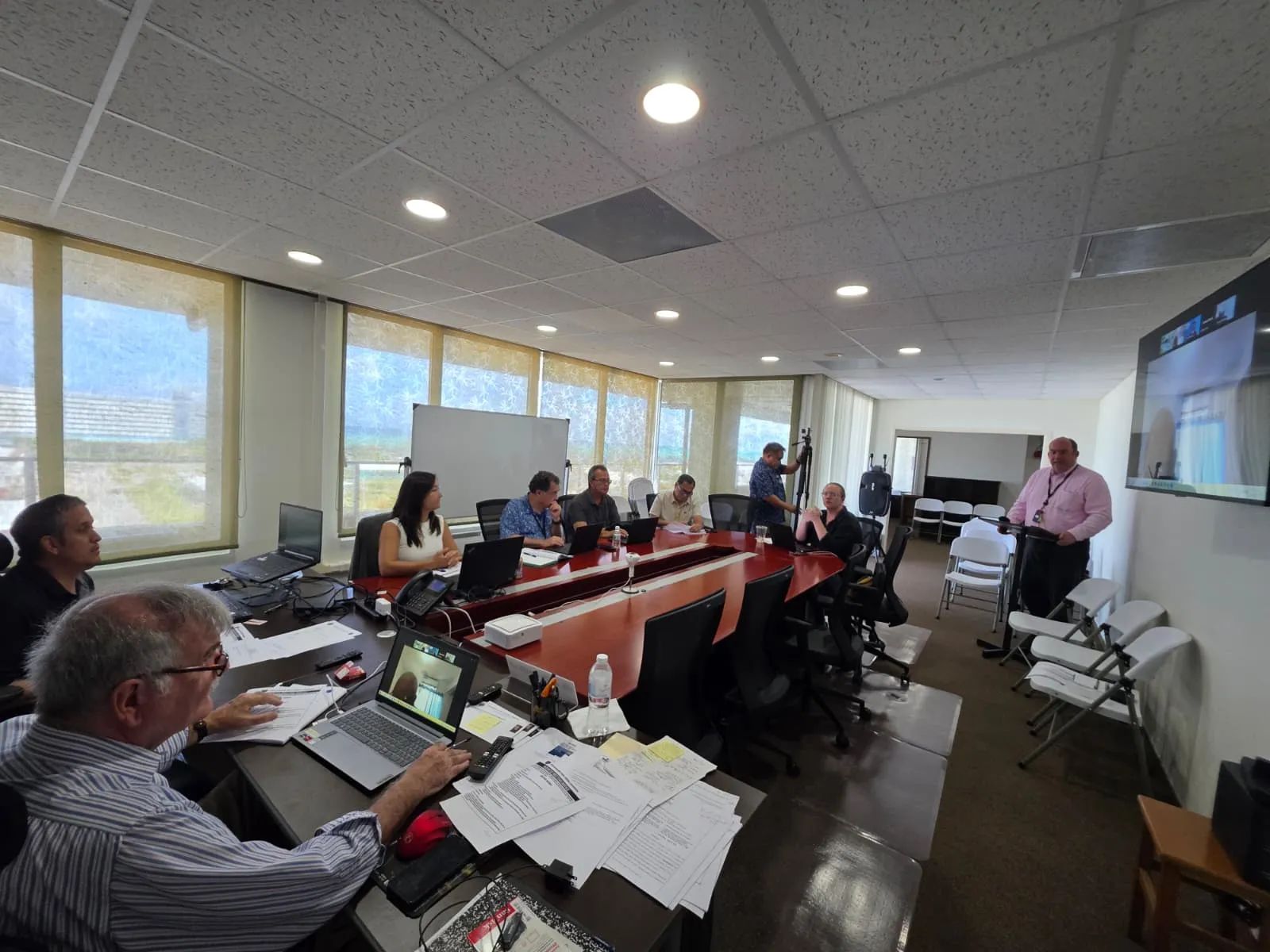
Several Rota residents testified in support of all three nominees. The hearings were conducted by Senate EAGI Chair Jude Hofschneider and Sens. Ronnie Calvo and Donald Manglona, with Sen. Manny Castro participating via Zoom.
The Rota hearings are the first of three scheduled public hearings on the governor’s judicial appointments. The committee will hold its next hearing on Tinian on March 26, followed by Saipan on April 1.
Background on nominees
• Roberto C. Naraja — Associate judge (2001–2003), presiding judge since 2003; former chief public defender and attorney general.
• Joseph N. Camacho — Former prosecutor; private practitioner; elected to the 16th House of Representatives in 2007; appointed to the Superior Court in 2011.
• Joey Patrick San Nicolas — Former attorney general; former Tinian mayor; former MPLT trustee; NMC regent and instructor; longtime attorney in public and private practice.
Bryan Manabat was a liberal arts student of Northern Marianas College where he also studied criminal justice. He is the recipient of the NMI Humanities Award as an Outstanding Teacher (Non-Classroom) in 2013, and has worked for the CNMI Motheread/Fatheread Literacy Program as lead facilitator.
