




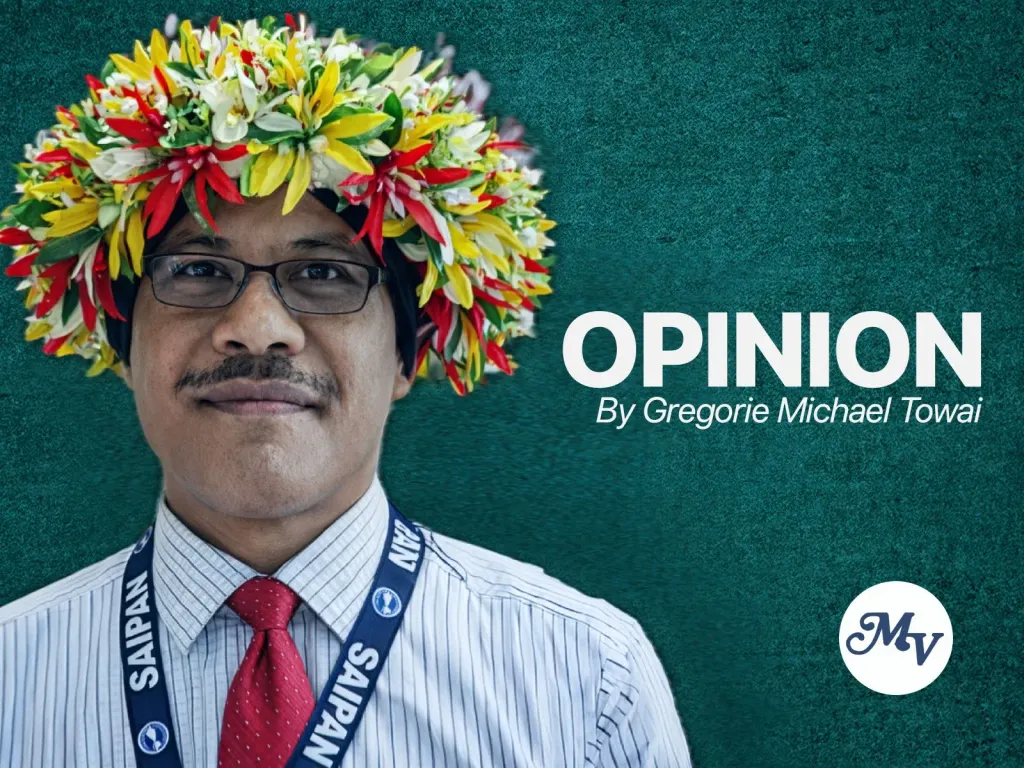
By Gregorie Michael Towai (Eipéráng)
For Variety
FOR many across the Pacific and in the diaspora, what is happening in Chuuk right now may feel distant, unclear, or reduced to fragments of social media posts. But the situation deserves careful attention, not speculation, because it speaks not only to a political dispute but to how governance, law, and community intersect in real time.
At the center of the issue is a leadership transition that has become legally contested. The Chuuk State Election Commission recently administered the oath of office to Mark Mailo as governor and Joe Enlet as lieutenant governor, signaling what would normally be a routine transfer of executive authority. However, the sitting administration, led by Governor Alexander R. Narruhn and Lieutenant Governor Mekioshy William, has challenged this transition by filing for a temporary restraining order before the Chuuk State Supreme Court. In response, the incoming leadership has taken reciprocal legal action, filing its own motion against the sitting administration. What this has created is a rare and complex scenario where both sides are asserting legal standing at the same time, effectively placing the question of legitimate authority into the hands of the judiciary.
Compounding this, public actions have continued alongside the legal process. The incoming administration has issued notices indicating their intent to assume office and has reportedly called on current cabinet members to resign. This introduces an additional layer of tension, as administrative continuity, government operations, and public services all depend on clarity of leadership. Without a definitive ruling, agencies and civil servants may find themselves navigating uncertainty about whose directives to follow.
For those unfamiliar with governance structures in Chuuk, this is not simply a matter of political disagreement. It is a constitutional and legal question about succession, authority, and the interpretation of electoral outcomes. The court’s role now becomes central, not as a political actor, but as the arbiter of process. Temporary restraining orders, by design, are not final decisions. They are instruments meant to pause or preserve conditions while the court reviews the merits of a case. That means what the public is witnessing is not the conclusion, but the beginning of a formal legal determination.
At the same time, it is important to separate the mechanics of government from the fabric of the community. Political disputes can feel destabilizing, especially when they involve competing claims to leadership. But they do not automatically equate to societal breakdown. Chuukese communities, both on island and abroad, are grounded in systems of respect, kinship, and shared responsibility that exist independently of political cycles. These cultural foundations often act as stabilizers in moments when formal institutions are under strain.
This is where perspective matters. It is easy for outside observers to interpret the situation through the lens of crisis. It is just as easy for those within to feel pulled into taking immediate sides. But what is unfolding is a process, one that will be resolved through legal channels, even if it feels prolonged or uncertain in the moment. The judiciary will review filings, assess the validity of claims, and ultimately determine the lawful path forward.
In the meantime, the responsibility of the public, both locally and in the diaspora, is not to inflame the situation but to remain informed, measured, and grounded. Information should be verified. Assumptions should be avoided. And above all, relationships within families and communities should not be sacrificed to political alignment. History has shown that political disputes are temporary, but the consequences of fractured communities can last much longer.
For those hearing about this for the first time, the key takeaway is this. Chuuk is not defined by this dispute, but it is being tested by it. The outcome will not only depend on legal arguments, but on how leaders conduct themselves, how institutions hold, and how the people respond in the space between uncertainty and resolution.
What happens next will come through the courts. But what endures will be determined by the people.
Gregorie Michael Towai (Eipéráng) is a cultural advocate and independent researcher from the Commonwealth of the Northern Mariana Islands currently residing in Oregon. He writes on Pacific governance, ocean policy, and diaspora political. He is also founder, publisher, and managing editor of Refaluwasch Journal of Knowledge and Culture and co-founder and impact advisor to Islander Connect.
