


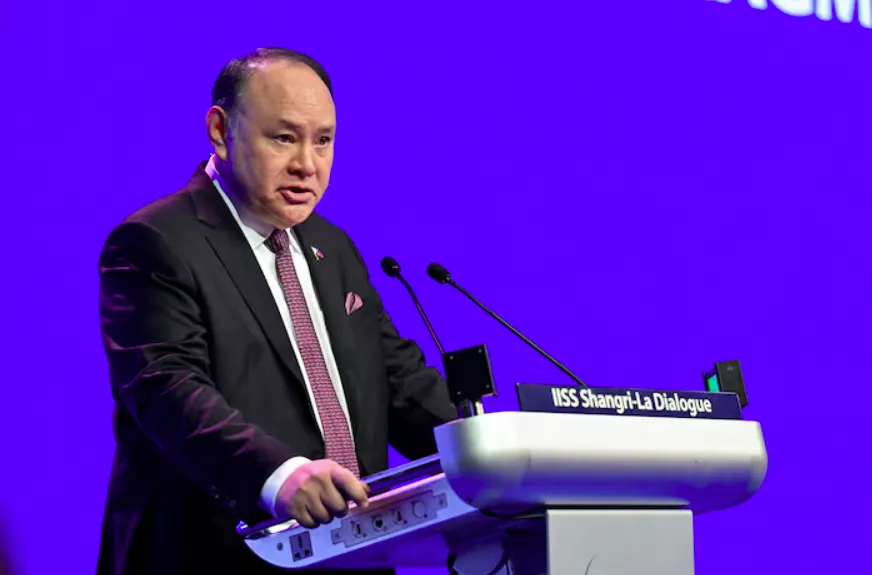





HOUSE Speaker Heinz S. Hofschneider has pre-filed a measure that seeks to transfer the Office of Personnel Management to the Civil Service Commission and bring “clarity” to excepted and civil service positions in the government.
Hofschneider said OPM, which is under the control of the Office of the Governor, should return to CSC as the Legislature is “bound” by the CNMI Constitution to do so.
He said Article 20 of the Constitution provides for a “non-partisan and independent civil service that has the duty to both establish and administer personnel policies for the…government.”
“When the Committee on Government Institutions reported to the 2nd Northern Marianas Constitutional Convention, (it) was well aware of the basic proposition that CSC is to perform executive functions…independently…and free of political manipulation,” said Hofschneider, R-Saipan.
Acting OPM Director Juan I. Tenorio, in an interview Thursday, said if such is the mandate of the Constitution, “I believe that we should all be responsible to follow the mandate of our supreme law. We have no reservations with that. We have to do what we believe is right.”
The bill specifically seeks to repeal section 3 of P.L. 13-1 which reenacted section 14 of the 1994 executive order that placed OPM under the Office of the Governor.
Asked if it would be more advantageous to return OPM to CSC, Tenorio said he must sit down and look at the history of OPM under CSC and under the Office of the Governor to be able to give an “objective answer.”
The Legislature, according to Hofschneider is also “cognizant” of the need to exempt from civil service certain political and confidential staff positions under the Office of the Governor and Office of the Lt. Governor. Thus the bill would also establish “clearer distinction” between the political staff appointed by the office of the governor or lt. governor and the career civil service staff employed by the two offices.
For the Office of the Governor, the following positions would be exempted from civil service: the executive assistant for Carolinian affairs, the special assistant for women’s affairs, the resident executive for indigenous affairs, executive director of the Criminal Justice Planning Agency, the public information and protocol officer, the special assistant for administration, the special assistant for management and budget, the special assistant for programs and legislative review, the special assistant for youth affairs, the director of emergency operations, the special assistant for public liaison, the confidential secretaries and additional advisors, attorneys, personal assistants and special assistants.
For the Office of the Lt. Governor, confidential secretaries, advisors, attorneys, personnel assistants and special assistants would be exempt from civil service.
The governor and the lt. governor could also fill clerical, administrative and support staff positions, but these would fall under civil service.
Section 8131 of H.B. 13-126 further exempts the following positions from civil service: those covered by the United States Civil Service Commission; positions of a temporary nature needed in the public interest in which employment should not exceed 90 days and a maximum of 180 additional days for positions engaged in relief, repair or rehabilitation if there are disasters; election inspectors, election clerks, election workers and other positions under the control of the Election Commission; executive positions filled by appointment of the governor or the lt. governor; any position involving intermittent performance which does not require more than 40 hours in any one month; positions of a part-time nature requiring the services of four hours or less a day but not exceeding one year; temporary positions which involve special projects having specific completion dates which shall not exceed one year; positions within the mayor’s office of Rota, Tinian, Saipan and the Northern Islands as defined by full-time employee ceilings and established by annual appropriations for those offices; positions within the Commonwealth Utilities Corp. and any position in the government at and above the level of division director, including the principal executive offices, boards, commissions and councils, and the executive staff of any commonwealth liaison office.
H.B. 13-126 further allowed CSC to exempt other positions from classified civil service pursuant to its constitutional authority under section 20 of the CNMI Constitution.
Persons in positions which cannot be filled at salaries within the established salary schedules as certified by the appointing authority and determined by the commission would be exempted from civil service.
Likewise, CSC could exempt persons retained by contract where the appointing authority certifies to CSC and the commission determines that the duties to be performed are “special and unique, essential to public interest and because of the degree of expertise or special knowledge required and due to the nature of duties to be performed, it would not be practical to obtain personnel to perform such duties through normal public service recruitment procedures.”
Tenorio, however, raised concern about the section of the measure that allows CSC to hire “special and uniquely skilled” employees.
He said although it is not stated in the bill, these employees based on part 4 of CSC rules and regulations can “draw down a 50 percent bonus on top of their base salaries.”
“The Legislature has to be prudent on expenditure funds. I think that it should be mindful that the section of that measure would allow attorneys general, certified public accountants and other special skilled employees to draw down 50 percent of their bonus, so they will end up receiving salaries ranging from $75,000 to $130,000 per annum,” he said.
Attorney General Robert T. Torres, in a separate interview Thursday, said he was waiting for the House to solicit the administration’s official position on the measure.
Torres said he had already reviewed the measure and found that it has “very, very important provisions that would hopefully bring clarity, consistency and predictability in CSC provisions and address the constitutional issues raised by the commission.”
