


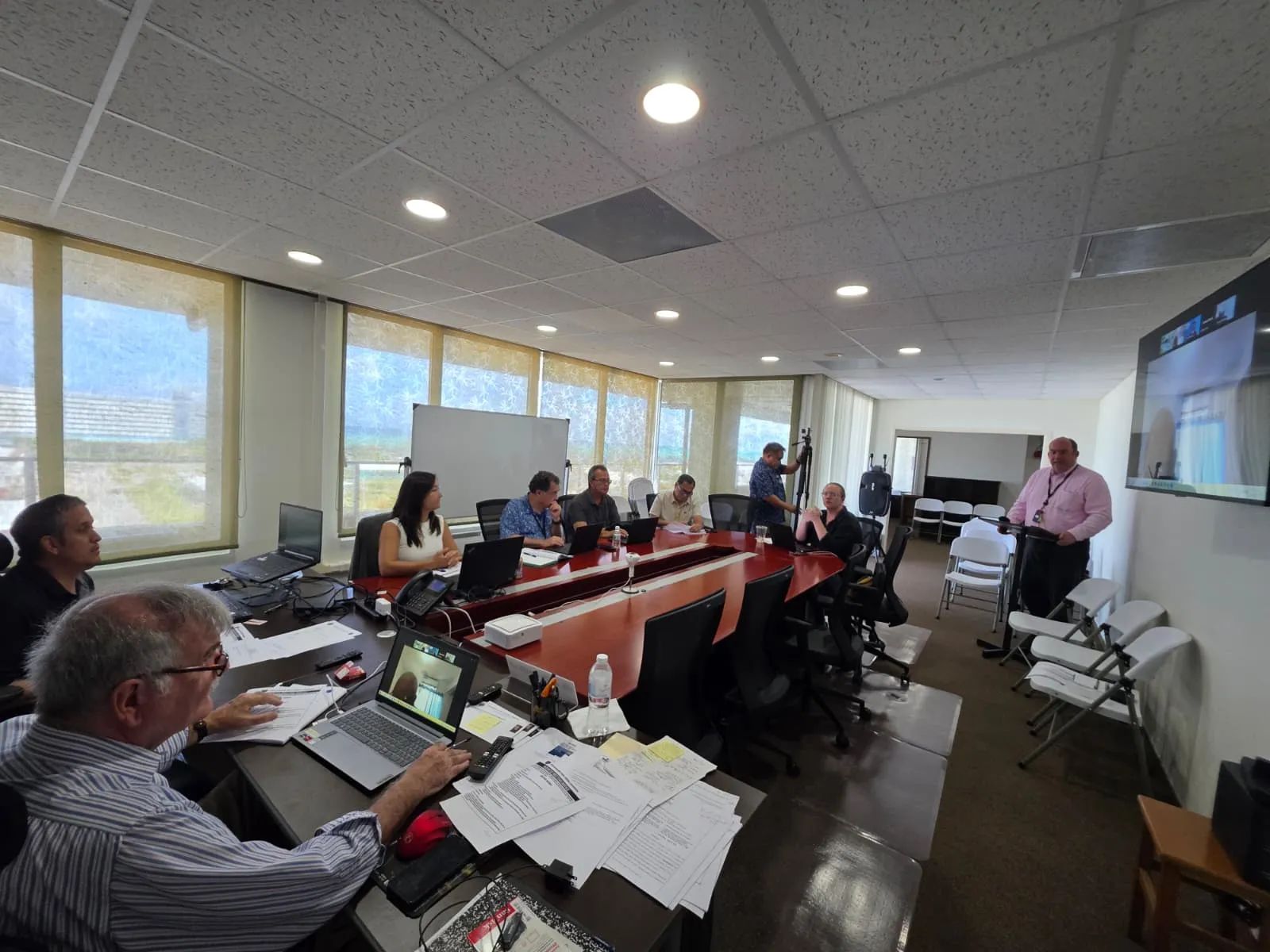


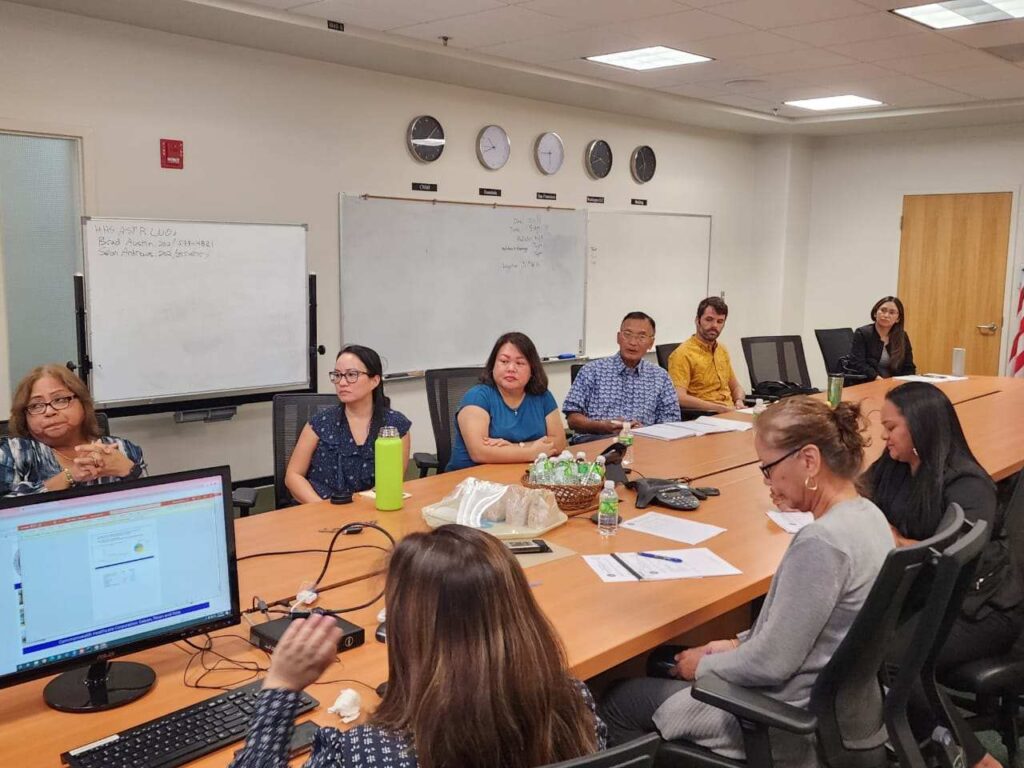
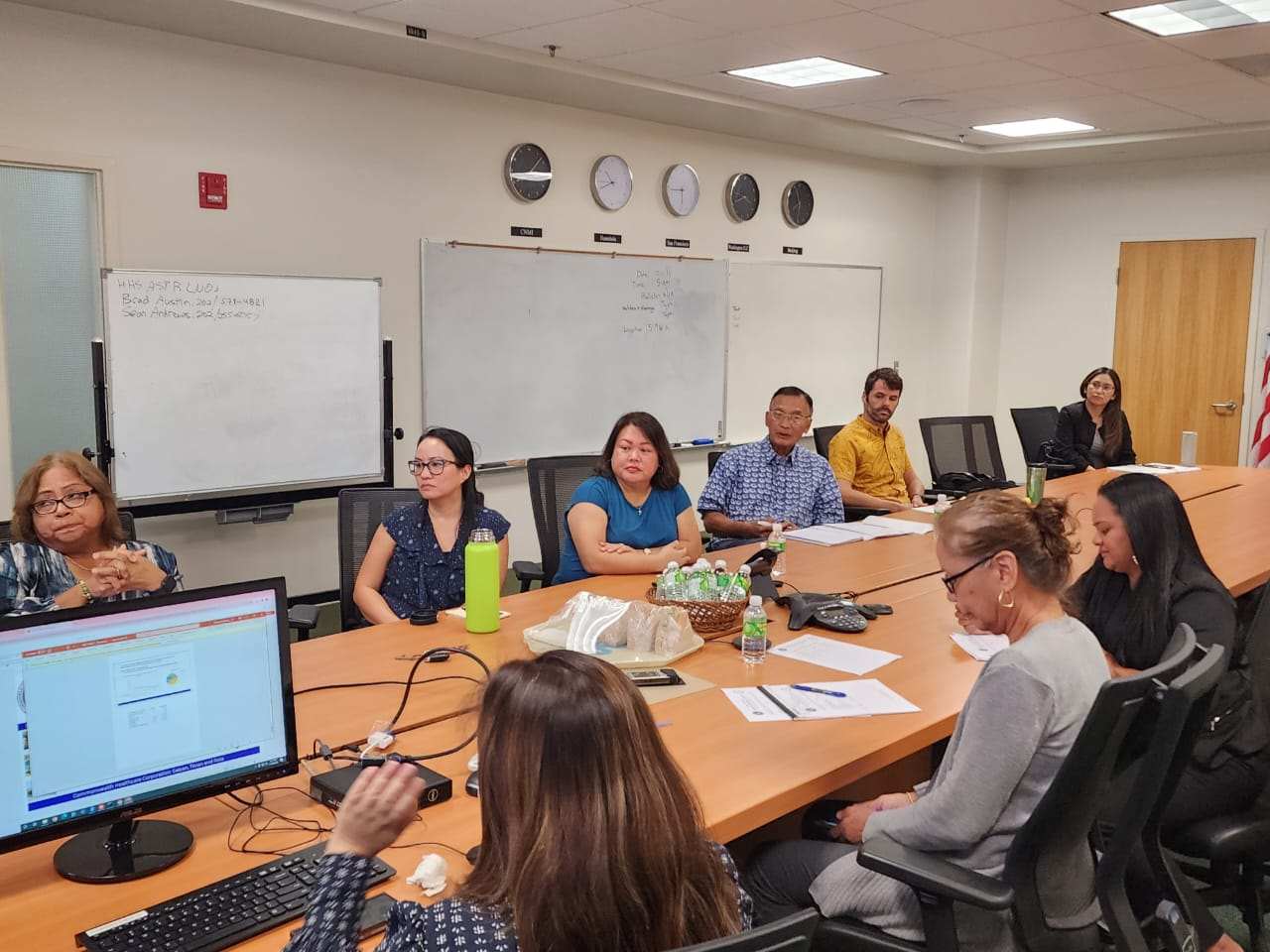
Commonwealth Healthcare Corp. Chief Executive Officer Esther L. Muna, board trustees Phyllis Chong, Polly Masga and Juan N. Babauta, along with CHCC staff, attend a board meeting on Thursday in the CHCC conference room.
THE Commonwealth Healthcare Corp. has been earning an average of $67.63 million annually from 2018 to 2023 while spending an average of $9.9 million a year on uncompensated care, CHCC Chief Finance Officer Perlita Santos said in a CHCC board meeting on Thursday.
Santos reported on the autonomous public corporation’s yearly revenue and uncompensated care costs in the last six years. She did not mention a deficit.
Santos said uncompensated care is the care given to patients who were discharged but were not able to pay.
In 2018, she said CHCC earned $45.3 million and spent $16.4 million on individuals who couldn’t pay for the medical care provided to them.
In 2019, CHCC’s revenue went up to $71.6 million, but the cost for uncompensated care also went up to $17.6 million.
In 2020, CHCC’s revenue went down to $59.9 million while the uncompensated care cost also went down to $5.7 million.
In 2021, CHCC revenue increased to $75.9 million while uncompensated care totaled $5.7 million.
In 2022, CHCC generated $70.9 million in revenue while the cost for uncompensated care dramatically went down to $1.2 million.
Santos attributed this decrease to the federally funded presumptive eligibility that provided patients access to Medicaid or the Children’s Health Insurance Program from May 2020 to May 2023. She said 26,000 NMI residents were enrolled through Medicaid presumptive eligibility.
In 2023, CHCC revenue increased to $82.8 million, the highest so far, but it also had to spend $11.7 million on uncompensated care.
Muna said they can tap Medicaid or Medicare funds for uncompensated care, but only for those who are eligible for Medicare or Medicaid.
Santos said CHCC was able to tap $9 million in Medicaid funds for uncompensated care cost in 2023 for patients eligible for Medicaid.
Except for those enrolled in presumptive eligibility, which ended in May 2023, nonresidents or non-U.S. citizens are not eligible for Medicaid or Medicare.
According to CHCC’s report to the Legislature, roughly 28% of the CNMI population relies on Medicaid in order to affordably access healthcare services.
But “despite the high poverty rate (52%), many CNMI residents don’t qualify for Medicaid because they do not hold the necessary immigration status to be eligible,” the report stated.
Muna said for the current year, they don’t have the exact number of nonresidents who account for the hospital’s uncompensated cost.
But she said one of the four individuals has been staying at CHCC for quite a while because they have nowhere to go is a nonresident.
She said these individuals were deemed discharged on the record but they remain in the hospital because they still need care. One of them has been staying in the hospital for a year now.
Santos said there are patients who could pay either through insurance or self-pay, but could not be accommodated as in-patient because a ward is occupied by “individuals under uncompensated care.”
The revenue that CHCC could have received from paying patients but did not because of the uncompensated care occupants is also considered loss in revenue, Santos said.
She wrapped up her report by saying that CHCC has asked the Legislature for assistance “to make sure that the revenue we make is sufficient to support charity care.”
She said CHCC is required by federal law to provide care not only to Medicaid patients, but to anyone regardless of immigration status.
“The burden will have to be on the hospital revenue or the CNMI government,” she said.
She said for fiscal year 2024, CHCC requested the Legislature for a $1.5 million subsidy, but Public Law 23-9 or the FY 2024 Appropriation Act provided a dollar only.
The budget law also appropriated $797,711 for the Health Network —or medical referral — Program.
CHCC, however, asked $8.19 million for the program.
In an interview after the board meeting, Muna said the amount for the Health Network Program had not been transferred to them yet. “We are waiting for Finance to do that,” she said.
Muna said to ensure that CHCC will have funds for its operations and personnel, “we [will] just hold back on projects and initiatives.”
She said, “We do live within our means.” Some job positions have been “moved” to federally funded tasks, she added.
As for the hospital supplies, she said “we ensure we [get] reimbursements from payers and just continue to work on improving our supply management.”
Also present during the board meeting on Thursday were Muna, CHCC Board Chairman Juan N. Babauta, trustees Mariah Barcinas, Phyllis Chong and Polly Masga, Health Network Program interim Director Carmilyn Ogumoro and Rep. Marissa Flores, who chairs the House Committee on Judiciary and Governmental Operations.
