




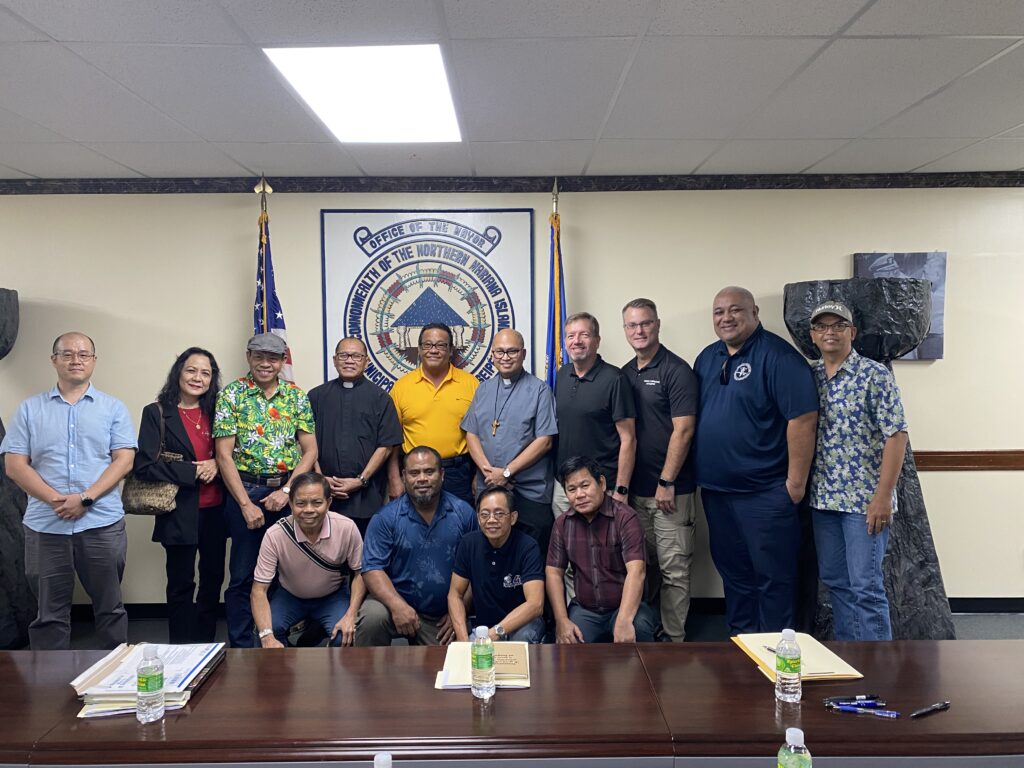

From left, back row, Pastor Seung Hwan Shin, Amalia Ibanez, Pastor Danny Ibanez, Father Rey Rosal, Mayor RB Camacho, Bishop Ryan Jimenez, Pastor Steve Dame, Pastor Michael Rodgers, Pastor Fred Fatialofa and. Pastor Eric Abragan. From left front row, Pastor Noli Villacrusis, Pastor Ferdinand Ngirmekur, Pastor Alexander and Pastor Val Tanguan.
SAIPAN Mayor RB Camacho met with leaders of different Christian denominations on Tuesday, Nov. 1, to seek their input on the public cemetery in Marpi and how they and the mayor’s office can help prevent crime.
Regarding the Marpi cemetery, Camacho said it is “completely different” from the cemetery in Chalan Kanoa as it does not belong to any single church.
Owned and managed by the CNMI government, the Marpi cemetery was established by Public Law 11-117 in 1999.
Camacho said the grounds, chapel, restroom and crypt are overgrown with vegetation, rendering the public cemetery unusable. He said he plans to help clear the land and make it available, but he also wants input from religious leaders on how to proceed once the land is ready to receive burials.
Camacho asked that the religious leaders review Public Law 11-117, as well as the Commonwealth’s cemetery and mortuary rules and regulations. The mayor provided copies of both documents to the leaders and asked that they return to their next meeting with “at least two issues” they’d like addressed.
Bishop Ryan Jimenez said they may want the government to consider how to disseminate rules and regulations to the public once the cemetery is open.
“Make the public know what are the procedures so we start well,” he added.
He likewise suggested that the government seek public comments on cemetery regulations and procedures. He added that the burial permit fee mentioned in P.L. 11-17 — “such fee shall not exceed $50” — is something that many island residents may not be able to afford.
He believes, however, that a new public cemetery is necessary.
“I look forward to that day when it is open and made available to the public because it is needed by our people regardless of religion,” he added.
He said the cemetery in Chalan Kanoa is at capacity, but residents continue to ask that their family members be buried there.
Pastor Michael Rodgers had questions regarding the current Wireless Ridge Public Cemetery. According to P.L. 11-117, it should have been closed upon completion of the Marpi cemetery.
The law also states that remains buried at Wireless Ridge Public Cemetery should be exhumed and transferred to Marpi.
Pastor Rodgers said his mother-in-law is buried in Wireless Ridge, and so he wondered who would pay for the cost of exhuming and moving human remains.
He said the Wireless Ridge graveyard is “wild and unruly” with overgrown vegetation.
“It’s a bit of a concern… It’s very difficult to find graves,” he added.
Pastor Rodgers said some families who buried their deceased loved ones at Wireless Ridge have already moved off-island.
Preventing crime
During the meeting, Mayor Camacho also asked religious leaders about crime prevention.
Many of the pastors mentioned drug use and poker parlor gambling as concerns that their congregation members have brought up to them.
Camacho mentioned the neighborhood watch program, and asked the religious leaders to encourage their congregation members to be vigilant and to speak up if they see something suspicious.
Pastor Ferdinand Ngirmekur said when it comes to seeking police help, there is a cultural element keeping some families silent.
“As an islander when it comes to this kind of issue, [we say] it’s our own problem, and we hide that problem as a family because we don’t want our reputation to be bad in the community,” Pastor Ngirmekur said.
“This is a reality we face in the island,” he added.
Pastor Rodgers said drug use and gambling can be addressed among congregations, but they can’t force anyone to come to church and receive instruction.
“[There are] people on the street who don’t attend any of our churches,” he said. “This is a conundrum for all of us because we wish they would come into our churches, but we know people’s hearts will be led where they want to go, and many do not want to seek God.”
He said crime requires “more than just a faith-based solution at this point.”
As for Bishop Jimenez, he said “one of the challenges I see…is the sense of continuity in terms of [implementing a] program.”
He said in the past, a government organization brought together faith-based leaders to combat drug use, but that program was eventually disbanded.
“It’s unfortunate that for a small island…there’s really no sense of continuity,” he said. “There had been a lot of initiatives, but they would stop for whatever reason…. This is a good restart, but I guess sometimes I feel like we always restart.”
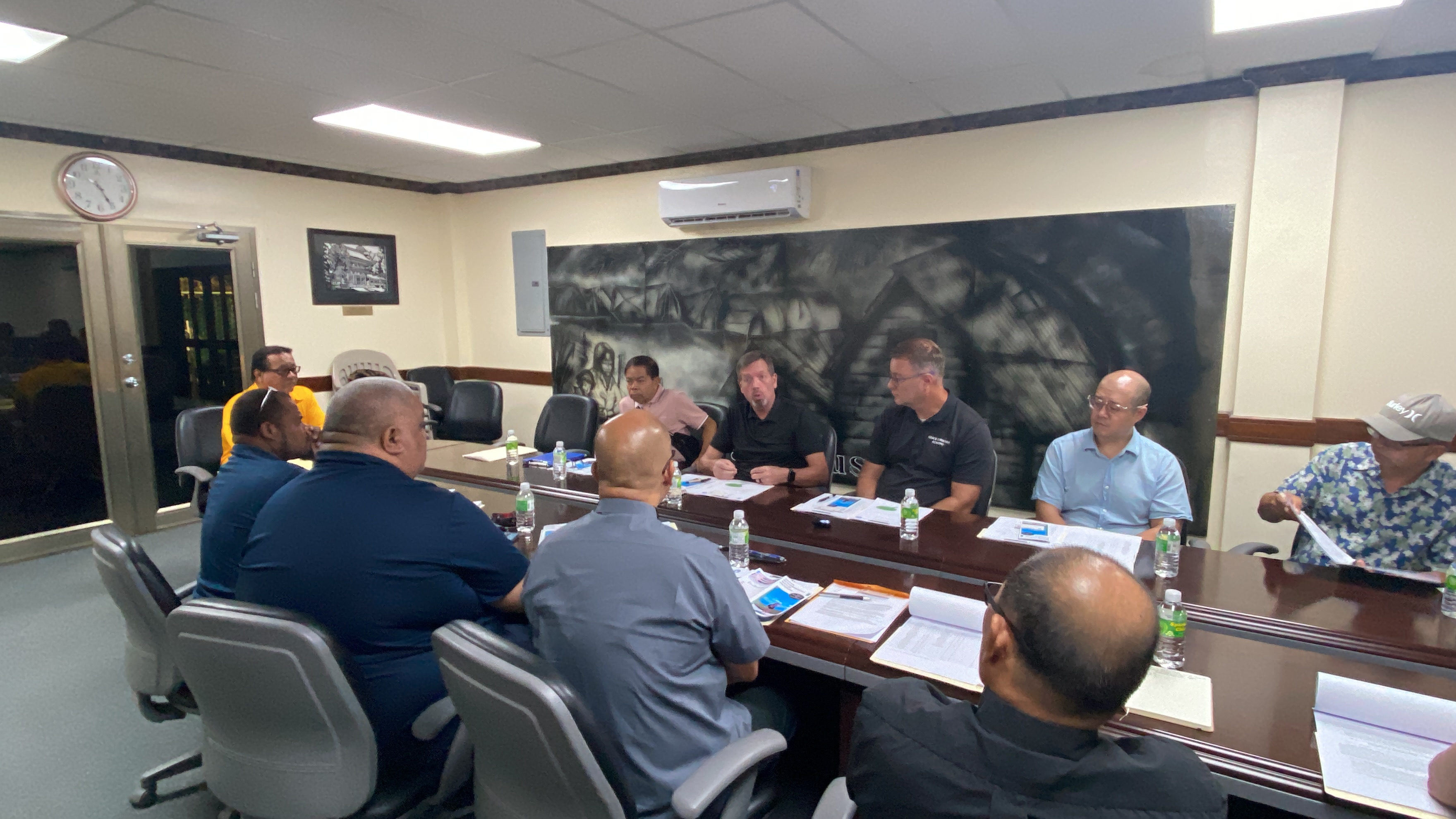
Saipan Mayor RB Camacho meets with faith-based leaders in the conference room of the mayor’s office on Wednesday, Nov. 1.
