





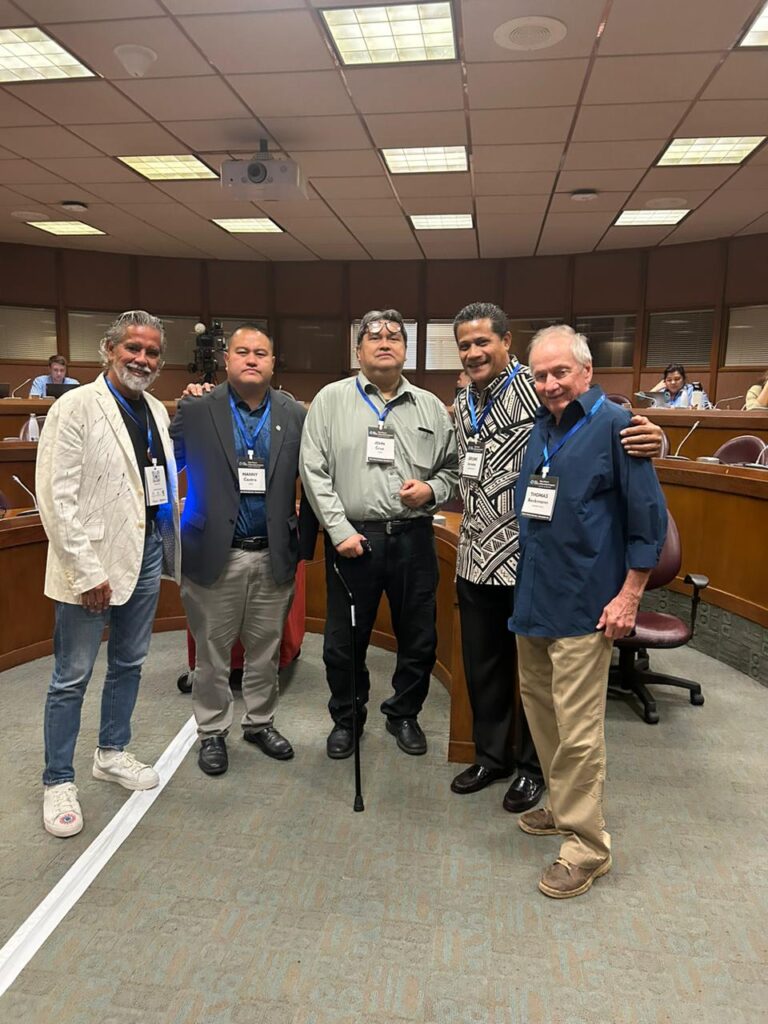
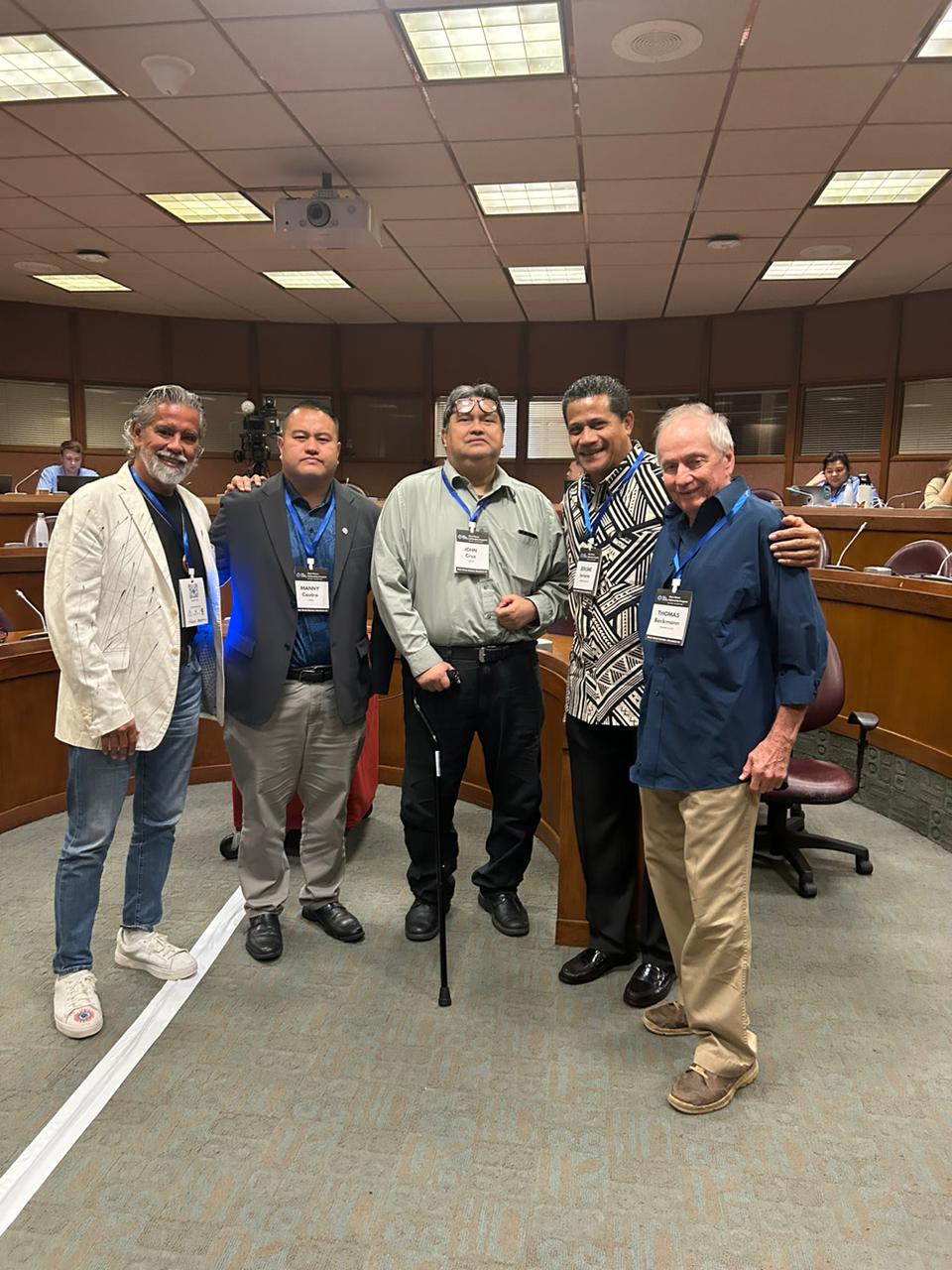
From left, Henk Rogers, founder of Blue Planet Alliance; Rep. Manny Gregory T. Castro; John Cruz, assistant general manager for Guam Power Authority; Jerome Ierome, senior renewable energy team leader for the American Samoa Power Authority; and Thomas Beckman, legal counsel of the Pohnpei State Legislature.
REPRESENTATIVE Manny Gregory T. Castro is participating in the Blue Planet Alliance’s inaugural fellowship in Honolulu, Hawaii from Oct. 14 to 22.
The chairman of Saipan and Northern Islands Legislative Delegation’s Committee on Public Utilities, Transportation and Communications, Castro met with the representatives of Blue Planet Alliance during the U.S. Department of the Interior’s Territorial Climate and Infrastructure Workshop in May 2023.
On July 26, 2023, he was cordially invited to represent the CNMI in the inaugural fellowship in Hawaii.
He said the program is for island leaders around the globe who are looking to transition their islands away from fossil fuels and toward a renewable energy future.
Castro said if the technology that can harness geothermal energy and convert it to containerized hydrogen exists in the CNMI, “we would then be able to export it to various places in Asia. This will effectively reduce our dependence on the importation of fossil fuels, and more importantly increase our gross domestic product.”
He said this will bring much needed economic, environmental and workforce development opportunities to the people of the CNMI.
In Hawaii, Castro said he will hear from policy experts, utility executives, community organizers, climate-solution advocates, and leaders with extensive knowledge of why renewable energy is the answer, “and how we can do it together.”
He said in 2015, Hawaii became the first U.S. state to legislatively mandate a transition to 100% renewable energy by 2045. This landmark legislation, Castro said, inspired other jurisdictions throughout the country to set similar ambitious climate goals.
Today, more than 20 U.S. states and jurisdictions have followed Hawaii’s lead and targeted a transition to 100% renewable energy.
“For Hawaii, there were myriad considerations for the switch. Of course, there were existential reasons: experts have noted that dirty energy can cause irreversible environmental damage that would be devastating to Hawaii’s future. But there were also economic reasons: the state was spending $6 billion a year importing gas and coal. Now with the new plan, the state will save billions and keep that money invested in the local economy,” he said.
Hawaii is not markedly different from the CNMI and other islands in this regard, Castro said.
The objective of the fellowship program is to share all the knowledge gained, all the lessons learned, and explore opportunities for the CNMI to similarly transition to a 100% renewable energy future, he added.
