




HAGÅTÑA (The Guam Daily Post) — Certain business leaders have spoken up in support of a measure seeking to increase the limit for nonresidential customer class net metering systems, according to a press release from the bill’s sponsor, Sen. William Parkinson.
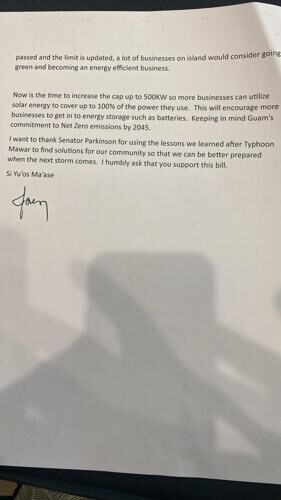
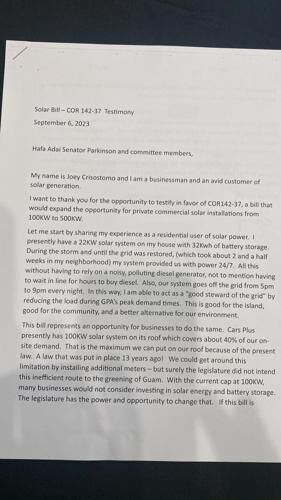
Included in the release were supporting statements from Jim Beighley, CEO of Pacific Group; Marcos Fong, CEO of Foremost; and Joey Crisostomo, president and dealer principal at Cars Plus.
Their testimony essentially spoke about utilizing solar power to lighten the load on the power grid, as the Guam Power Authority is currently experiencing generation shortfalls, as well as being able to offset more of their power use.
In his release, Parkinson said Bill 142 is the private sector solution to load shedding, and the private sector’s ability to generate its own power should not be limited.
However, despite supporting the intent of the measure, GPA spoke up against the bill’s passage because of concerns with resulting impacts to base rate revenues and likely base rate increases for non-net-energy-metered customers.
Parkinson’s Bill 142-37 would increase the limit for nonresidential customer class net metering systems from 100 kilowatts to 500 kilowatts of generation.
Net-metered GPA customers utilize renewable energy systems and receive credits for the excess energy that these systems feed back into the power grid.
On Guam, renewable energy almost always means solar power.
Written testimony on Bill 142 from GPA General Manager John Benavente was read aloud by Assistant General Manager Tricee Limtiaco during the public hearing on the measure on Thursday.
Benavente’s testimony stated that net metering, while mandated with the good intention of increasing renewable energy use on island, has resulted in a significant negative impact on base rate revenues. Currently, NEM customers are not required to pay about $5.2 million of annual operating costs, which are subsidized by non-NEM customers, according to Benavente’s testimony.
Should Bill 142 become law, about 1,300 NEM customers will have the opportunity to increase renewable energy production, and if 25% of them move above 100 kW, that is estimated to result in a $12 million revenue loss to GPA.
“Add to this the current $5 million subsidy, and the NEM program’s impact to non-NEM customers will be an estimated $17 million annually by avoiding base rate costs,” Limtiaco read from Benavente’s testimony.
The financial impact estimate also does not include costs for impact studies and mitigation projects to address an increase in power generation from NEM customers, according to the testimony.
“This change will certainly require GPA to file for a rate increase to cover its operating costs, which is borne by only the non-NEM customers,” Limtiaco read, adding that GPA has asked the Public Utilities Commission to replace the current NEM credit rate with an avoided cost rate.
Adjusting the current NEM rate may significantly change the projected impact of Bill 142 to non-NEM customers, Benavente’s testimony stated, before concluding that the issue should be taken to the PUC for decision, as required by bond covenants, before further action is taken.