



MAJURO — Momentum is picking up for renewing Compacts of Free Association with Palau and the Marshall Islands, both western Pacific nations considered key to United States security in the Pacific region.
Palau and U.S. leaders signed a memorandum of understanding for a third Compact of Free Association agreement in Los Angeles on Wednesday this week. With the signing of the MOU by Palau Finance Minister Kaleb Udui Jr. and U.S. Special Presidential Envoy for Compact Negotiations Joseph Yun in Los Angeles, Palau is the first of the three freely associated states to commit to a framework for the ongoing negotiations.
The Marshall Islands was reportedly also slated to sign a separate MOU with the U.S. the same day as Palau, but that was delayed by a review of a final draft of the MOU by the Marshall Islands Compact Negotiating Committee or CNC. However, following the reported cabinet authorization Tuesday to approve the Marshall Islands-U.S. MOU, Foreign Minister and chief negotiator Kitlang Kabua was scheduled to depart Majuro Wednesday night for a signing ceremony with Ambassador Yun Thursday in LA. Opposition members of parliament were critical of the haste to sign the MOU, which is not a final agreement, but sets out parameters of the continuing negotiations as U.S. and island negotiators work to hash out details.
Nitijela Speaker Kenneth Kedi called the Marshall Islands-U.S. MOU a “huge step in moving to complete a Compact of Free Association that will work for both the U.S. and the Marshall Islands.”
The draft MOU between the Marshall Islands and the U.S. contains agreement on seven areas of specific funding, while stating the US will continue to provide programs and services to the Marshall Islands as are currently provided in the existing Compact and through the Federal Programs and Services Agreement. The current U.S. grant agreement expires September 30 this year.
The most significant amount of funding contained in the MOU is a new, $700 million contribution to a “repurposed” trust fund.
The Compact Negotiating Committee review meeting, held initially Monday morning before the Nitijela (parliament) session, was continued Tuesday, forcing Nitijela to recess until Wednesday to give CNC members more time for their review.
According to CNC participants, Tuesday’s meeting was “contentious.” But most appeared prepared to move ahead with the MOU. Later on Tuesday, Foreign Minister Kabua briefed Cabinet on the draft MOU with the U.S., which reportedly gave its okay for her to sign the agreement.
“A couple of months back I said there was light at the end of the tunnel,” said Speaker Kedi Wednesday. “But now, we are near the end of the tunnel.”
The Speaker’s comments are largely based on the U.S. commitment, in the MOU, to inject $700 million over four years into the Marshall Islands Compact trust fund that would be revised so that some of these funds can be used for nuclear compensation. The nuclear legacy has been a key stumbling block in the current talks and was the cause of Marshall Islands negotiators breaking off a scheduled negotiating session with the U.S. last September.
Kwajalein Nitijela Member David Paul, who is on the CNC, raised a series of objections to signing the MOU at this time. Paul said three issues need to be resolved before the Marshall Islands should sign the MOU: U.S. funding should be subject to full inflation adjustment annually; agreement needs to be reached that the Marshall Islands gets “current value” for funding for the trust fund; and greater autonomy for the Marshall Islands to decide how Compact funding is used instead of continuing the existing financial management system in which the U.S. government maintains a three-to-two majority on the oversight committee.
Paul said while those focused on the nuclear legacy have received “what they needed,” broader issues such as full inflation and greater autonomy for use of funding are not resolved and will affect the nation going forward. “It will be a flawed deal if we don’t have these in place,” Paul said, adding “what they’re giving us is far short of what we asked for.”
The Speaker said Wednesday that while Paul made the point that the Marshall Islands would be losing out without these provisions, “I said losing out on what? The MOU quadruples what we’ve had in the past compared to the Compact one and two nuclear fund.”
Kedi cautioned, however, that this is not the final agreement and there is still plenty of work to hammer out details. “This sets a framework in place and secures funding numbers for fiscal year 2024,” the Speaker said. “There are a number of issues still to work out.”
In addition to MP Paul, former Marshall Islands President and MP Hilda Heine pushed back on the plan of the Marshall Islands and the U.S. to sign a MOU for the Compact.
“The government continues to push to sign an MOU with the U.S. despite a lack of consensus, in my opinion, on a number of important elements of the agreement, including the climate change issue,” said Heine in comments last weekend. “The U.S. position seems to be putting its greatest share of its investment in the Trust Fund and then let the Marshall Islands parties haggle it out.”
Heine said it looks as though “whatever interest group with the strongest lobbying group in the Compact Team will get the most share regardless of others’ needs.” She added: “This approach deserves more discussion internally before it’s accepted.”
Late last year, Heine and other opposition members of Nitijela sent a letter to President David Kabua urging him not to rush into signing anything until more details were worked out. “We never received a response to our letter from the President or anyone in the Cabinet,” she said.
Meanwhile, on Wednesday (Majuro date) in Los Angeles, U.S. and Palau officials signed the U.S.-Palau MOU with Palau President Surangel Whipps Jr. in attendance. No details were released on the details of the Palau MOU.
“The Memorandum of Understanding (with Palau) was signed as part of ongoing Compact related negotiations and confirms our shared vision for a strengthened and lasting partnership that will continue to benefit both nations and the entire Pacific region,” said the State Department in a release.
There is no schedule for the Federated States of Micronesia to join the other two freely associated states in signing a MOU with the U.S. The FSM negotiating team is still in discussions with the U.S. on possible funding options, and with those unresolved, signing of a MOU or a final agreement is not imminent.
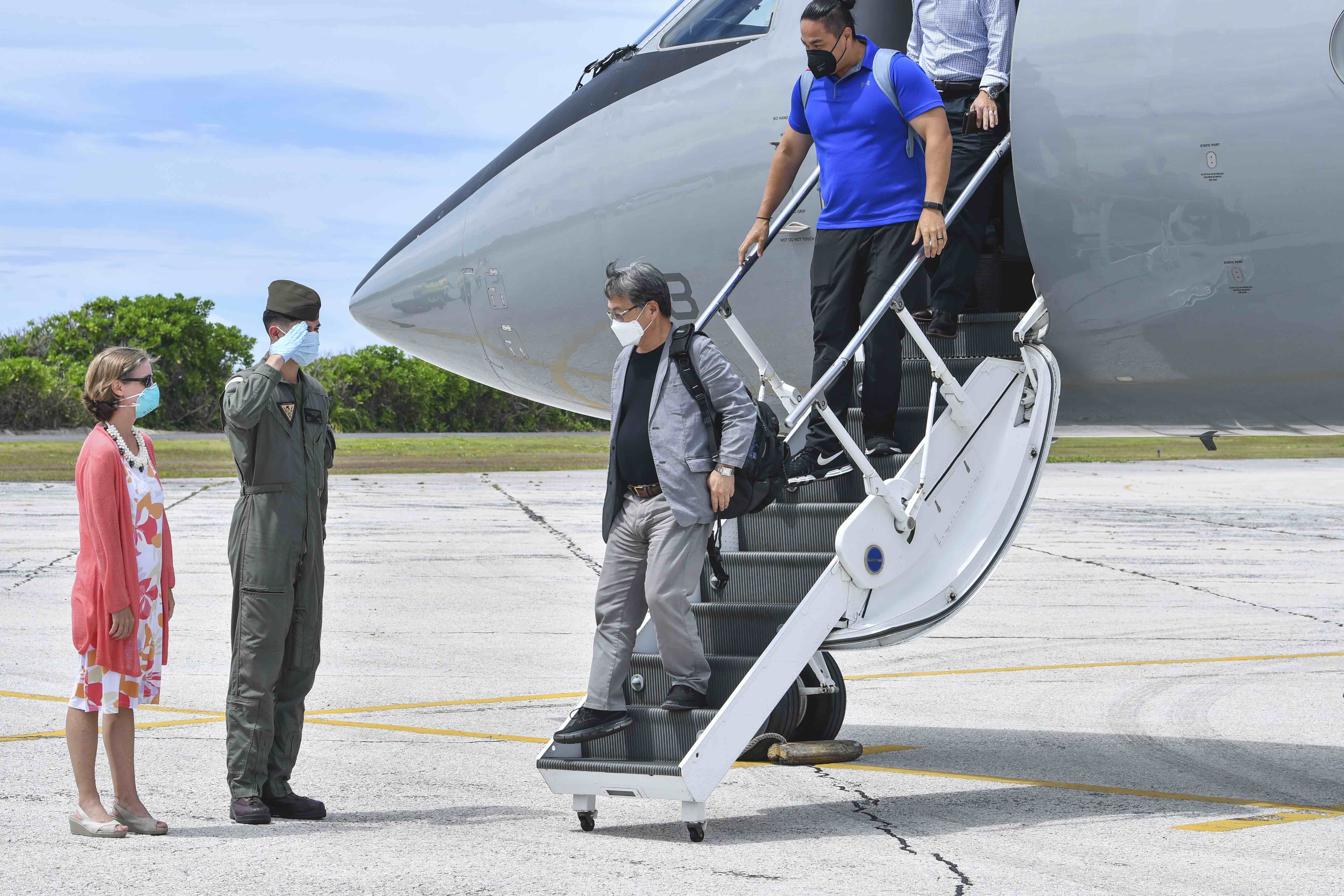
U.S. Special Presidential Envoy for Compact Negotiations Joseph Yun greets U.S. Ambassador to the Republic of the Marshall Islands Roxanne Cabral following the arrival of the U.S. delegation at Bucholz Army Airfield on U.S. Army Garrison-Kwajalein Atoll on June 14, 2022.
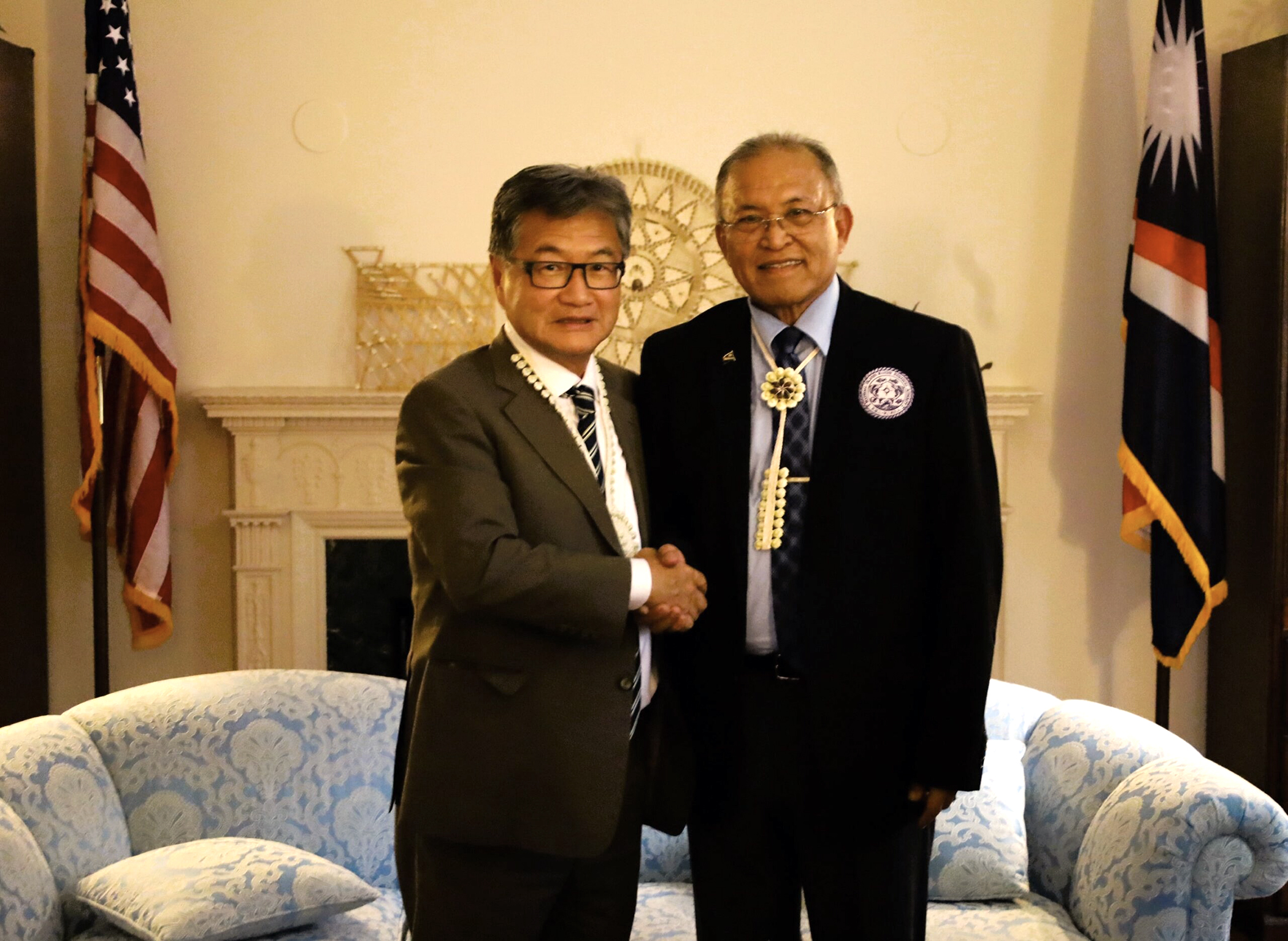
U.S. Special Presidential Envoy for Compact Negotiations Joseph Yun, left, met with Marshall Islands President David Kabua in Washington, D.C. last September on the eve of the White House US-Pacific Islands Summit.
