





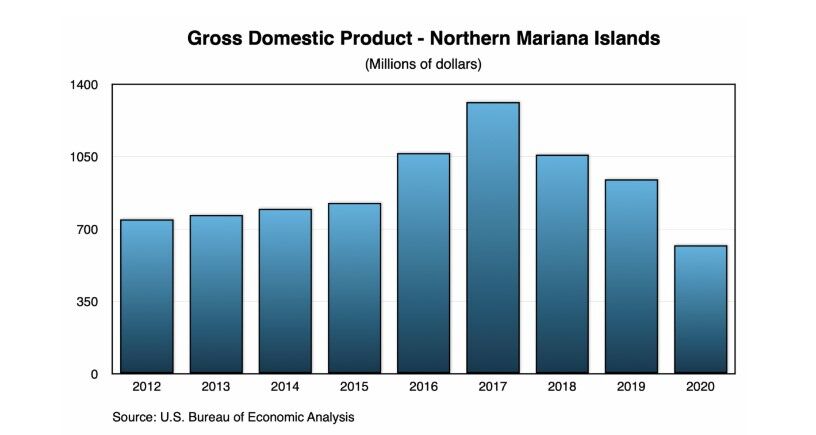
THE CNMI’s real gross domestic product or GDP decreased by 29.7% in 2020 when a global pandemic shut down the local economy, according to the statistics released last week by the U.S. Department of Commerce’s Bureau of Economic Analysis.
GDP is the total value of everything produced within a country. Its growth rate measures how rapidly the economy is growing or shrinking.
According to estimates, during the Great Depression of the 1930s, the GDP of the U.S. fell by approximately 30% from 1929 to 1933.
As for the CNMI, the BEA said the decrease in real GDP “reflected decreases in exports of goods and services, private fixed investment, personal consumption expenditures, and government spending. Imports, a subtraction item in the calculation of GDP, also decreased.”
BEA statistics showed that in 2020, personal consumption expenditures in the CNMI went down by 3.58% after a 0.36% increase in 2019. The data also showed that from 2013 to 2017 there was a steady increase in personal consumption expenditures, with 5.21% in 2017 being the highest, before it plummeted to 0.46% in 2018, and 0.36% in 2019.
In an interview on Monday, acting Gov. David M. Apatang said he and Gov. Arnold I. Palacios met with key cabinet members on Saturday to discuss the BEA’s latest report.
Obviously, he said, the Covid-19 pandemic impacted the Commonwealth’s GDP.
This year, Apatang said, “we’re pretty much almost clear with Covid with all the vaccinations and all that. But the governor and I are still looking at it, making sure we are monitoring it still because we don’t want to say ‘we are all clear’ when we know that there are still Covid cases going around. We just have to ask our people to continue to protect themselves, practice the three Ws —watch your distance, wear a mask, and wash your hands — and be careful out there.”
As for the local economy, Apatang said he and the governor are hoping that the islands’ only industry, tourism “will come back.”
“We are trying every way possible to continue to promote the NMI…through the Marianas Visitors Authority in the Japan and Korean markets,” he added.
In his weekly e-newsletter, U.S. Congressman Gregorio Kilili Camacho Sablan stated that “the decline in economic activity [in 2020] was largely due to the Covid-related drop in tourism, although a slowdown in construction and reduced government expenditures added to the loss.”
He said 2020 was “the worst year for the economy since before 2002.”
But he added that “despite the lack of tourists, private sector workers’ earnings fell only slightly and compensation to government workers actually went up during 2020. This helped support consumer spending, which, though also down slightly, got help from the $180 million in Pandemic Unemployment Assistance and Federal Pandemic Unemployment Compensation Congress provided in the CARES Act during 2020.”
The BEA report noted that the U.S. government “passed several laws to support and sustain businesses and individuals through the pandemic.”
The report also stated that “the full effects of the pandemic cannot be quantified in BEA’s statistics for the CNMI, because the impacts are generally embedded in source data and cannot be separately identified.
Moreover, “due to lags in the availability of data for various components of GDP, the statistics presented…for 2020 are preliminary estimates. For example, as of mid-January 2023, the CNMI government’s fiscal year 2020 audited financial statements were unavailable.”
BEA said it used draft versions of these financial statements to prepare estimates of government spending.
As additional source data becomes available, BEA said it will incorporate the information and will release updated estimates.

