







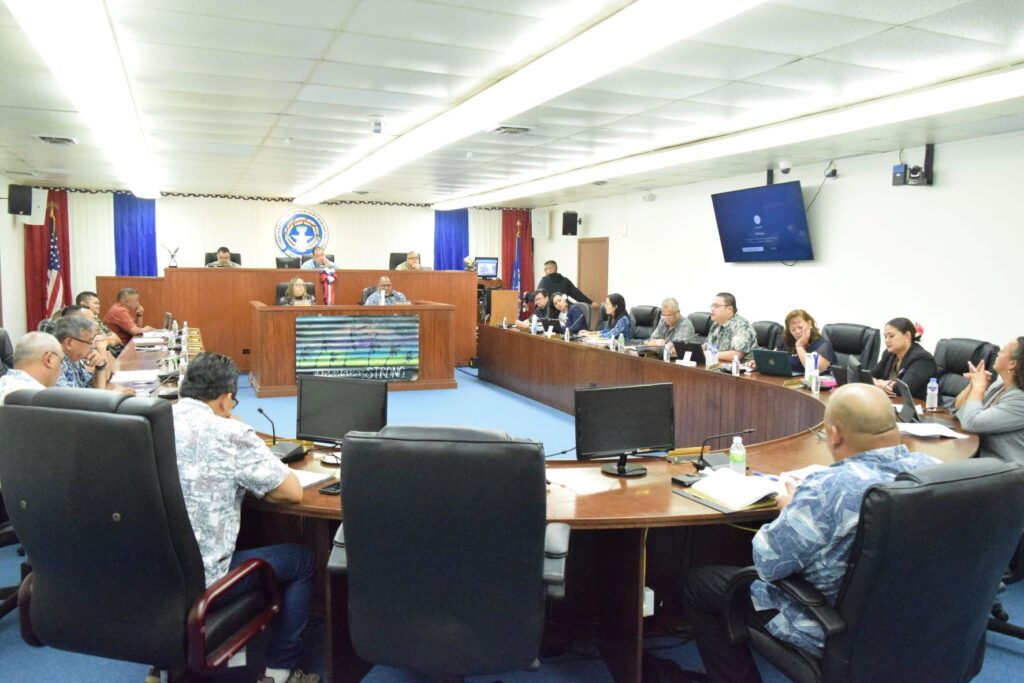
BY a vote of 14 to 5, the House of Representatives on Tuesday rejected the Senate version of the fiscal year 2023 budget measure or House Bill 22-116. The current fiscal year ends on Friday, Sept. 30. If a new balanced budget is not enacted into law on or before that date, there will be a partial government shutdown.
It was House Floor Leader Ralph Yumul who moved to reject the Senate version of H.B. 22-116 which House Ways and Means Committee Chairman Donald Manglona said “reverted” the budget to what Gov. Ralph DLG Torres had proposed.
Members of the House leadership expressed their concern about the Senate version which the five minority bloc members supported.
Rep. Denita Yangetmai, a member of the House leadership, was excused.
Looming
Will only two days left before the end of the current fiscal year, some government agencies deemed non-essential are now bracing for the partial government shutdown.
Legislative Bureau acting Director Carla San Nicolas said most of their employees will be affected. During a partial government shutdown, she said only the legal counsels, the House and Senate clerks, the sergeant-at-arms and legislative assistants will continue working. But most of the 28 employees will not report for work.
An executive branch agency head who requested anonymity said half of their employees will be affected. The other half are federally funded.
The agency head said it would be heartbreaking to see their locally funded employees affected by the partial shutdown.
The first partial government shutdown occurred in October 2010 and lasted 10 days.
No identified resources
In his remarks, Manglona said the Senate version of H.B. 22-116 mirrored the governor’s budget proposal and “left no identified resources to ensure that the retirees will get paid nor Medicaid receiving their match — putting the health and safety of our people at risk.”
Manglona said under the governor’s proposal, departments and agencies would have “to beg the administration for any funding needed to function.”
He said the Senate version of the budget, like the governor’s, cut operational funding for departments and agencies. “Vacant [full-time equivalent or] FTEs, despite no funding for those positions, were restored, and funding for Medicaid and retirees was taken out,” he added.
To help the government “survive” after the expiration of American Rescue Plan Act funds, Manglona said they removed all vacant FTEs.
He added that “people’s jobs were never at risk.”
He said “it is common sense that if an agency has three vacant FTEs and the budget reduces the number of positions by three FTEs in that agency, then that reduction was to eliminate those vacant positions.”
The House, he added was not going to engage in micromanagement. “We did not feel the need to tell the agencies that they should retain their employees and not fill the vacant spots,” he said.
He reiterated that the House version of the budget did not remove any filled positions.
“So again, the House did not jeopardize anyone’s jobs. We were simply trying to give the various departments and agencies an operations budget so they can perform their jobs. To quote my Senate colleagues, ‘It’s common sense.’ ”
Blame game
Manglona said the governor blames the House leadership for passing the budget bill in August, “but let me remind you that it was the administration that failed to properly inform the Legislature of the available resources.”
The governor submitted his budget proposal on April 1.
Manglona said his committee discovered discrepancies, including an overpayment to the Settlement Fund. “Because of this,” he added, “the House identified $3 million in additional resources.”
Additionally, Manglona said Finance Secretary David DLG Atalig mentioned that he would include operational funds in a revised submission, but Atalig didn’t, Manglona added.
This again forced the House to address the need of the departments, Manglona said.
“Let me remind the Governor, that the House cannot act on a budget without the Senate passing the House concurrent resolution, which identifies the available resources. The Senate passed the Concurrent resolution in mid-August. The House then passed the budget bill shortly thereafter. We received information on August 16 that the Medicaid payment funds in the amount of $20 million were being returned. So, we took the time to allocate these funds to the operations budget of various underfunded departments and other critical needs that we identified. We passed the budget on a Saturday instead of waiting for the beginning of the week to avoid wasting a single day,” Manglona said.
He said the administration continues to withhold information from the Legislature despite repeated requests for information pertaining to fund balances.
Manglona reiterated that the administration “overestimated” $3 million for the Settlement Fund.
“What would have been the governor’s plan to spend this $3 million? More increases to his loyal supporters and illegal contracts? Why did they report 16 million for government resources in his April 1st submission and then 32 million in July 1st?” Manglona asked.
He said the governor’s budget proposal “failed to address the retirees, Medicaid, and government operations.”
“It didn’t take the Senate too long to pass their version of the budget because it basically undid our work and returned everything back to what the governor had asked. Where’s the check and balance in that? Why would the Legislature give up our power to control the purse? We weren’t elected to represent our Governor. We were elected to fight for our people and to do what is right and the right thing to do is be transparent, responsible, and fair,” Manglona said.
“We have a few days to pass a budget in order to avoid a shutdown. I stand ready to work with the Senate to address concerns in the budget. But for now, for all these reasons that I’ve mentioned, I cannot support the Senate budget version of the budget and I ask my colleagues to reject [it],” he added.
Confusion
House Minority Leader Angel Demapan said they need to clarify the advice lawmakers are getting from the legal counsels of the House and the Senate.
“I don’t know who’s right between the counsels, but I do know that both counsels work for the same Legislative Bureau. And two houses are getting two different [pieces of] advice and counsel from the counsels.”
Demapan said this is causing confusion not just among lawmakers, but to the members of the public as well because they see a divided Legislature working on legal interpretations that are not the same.
He said there should be “some kind of understanding” between the legal counsels employed by the Legislative Bureau.
“That is what is before us today,” he added. “Two different versions, two counsels working for the same entity providing two different [pieces of] advice. We rely heavily on our own counsel. So, I’d like that we find a way to address this discrepancy so our process, our vote, our decision-making is made in a more sound manner.”
Another House minority bloc member, Rep. Roy Ada, said the Torres administration has never failed the retirees.
On top of that, he added, the governor also found money to give them a bonus. “I think this administration has done a good job in making sure that the retirees are taken care of,” Ada said.
Rep. Patrick San Nicolas of Tinian reminded his colleagues that the end of the fiscal year is on Friday. “If we don’t pass this budget, the government will partially shutdown and many government employees will not be reporting to work. This will have immediate effect on their personal finances as well as in the delivery of public services in the community,” he said.
Although the versions of the Senate and the House differ, San Nicolas said he supports the Senate version which is “clearer and provides more security for our government employees, and most importantly the FTEs for Tinian and Rota.”
Rep. Celina Babauta, a member of the leadership, told Ada and San Nicolas that they voted yes to the House version. She recalled Ada saying that “the House version was the best we could come up with.”
She said San Nicolas, “also voted yes to the House version, so I don’t understand why the mayor of Tinian is claiming politics. You are a member of Ways and Means, and you did not raise any concerns. You did not bring up the financial needs of Tinian. Your silence told us that you agreed, and we did not hear from you.”
Conference committee
Speaker Edmund S. Villagomez named Manglona, Vice Speaker Blas Jonathan Attao, House Floor Leader Ralph Yumul, Reps. Celina Babauta and Corina Magofna as the House conferees.
Senate President Jude U. Hofschneider, for his part, has named the following as the Senate conferees: Senate Fiscal Affairs Committee Chair Victor B. Hocog, Senate Floor Leader Vinnie F. Sablan, Sen. Karl R. King-Nabors and Sen. Francisco Q. Cruz as alternate member.
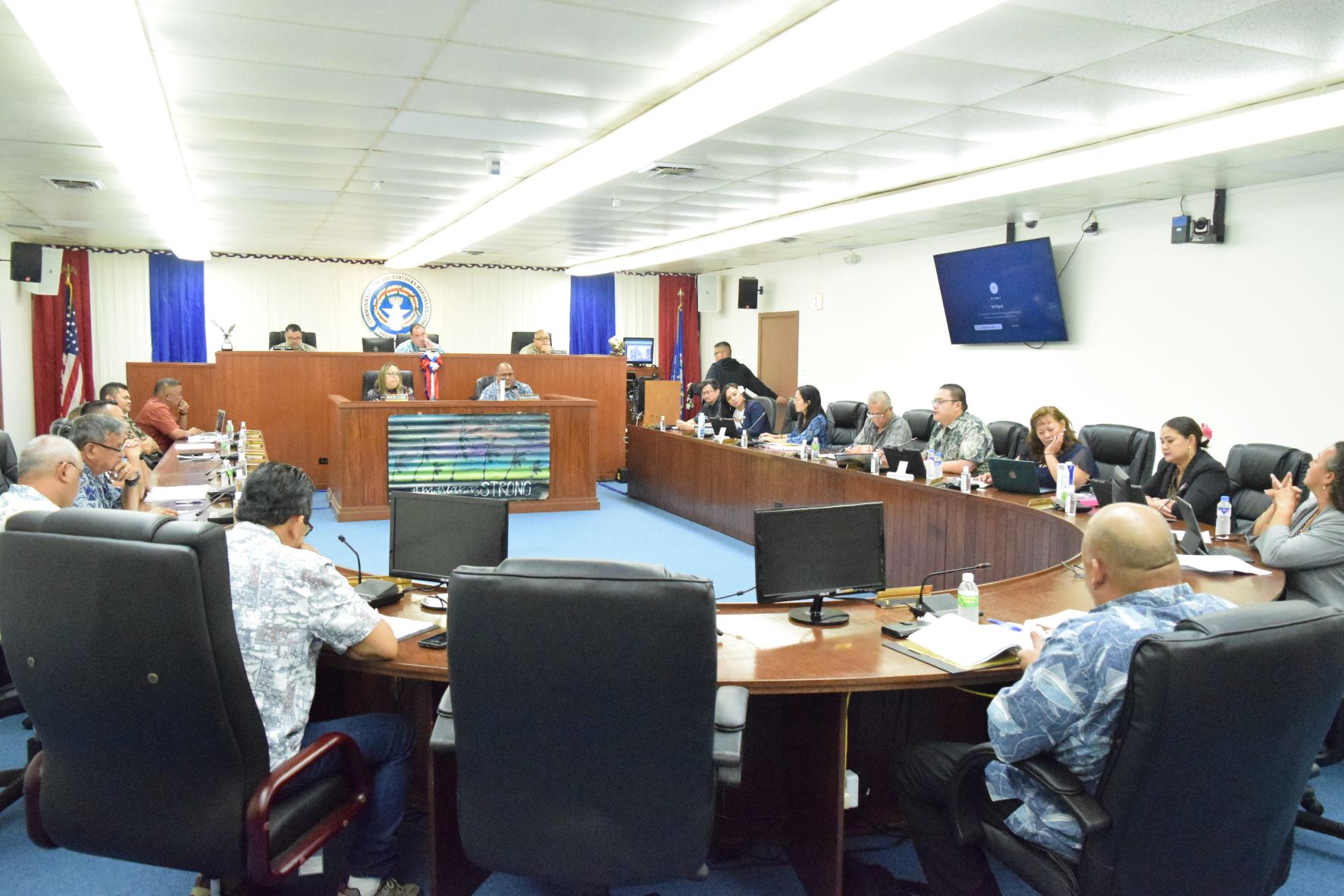
House Ways and Means Committee Chairman Donald Manglona delivers his remarks during the House session on Tuesday.
