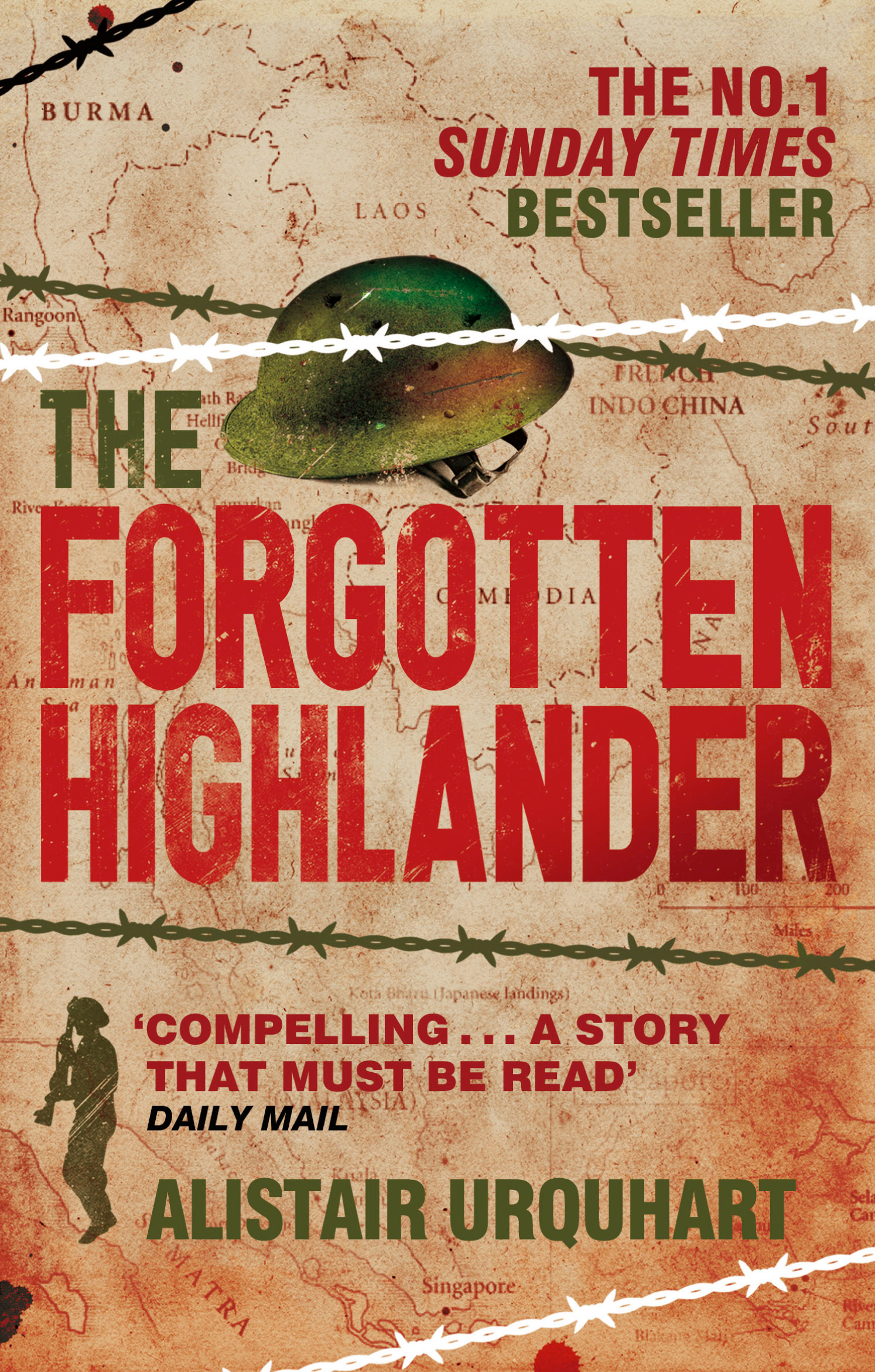






I WILL never say I am having a bad day again. I just finished the autobiography of Alistair Urquhart, a Scottish soldier in the Second World War. What he experienced went beyond anything you have heard before, and we may never have heard his story, but as he neared the end of his life, he purged his soul before meeting his maker. We are so glad he did.
The book is titled “The Forgotten Highlander: My Incredible Story of Survival During the War in the Far East.” He spends some time telling us about his childhood in Scotland, but gets to the war pretty quickly. He was drafted into the British army and was stationed in Singapore, where he felt securely distant from the fighting in Europe. But as the Japanese grew more aggressive and war clouds gathered, he knew he stood in harm’s way.
Singapore was attacked in late 1941, immediately after the Pearl Harbor raid, and fell to the Japanese a few months later. Along with a couple hundred thousand others, Alistair was taken prisoner and forced to endure torture, starvation, beatings, and humiliation. British soldiers soon learned that the Japanese did not recognize the Geneva Convention on the treatment of prisoners of war, and in fact they considered surrender the worst decision a soldier could make.
Alistair worked on the Death Railway, made famous by the movie “Bridge on the River Kwai,” and he informs us that while the movie accurately portrayed conditions in the camps, he never saw any Americans and his commanding officer never cooperated with the Japanese the way Alec Guinness did in the movie. That was all Hollywood. During that time, the prisoners were forced to live off a cup of rice per day. Alistair shriveled from his pre-war weight of 140 pounds to a mere 85 pounds. It is no wonder so many died.
After completing work on the railway, Alistair was re-assigned to work in mines in Japan. He was herded onto the infamous Hell Ships, in which the Japanese packed thousands of prisoners into the cargo holds of captured vessels and sealed the hatches. Thousands suffocated to death, starved, or went insane and had to be killed by their comrades. It was an easy way for the Japanese to thin out their numbers.
Along the way, the convoy Alistair was in was attacked by a group of American submarines and his ship was torpedoed. Thousands died but as the ship sank, Alistair was miraculously sucked out a hole by the rush of water and squirted into the open sea. Grabbing hold of some debris, he floated for nearly a week in shark-infested waters before being picked up by a Japanese fishing vessel. Placed aboard a second Hell Ship, Alistair finally made it to Japan. He was assigned to a prison camp on the southern island of Kyushu where he worked in mines outside the obscure town of Nagasaki, a place he had never heard of.
One day, as he was spreading fertilizer in a Japanese garden, he was knocked over by a blast of air that he described as unnaturally hot. He later learned that it was the atomic bomb, and he was close enough to be hit but far enough not to be killed. The war’s end came soon after, but Alistair and his fellow prisoners had to survive until relief forces arrived to rescue him, which was one of the scariest times for him. It was widely known that the Japanese planned to kill all prisoners in the event they lost the war to prevent them from telling what they experienced. In the end, much to the credit of the Japanese people, no such massacre took place and Alistair made his way back to Scotland to live out a long, happy life.
I learn many things from Alistair. First is that no matter what I have gone through, someone else has been through worse. We all need that kind of perspective from time to time, when our problems grow out of proportion. The second thing I learn from him is that attitude is everything. Many books have been written about survival situations, whether it be trapped on a snow-covered mountain or floating in a life raft at sea, and why one person lives and another dies. Many authors conclude that survival often comes down to a person’s attitude and mental state. If you believe you will not make it, you probably won’t, and likewise, if you firmly believe you will get out of the situation, chances are good that you will.
Alistair is living proof of the survivor principle. Captured, beaten, escaped, recaptured, beaten again, starved, torpedoed, drifted, recaptured, beaten again, starved again, blasted by an atomic bomb. Yes, he lost his optimism, yes, there were times when he would rather have died than carry on. But he always bounced back from those lows. As a result, he not only survived the worst horrors of war, but he lived well into his nineties. I want to be like him.
BC Cook, PhD lived on Saipan and has taught history for 20 years. He currently resides on the mainland U.S.