






By Zaldy Dandan – Variety Editor
THE United Nations’ Special Committee on Decolonization considers Guam a “colony.” But then again, among the members of the U.N.’s Human Rights Council have been Cuba, China, Saudi Arabia and Iran.
There is, in any case, something Orwellian about the U.N.’s relationship with the English language. “Colony,” it seems, is now like “fascism,” “racism,” “poverty” and “socialism” — words that no longer mean what they once did, but instead denote whatever we want them to mean.
There was a time, however, when such words referred to specific, easily recognizable, generally agreed-upon characteristics.
A colony, for example, meant a territory under foreign rule.
That was the case with Las Islas Filipinas — the Philippine Islands — which were under American sovereignty from 1898 to 1946. How did that happen? The United States vanquished Spain in what Secretary of State John Hay called a “splendid little war” and acquired, for $20 million (about 780 million in today’s U.S. dollars), the Philippines and Guam, both Spanish possessions at the time. The rest of the Mariana Islands — Saipan, Tinian, Rota and the Northern Islands — were later sold by Spain to Germany for about $4.2 million (roughly $164.5 million today).
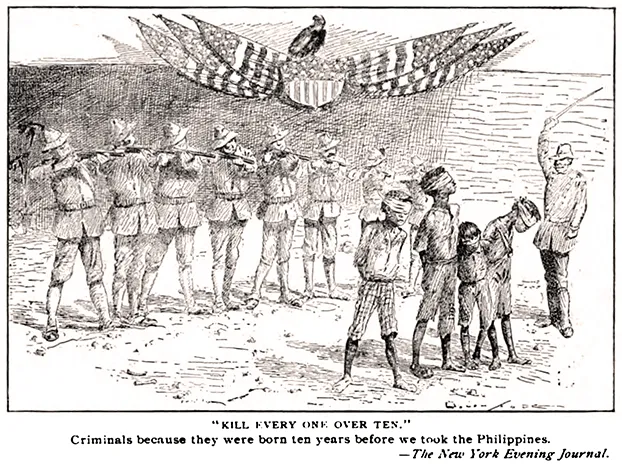
The United States wanted the Philippines mainly as a springboard to gain access to Chinese markets. In the islands, however, Filipino patriots had already declared independence, adopted a constitution and established a government. The U.S. dismissed them as insurgents and proceeded to crush them.
Consider the reality. A well-armed military force, composed largely of white men, was sent to subdue poorly armed brown people seeking to govern their own country. It was the late 19th century. It was never going to be pretty.
In a letter home, an American soldier, Fred D. Sweet of the Utah Light Battery, wrote: “The scene reminded me of the shooting of jack-rabbits in Utah, only the rabbits sometimes got away, but the insurgents did not.”
Leonard F. Adams of Ozark, serving in the Washington Regiment, wrote: “I don’t know how many men, women, and children the Tennessee boys did kill. They would not take any prisoners. One company of the Tennessee boys was sent to headquarters with thirty prisoners, and got there with about a hundred chickens and no prisoners.”
Frank M. Erb of the Pennsylvania Regiment wrote: “We have been in this ni**er-fighting business now for twenty-three days, and have been under fire for the greater part of that time.… The morning of the 6th a burying detail from our regiment buried forty-nine ni**er enlisted men and two ni**er officers … We are supposed to have killed about three hundred.”
Estimates of Filipino deaths during the Philippine-American War vary widely. In a 1981 New York Review of Books article, Gore Vidal cited historian Bernard Fall in referencing three million deaths, invoking Gen. J. Franklin Bell’s 1901 statement that U.S. forces had effectively killed one-sixth of Luzon’s population through scorched-earth tactics, torture and mass killings. Most modern historians place the total number of Filipino deaths between 200,000 and one million, the vast majority civilians. (The northern island of Luzon, where Manila is located, is the Philippines’ largest.)
Once the “insurgency” was suppressed, the United States established an insular government. It included a bicameral legislature whose members were Filipinos elected by Filipino voters. But laws passed by the legislature were reported to the U.S. Congress, which retained the authority to annul them.
The Philippine Supreme Court was headed by a Filipino chief justice, though a majority of the justices were Americans. From 1907 to 1936, the Philippines also had two delegates (called resident commissioners) to the U.S. House of Representatives, but they did not have full voting rights.
The executive branch included Filipino cabinet members, but the Department of Public Instruction was consistently led by an American. The chief executive was the American governor-general, appointed by the U.S. president with the advice and consent of the U.S. Senate.
Filipinos were not granted U.S. citizenship. They were classified instead as “citizens of the Philippines entitled to the protection of the United States.”
The Philippine Islands were also — and every time I mention this, some of my stateside friends think I am joking — financially self-sufficient.
In the abridged 1945 edition of his two-volume work “The Philippine Islands,” originally published in 1928, former Governor-General W. Cameron Forbes wrote:
“The civil administration of the Philippine Islands, contrary to a very prevailing misapprehension, has been self-supporting from the beginning of American occupation in August, 1898.
“The revenues derived from taxes and incidental sources have been sufficient to meet all expenses necessarily incident to civil administration during this entire period, and to pay something toward public works.
“The cost to the United States has been that of the army and navy during the insurrection and that which since pacification has pertained to the defense of the Islands.”
That “defense,” however, did not prevent the Japanese invasion during World War II — an invasion made more likely precisely because the islands were an American possession. Manila became the second most devastated Allied city of the war after Warsaw. An estimated 500,000 to 1.1 million Filipinos died during the conflict, the vast majority civilians. For a population of roughly 17 million, that meant about one in every 17 Filipinos perished.
On July 4, 1946, during a rain-soaked ceremony at Luneta Park in Manila, amid the rubble of war, U.S. High Commissioner Paul V. McNutt read President Harry S. Truman’s Proclamation of Philippine Independence.
As Sen. Huey Long of Louisiana remarked in 1932, supporting independence: “We do not need to worry about the Filipinos. The Lord put them over in a country where they do not need to have shoes. They do not need to have clothes. They can live on the nuts that fall from the trees…. We need to protect our own sugar industry. That is why we need to get them out of the way. We have no business being hooked up with them.”
Send feedback to [email protected]
Zaldy Dandan is the recipient of the NMI Society of Professional Journalists’ Best in Editorial Writing Award and the NMI Humanities Award for Outstanding Contributions to Journalism. His four books are available on amazon.com/.
