



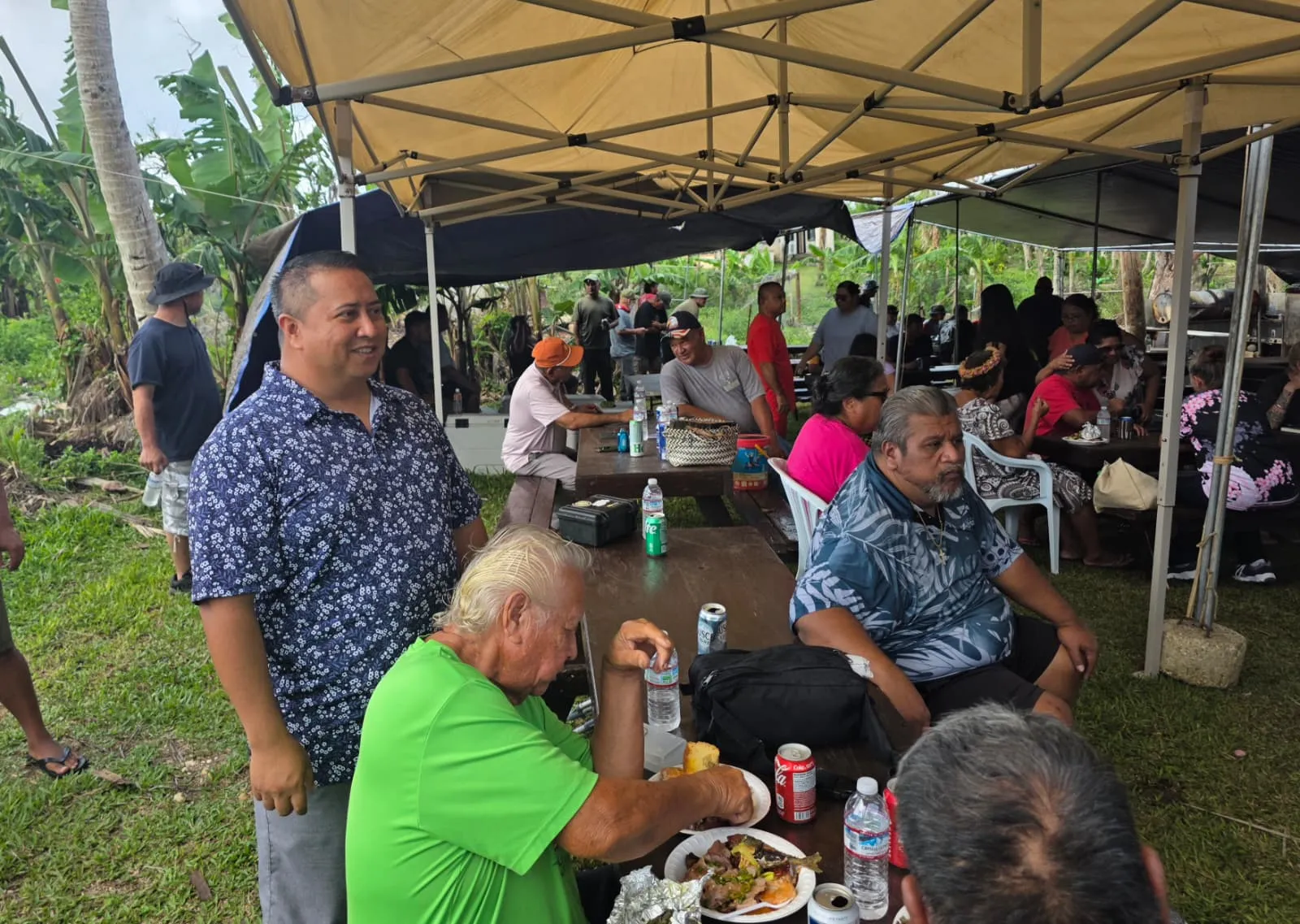


Ray B. Camacho and Bill Ada said they, like other farmers, sell their products during the Saturday market in Susupe and the Tuesday market in Garapan.
But they believe that big-time clients from off-island cannot rely on any of the individual vegetable dealers on Saipan.
Now that the off-island market is within their reach, local farmers should revisit the old idea of creating a cooperative, Camacho said.
Businessman Tony Pellegrino’s move to buy aircraft that will bring local produce to Guam is very promising, Camacho added, but farmers must also meet their commitments.
Camacho, who is also the chairman of the Saipan municipal council, said local farmers can enhance their production only if they can spend enough time on their crops.
Right now, farmers have to leave their plots for several hours every Saturday and Tuesday to sell their produce.
This, Camacho said, limits their ability to prepare for the next batch of crops.
Even those who are not part of the Sabalu association have to leave their farm which delays the cultivation of their plots, he added.
With a co-op, however, farmers can deliver their produce to the co-op center and return to their farms to till their plots again.
The co-op pays the farmers upfront and then sell the produce to local consumers and off-island buyers.
The co-op, Camacho said, should be run like any other business establishments. A businessman and not a farmer will run the co-op, he added.
Also, farmers or producers can only sell their crops to the co-op in order to avoid breaking deals with the big clients, Camacho said.
The farmers association, he said, does not have to disband or reorganize just to transform itself into a co-op.
The Sabalu group has seven board members who elect from among themselves, the president, the first and second vice presidents, the treasurer and the secretary. These officers can consult with the general membership and amend their by-laws to transform the group into a cooperative, Camacho said.
Once the co-op is formed, Camacho said the Sabalu market has to cease operation. Otherwise, he added, it will defeat the purpose of a cooperative.
Many of the Sabalu market farmers, including Pellegrino like the co-op idea, Camacho said.
The farmers support group, which is composed of the municipal council, the Sabalu group, the Division of Agriculture and Northern Marianas-College Cooperative Research Extension and Education Service, met yesterday to discuss establishing a co-op, Variety learned.
Camacho said two months ago, Gov. Benigno R. Fitial designated the former Samoa Housing in Garapan to be the farmers co-op center.
The farmers support group that will spearhead the formation of the cooperative will meet again with the Department of Public Lands to discuss the status of the facility.
While transforming their group into a cooperative, Camacho said they have to get somebody to write a grant that will fund the renovation of the former Samoa Housing.
Camacho believes that their group will grow once it becomes a co-op.
There are so many farmers out there waiting for the limited slots in Sabalu markets, he added. If they become a co-op, he said, the Sabalu market will cease to exist but any farmers can join the co-op and have a “guaranteed” market for their produce.
The co-op, Camacho said, can also create jobs and possibly come up with other programs to help its members.
It can even entice other residents to venture into agriculture and make many idle but arable lands productive, he added.
Ada said they tried to create a co-op in the past but failed. He recalled that during the Trust Territory times, there was a farmers cooperative on Saipan that went bankrupt twice because a lot of shareholders failed to pay their dues.
The main problem that hinders them from forming a new co-op is the fear that bad things will happen again, he added.
“It was the trust that was lost and is very hard to restore now,” Ada said.
He hopes the new generation of farmers have learned the lessons of the past and will be more successful this time in forming a cooperative.
