






ROME (Reuters) — The Venice Biennale’s International Art Exhibition is a space of dialogue to prepare peace and not a court of law, the foundation’s head said on Wednesday last week in a passionate speech to defend his decision to let Russia return to the event.
Moscow has been allowed to reopen its pavilion at the gardens hosting the show in the lagoon city for the first time since its 2022 invasion of Ukraine, triggering criticism from the Italian government and the European Union.
Yet, Biennale chairman Pietrangelo Buttafuoco has remained firm in his stance, despite the storm that has been raging since the move became public in early March.
“This whole world born of the French Revolution, the Enlightenment and secularism has flipped into its exact opposite: a laboratory of intolerance, and demands for censorship, closure and exclusion,” he told a news conference.
“The Biennale is not a court; it is a garden of peace. We cannot shut it down, we cannot boycott as an automatic response. We must discuss. We may disagree, and we do so forcefully,” he said.
EU pressure
Brussels has threatened to withdraw 2 million euros ($2.36 million) in funding in response to the decision, while the Italian government has deployed inspectors in Venice to look into the matter. A Biennale representative has said Russia had not been invited but had the right to participate because it owns the pavilion.
Because of EU sanctions, Moscow will only be allowed to open its space during four days of press previews. For the duration of the six-month show, visitors will have to remain outside and watch videos projected onto its external walls.
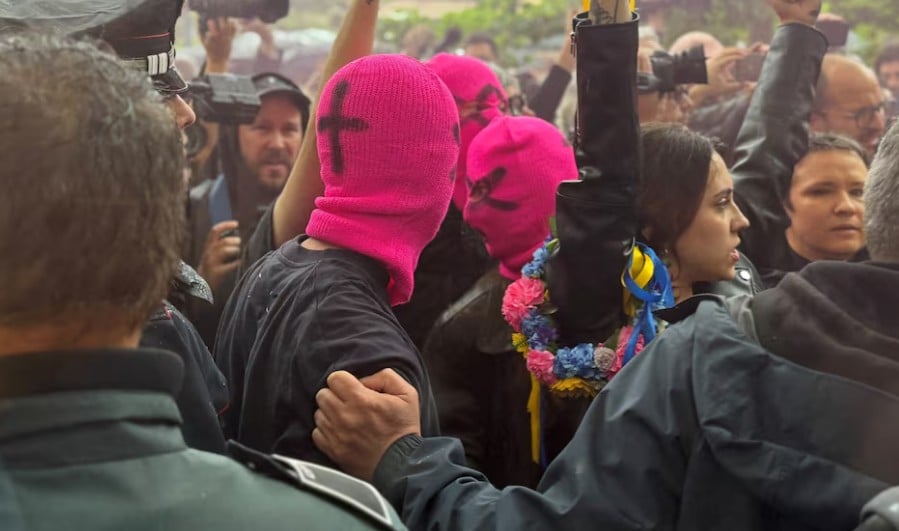
Earlier on Wednesday, feminist protest group Pussy Riot staged a demonstration in front of Russia’s sage-green building, using pink smoke flares and the colors of the Ukrainian flag.
In a comment on Facebook, the Russian ambassador to Italy Alexey Paramonov — who was in Venice for the pavilion’s inauguration — criticized the EU for what he called its “unreasonable obsession to hit Russian culture and arts.”
“Our presence at the Biennale simply bears witness to Russia’s readiness…to continue talking with Italy…through the language of culture and art,” he said.
