


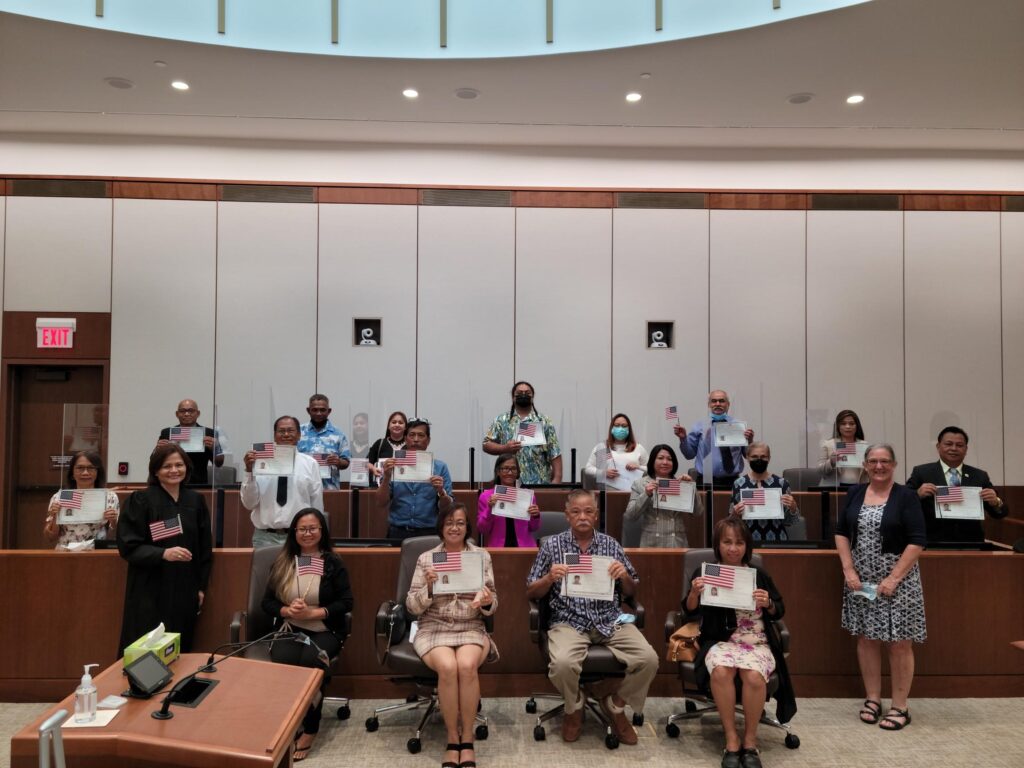
FRITZ Jacob Passi, an American Samoa national, said he applied for U.S. citizenship so he could petition a permanent resident card for his wife.
“My wife is non-U.S., and I’m a U.S. national. Our lawyer said I had to apply for U.S. citizenship in order to petition her,” he said.
American Samoa has been under the U.S. flag since the 1900s, but unlike the local people of the other U.S. territories, such as the CNMI, Guam, Puerto Rico, and the U.S. Virgin Islands, American Samoans are U.S. nationals, not U.S. citizens.
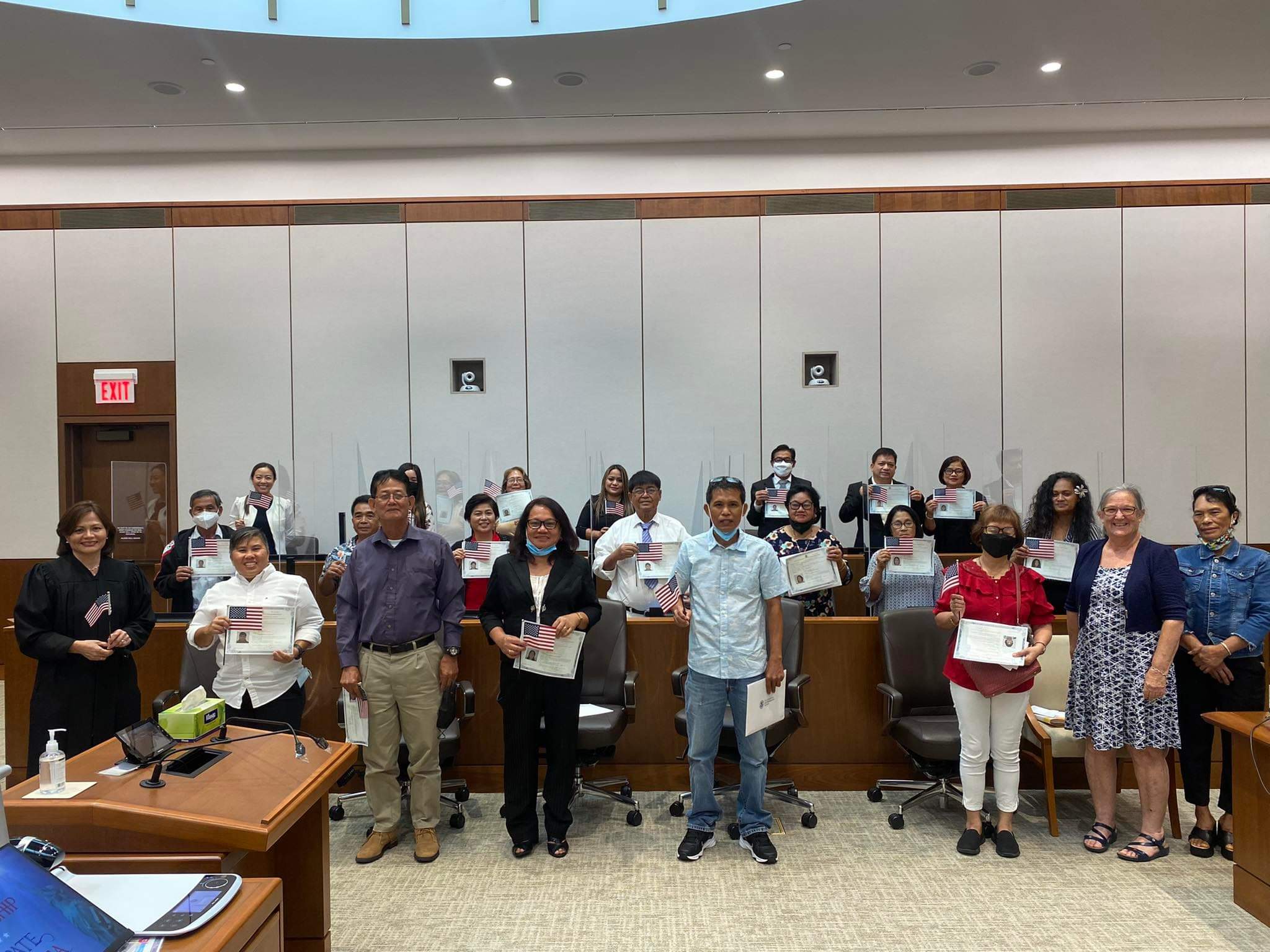
Passi was among the 18 new U.S. citizens sworn in at a naturalization ceremony at the District Court for the NMI Monday morning.
Presiding over the special session, Chief Judge Ramona V. Manglona noted she herself was not a natural-born U.S. citizen.
“I became a U.S. citizen by virtue of congressional action, which is called the Covenant to establish a Commonwealth of the Northern Mariana Islands in political union with the United States of America,” she said. “When I was born, we were not yet a Commonwealth.”
Jamerito Adona Casama, one of the new U.S. citizens, said: “I am very happy. I am now an American citizen. I have lived in Saipan for 31 years.”
For another new U.S. citizen, Maria Sarah Constantino Javier, her goal is to register as a voter and exercise her right to vote.
“I know that if I make the right choice, it will benefit not only my family but as well as the community in general,” Javier added.
Also sworn in as U.S. citizens in the morning session were Ricardo Jimenez Amog, Noime Pangelinan Babauta, Beverly Casaclang Balakrishnan, Gayline Patricia Blau, Virgilio Salum Cucal, Zenaida Mongado Cuerdo, Marivic Ballesteros Fernandez, Windy Ann Ventura Fernandez, Alberto Olea Lucido, Maria Concepcion Capangpangan Mettao, Reynaldo Gonza Moreno, Edgardp Trajano Oliva, Josefino Zamoranos Tadifa Jr., Rafaela Baruela Tadifa, and Adelaida Espiritu Toribio.
Afternoon session
In the afternoon, 19 new U.S. citizens were sworn including Ann Janine Romero Agulto, Marilyn Cubillan Aquino, Santiago Tulio Concepcion, Evelyn Baldoza Cuadra, Pacifico Ramilo Dimapilis, Elenita Cabatian Ebrado, Leo Atienza Espinosa, Susana Quiming Espinosa, Arnel Espinosa Garamonte, Romeo Juan Hernane, Hyun Jae Lee, Gemma Ricafort Lucido, Joselito Montes Lucido, Leticia Narito Mateo, Henrietta Diocera Pangelinan, Josephine Tapi Pialur, Gloria Cajucom Ramos, Eliseo Asuncion Valdez, and Christy Palmos Villaflor.
Patricia Phelan, U.S. Citizenship and Immigration Services officer, made the motion in court to accept the applicants as new citizens.
CNMI Supreme Court legal counsel Hyun Jae Lee, a newly sworn in U.S. citizen, was invited by Judge Manglona to address her fellow citizens as guest speaker.
“My family emigrated to Saipan in the early 1990s,” Lee said. “That’s before the invention of the mainstream internet, before the roads were paved and before we had traffic lights.”
She said she was 7 years old at the time. “When you’re so young and you are put in an unfamiliar land, it kind of becomes a shock. I have a very, very difficult time learning English….”
“I remember one time when I was in second grade, and one of my classmates told me that my food was stinky,” Lee said. “Your kimchee stinks,” she remembered her classmate saying.
Another time, she said, “my sister got into a fist fight with a boy classmate because he told my sister to go back to her home country.”
“When you are really young those words cut deep and are hurtful,” Lee said. “I really felt like I didn’t belong, but I liked to think of myself as a fighter and to commit myself and prove them wrong. I would make friends with every person in this classroom however different they might seem. So, I tried, and I think it really paid off because I really became friends with different people in my classroom, and I think they liked me because by the time I was in 11th grade they voted me as vice class president, and in senior year as president.”
Lee said she went to college in Atlanta, Georgia.
“I don’t know, but back then it was one of the most segregated cities in the United States. I was really a foreigner. I had a student visa and I looked very different, but with the same fire in me I challenged myself again, and intentionally [injected] myself into different groups of people to learn about them and hopefully they could learn about me. I joined the steps team. For those who don’t know, it’s like a dance group that was predominantly African Americans. I was the lone non-black person there and we won homecoming in college. I also joined an acoustic guitar band, composed of Caucasian males, and I was the only female there…and I just met a lot of people from different backgrounds, and they were really wonderful. And I realized there’s more good people out there than bad, and there’s more similarities that we all shared rather than our differences, but it did not come easy. I did face some obstacles along the way. I was called different names in a very ethnic slur, in the middle of the road, randomly by different people. My sister and I are called piece of rice, just by random people. They stereotyped me, into like Asian person doing this kind of work, in a very derogatory way. By that time, it was no longer deeply piercing to me because I realized that hate, a lot of times, was based on fear, and fear is really based on the unknown or ignorance. So those words, however annoying, were not hurtful,” she said.
According to Lee, she became an American “because legally, metaphorically, symbolically or literally, I have found a place where I belong…. America is known as a melting pot because everybody is different, we come together, we assimilate together as different cultures, and we become a stronger unit.”
Lee added, “We might have different journeys, but now we are in the same place.”
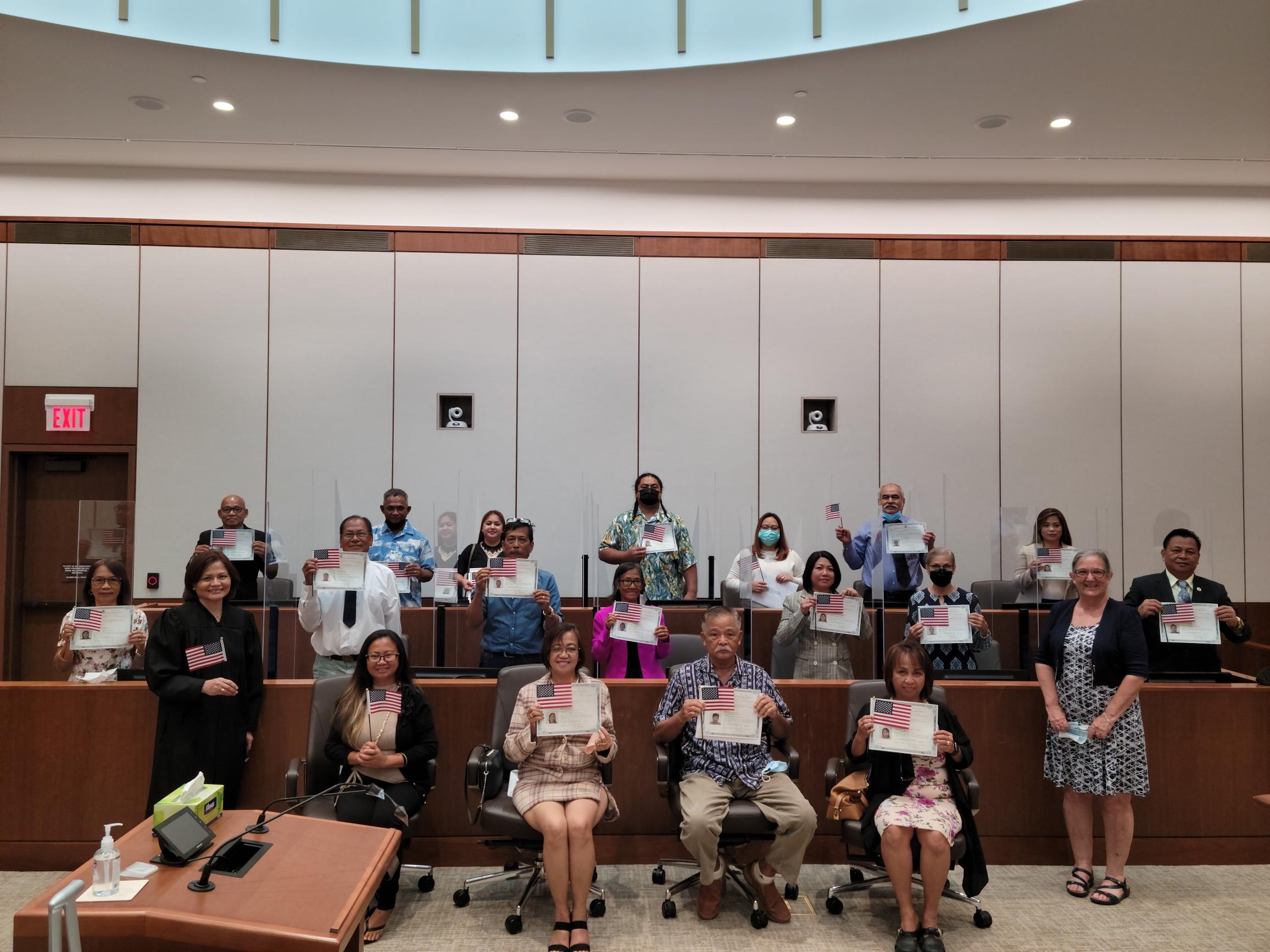
District Court for the NMI Chief Judge Ramona V. Manglona and Patricia Phelan, U.S. Citizenship and Immigrations Services officer, pose for a photo with the newly sworn in U.S. citizens at the U.S. courthouse Monday.