






A SPECIAL CNMI Drug Court session presided by Judge Teresa Kim-Tenorio at the Hibiscus Hall of Crown Plaza Resort on Thursday recognized six individuals who have maintained sobriety and fulfilled program conditions without violations.
They are Carrie Jane Ada, Gorjonny Camacho, Sonny Vicente Camacho, In Jun Cho, Diego Pinaula and Jashlie Reyes.
The six were each given an opportunity to address the drug court.
Ada, who has already obtained a high school diploma through the Northern Marianas College-Adult Basic Education program and is gainfully employed at Hyatt Regency Saipan, said she wants to “grow” professionally at her workplace.
She thanked Dolores B. Sablan, her case worker, “for guiding me out of my comfort zone, which led me to a whole new place that is life changing. I am now able to take responsibility and at the same time maintain my sobriety.”
Gorjonny Camacho has completed the core classes of the Northern Marianas Technical Institute’s electrical program and is gainfully employed at Lucky Bill Restaurant.
He aspires to give back to the community.
“Being in the Drug Court program changed my life,” he said. “It gave me the strength to overcome my addiction, it taught me ways to control my emotions, thoughts and triggers. It made me regain focus on the important things in life,” he added.
Sonny Vicente Camacho, the owner of Sunny’s Nursery, aspires to be a better husband, father and grandfather.
“I thank you Judge Kim-Tenorio for accepting me into this program, and giving me another chance to make things right,” he said.
In Jun Cho, for his part, is gainfully employed at Dong Boo Corporation and plans to take over the family business in the near future.
“It was not easy for me…but through this program…I’ve made it through all the way to graduation with the help of everyone,” he said.
To his fellow graduates, Cho said, “Keep doing what you’ve been doing to bring yourself to the point where you are at now and continue to set goals and reach them. Don’t let the Drug Court graduation be your last accomplishment. Push yourself to achieve more.”
Diego Pinaula has also obtained his high school diploma through NMC-ABE, and is gainfully employed at AA Enterprises Inc.
He aspires to be a merchant marine.
“I am thankful to all the people here today,” he said. “I am sober today. I used methamphetamine only for a short time but during that time I made poor decisions that I still regret…. I struggled when I started the program, but my determination to continue to remain motivated me. I now know how to recognize red flags, and how to stay away from dangerous drugs,” Pinaula said.
Jashlie Reyes, who aspires to obtain a bachelor’s degree in social work, is currently employed at the Commonwealth Healthcare Corp. as program assistant for the Pregnancy Risk Assessment Monitoring System.
“Since the time I was accepted to [the Drug Court] program my life has changed tremendously,” she said. “I’ve seen first-hand how the program helps individuals gain sobriety and return to society as a reliable and independent person. Judge Kim-Tenorio asked us three things during our change of plea hearing: to be honest, to show up and to try. Every day was a struggle, some days were harder than others. But being honest and accepting reality was the first step towards change. Showing up every day and keeping my head up was the next, and trying every day to pull myself together was the last. One of the greatest things I learned during treatment was to be smart, not strong. Being strong is not the key, but making smart decisions and choices and being honest with myself. Thinking of the future, the consequences, the rewards, is what helped me move forward in life.”
For her part, Judge Kim-Tenorio said the Drug Court program has an 83% success rate, “even with some relapse from some of the participants in the past. Eighty-three percent of our graduates are doing well; have not been rearrested. They are either working or in school.”
The local Drug Court program was created in December 2016 as a “collaborative, non-adversarial system to affect the rehabilitation and recovery of drug offenders through continuous court monitoring, regular drug testing, and holistic treatment for drug dependency.”
According to Judge Kim-Tenorio, when the Drug Court started it was new for everyone. “We were like infants, and I feel now that we are more like in our preteens,” she said in jest.
“We continue to learn, we continue to improve, we continue to see where we fall short, and we embrace that. We learn from it. We continue to train ourselves and our partners, we continue to reach out and educate the community about what treatment court is.”
The Drug Court’s stakeholders include the HOPE recovery center, the Community Guidance Center, the Commonwealth Healthcare Corporation, the Department of Corrections, the Department of Public Safety, the Department of Labor, the Office of the Attorney General and the Public Defender’s office.
“In treatment court in general, I wish we would have more psychiatrists, psychologists, social workers, counselors and addiction specialists in the CNMI,” Judge Kim-Tenorio said.
“At one time there was a focus to have more teachers. Scholarships for students who were going to be teachers was successful. Then it was for nurses, and it was successful too, and now I hope that we would shift our focus to mental health,” she added.
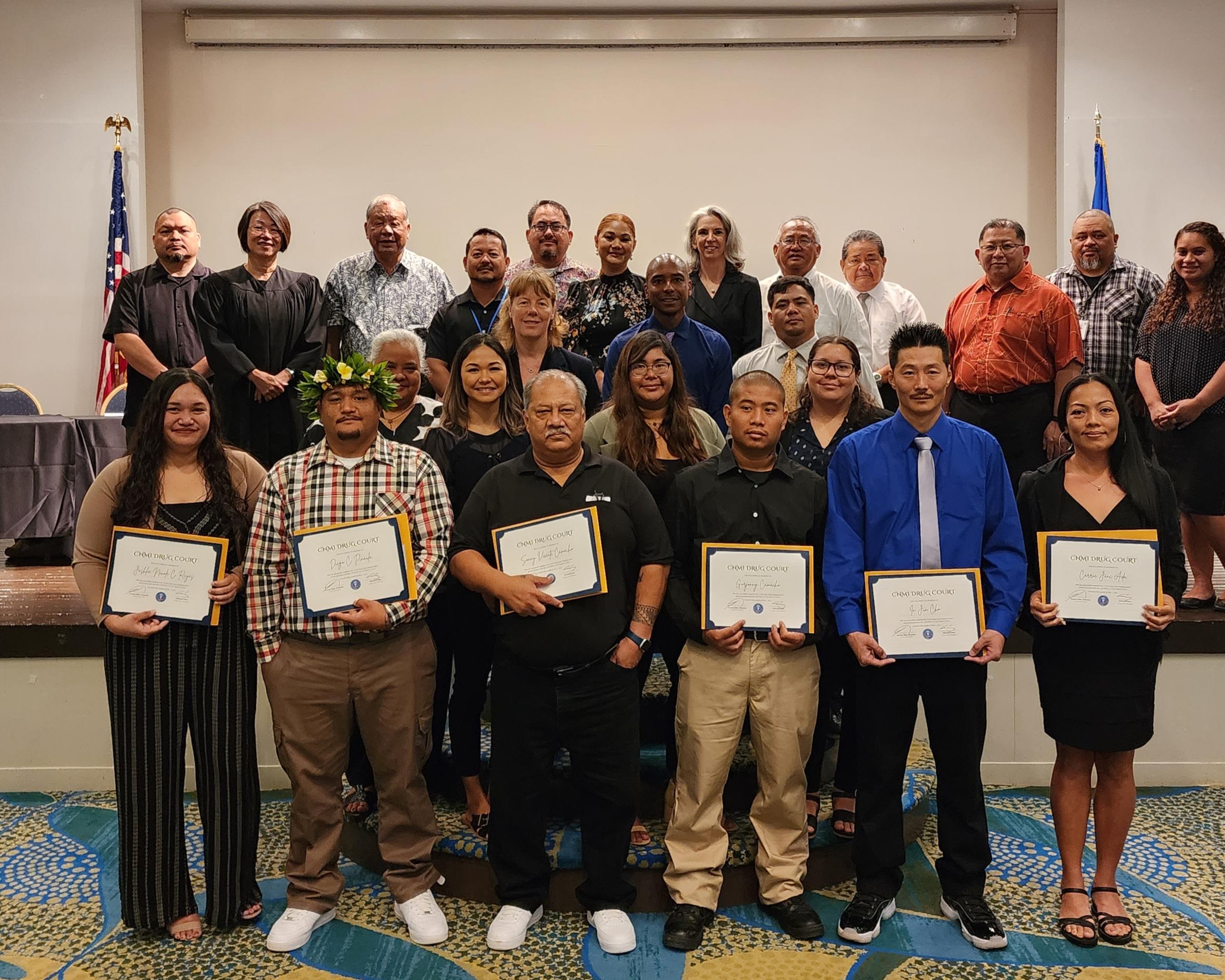
The six individuals who completed the Drug Court program pose for a photo with acting Gov. David M. Apatang, Chief Justice Alexandro Castro, judges, lawmakers, other government officials and stakeholders.
