






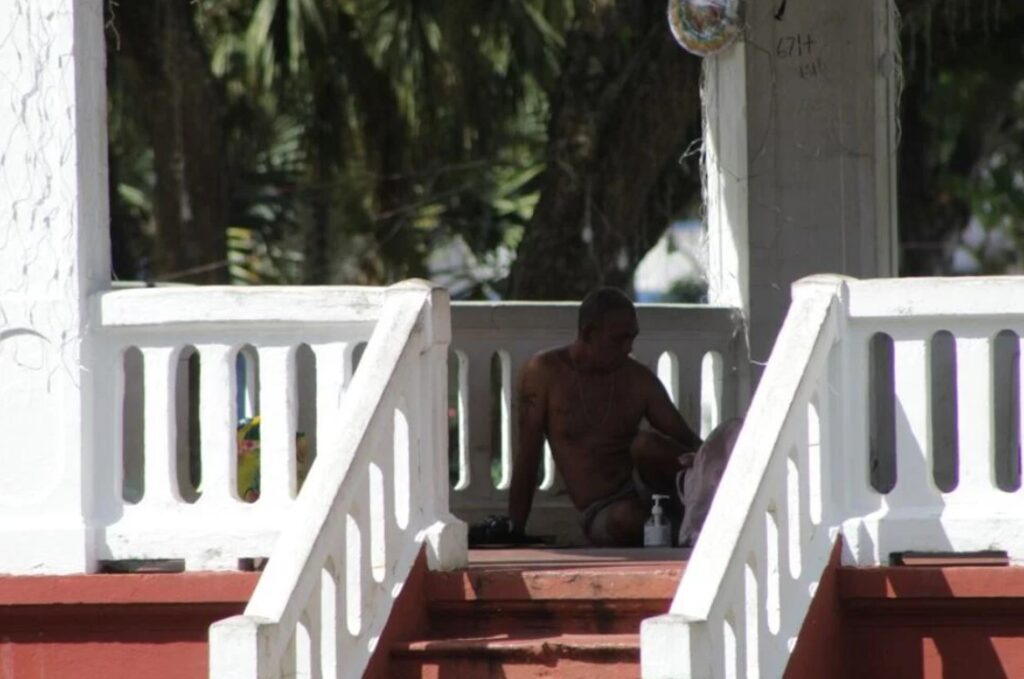
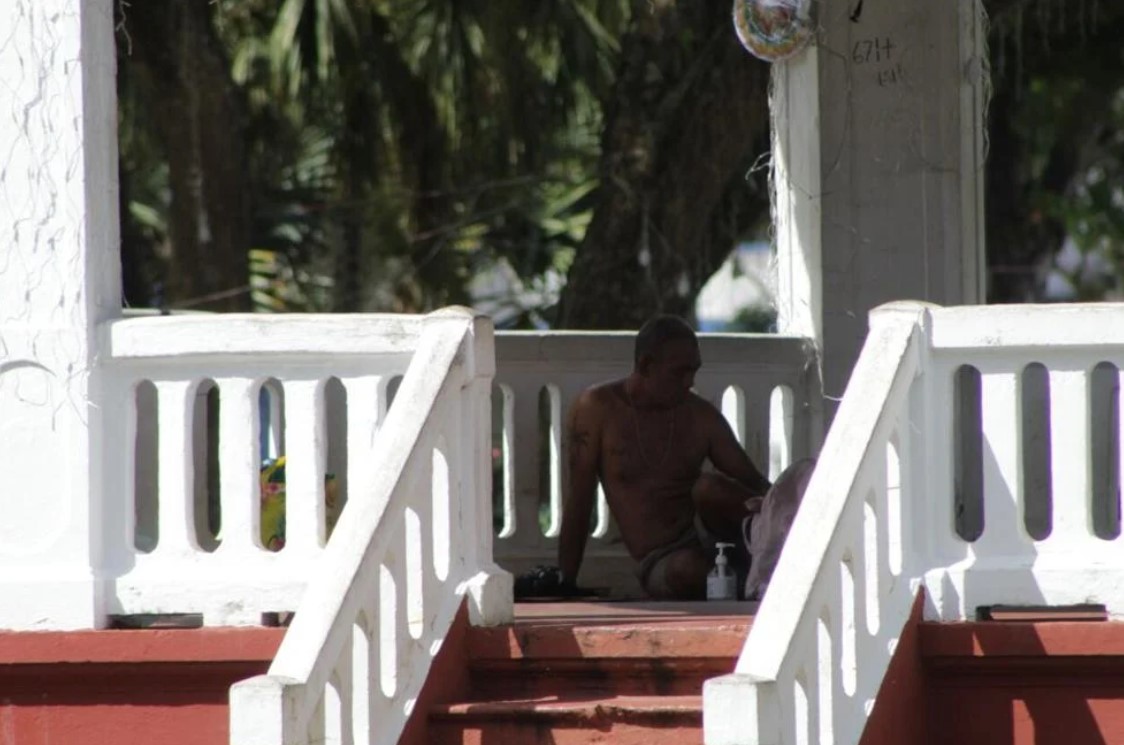
A homeless man sits under a concrete pavilion in Hagåtña on Jan. 23, 2023. Attorney General Douglas Moylan touched on a number of topics, including problems mayors encounter with homeless people, during a council meeting Wednesday, Feb. 15, 2023.
HAGÅTÑA (The Guam Daily Post) — Guam is “enduring an immigration problem” right now, according to Attorney General Douglas Moylan, who spoke before the Mayors’ Council of Guam during a special monthly meeting Wednesday.
“When I went out on the election these past few months, I think, collectively, every mayor is having an issue with the immigrants that have been allowed into our island,” Moylan said, referring to migrants who are able to travel and stay on Guam under the Compacts of Free Association or COFA.
“The immigrants are having a problem because they’re not following our laws, obviously. But, I see that alcohol abuse. And now we’ve got (methamphetamine), because it’s gone so low in the price. In the court system, we wouldn’t see, normally, a meth case dealing with a non-U.S. citizen, a local, here. Now, you’re seeing the actual (Federated States of Micronesia) immigrants being able to afford meth,” Moylan added at the onset of a discussion that would touch on a number of issues on island.
Citizens of the FSM, the Republic of Palau and the Republic of the Marshall Islands can live and work in the United States under agreements between those nations and the U.S.
The impacts of these agreements on Guam’s education, health and legal infrastructures, and whether the island is being properly compensated by the federal government for hosting migrant communities, have been significant long-term concerns for local leaders.
Deportation
Among Moylan’s priorities is the deportation of COFA migrants who commit crimes, which is already mandated under Guam law.
The attorney general wrote a letter to Guam’s delegate to the U.S. Congress over the weekend, following the conclusion of compact negotiations between the U.S. and the FSM, to request a copy of the draft compact treaty and information on how FSM citizens can be deported from Guam if they are found guilty of crimes.
On Wednesday, as he was discussing homelessness and other issues, Moylan also told the mayors that FSM migrants are lacking education about coming to Guam and that he plans to begin talking specifically to that community.
“The Palau community is better. We all know that Palauans, they don’t have as much problems, mainly because of education,” Moylan said. “They educate their people, then they migrate. FSM has a high incidence that they don’t have education for those people that are coming to Guam. That’s why we’re having, in my opinion, a lot of the problems. They’re just more prone to be addicted to substances, not be able to get a job and so forth … There’s usually a woman in charge of that household, … If we can get them to pull their family members together with the understanding that they’re going to get deported if they keep it up with their criminality.”
Mongmong-Toto-Maite Mayor Rudy Paco said he believed, with regard to the migrant issue, that the problem lay with screening at the airport.
“According to the compact-impact agreement, it’s education, employment or medical (reasons). I think if they don’t have the proper documents, then they shouldn’t be here. Even when we travel, they ask us where we’re going to stay. They ask us for how long. Is the immigration following up on all these people that are coming into our island?” Paco said.
Moylan made note of the mayor’s question, adding that he learned about a week ago of requirements for migrants under the current compact treaty.
“I just spoke with the governor on that and she’s the one that mentioned that to me, that under the current treaty, before they come to Guam, they have to have a place of employment or proof they have a job waiting. And then, also if there’s a financial, they can’t be going into the welfare system…. What you’re saying is, can the AG’s office communicate, probably with (the U.S. Department of) Homeland Security, to find out how they’re vetting those people?” Moylan said.
The AG has assigned Assistant Attorney General Thomas Keeler to the deportation issue, and said Wednesday that he would raise Paco’s point to Keeler.
Homelessness and public intoxication
Wednesday’s discussion on migrant concerns was interspersed within general talk on initiatives to address homelessness, loitering and public intoxication.
Moylan told mayors Wednesday that he is trying to work a connection with the Guam Police Department to address concerns with people gathering and drinking at community centers and other public areas.
“They will go react to your concern about these people that are drinking there and then warn them there’s a law about public intoxication and to clear out, go home, or they’re going to get arrested and we will prosecute them,” Moylan said, adding that it would be up to the mayors to call in gatherings they may be concerned about.
Moylan also said he is working with GPD, the governor and the lieutenant governor to address panhandlers at road intersections.
“On one hand, we’re a compassionate island. On the other hand, you kind of wonder if it’s a gimmick that these guys are pulling, asking for money when they don’t really need it. But, the bottom line from the public safety point of view is it’s going to cause an accident…. Plus, it’s trespassing because it’s on government property,” Moylan said.
Regarding the homeless encampments on Guam, Moylan said investigators have been going out to photograph and speak to homeless individuals living at the encampments, as potential plans are formulated for relocation.
“This is a bad look for Guam, … But the humanity of it, too, the idea that why are these homeless encampments starting on Guam?” Moylan said. “There’s about three that we’re looking at right now along with the governor’s office, because there’s…different government agencies that are going to be involved in our approach. And, it’s within this week that we’re starting to look at a possible plan on having them relocated.”
Meth addiction, substance abuse and mental health issues are concerns with this population, so the proper agencies have to be involved, he added.
Moylan said the OAG could “do it the hard way” and hit encampments with trespass or public nuisance complaints, but said that is not the attitude the office wants to take, unless “forced to take it.”
Moylan also told mayors to immediately call Child Protective Services if they see children at encampments “because they will be taken away from their parents, because you can’t have children being in the open environment.” However, Moylan quickly acknowledged that would be a “very violent” way to break up the family.
The attorney general also asked mayors to inform the Office of the Attorney General if homeless people are arriving from Hawaii.
“Because we played that game with them before and I think we were sending them back to Hawaii with a plane ticket…. We (have) got to be careful about Guam being used as a dumping ground,” he said.
