




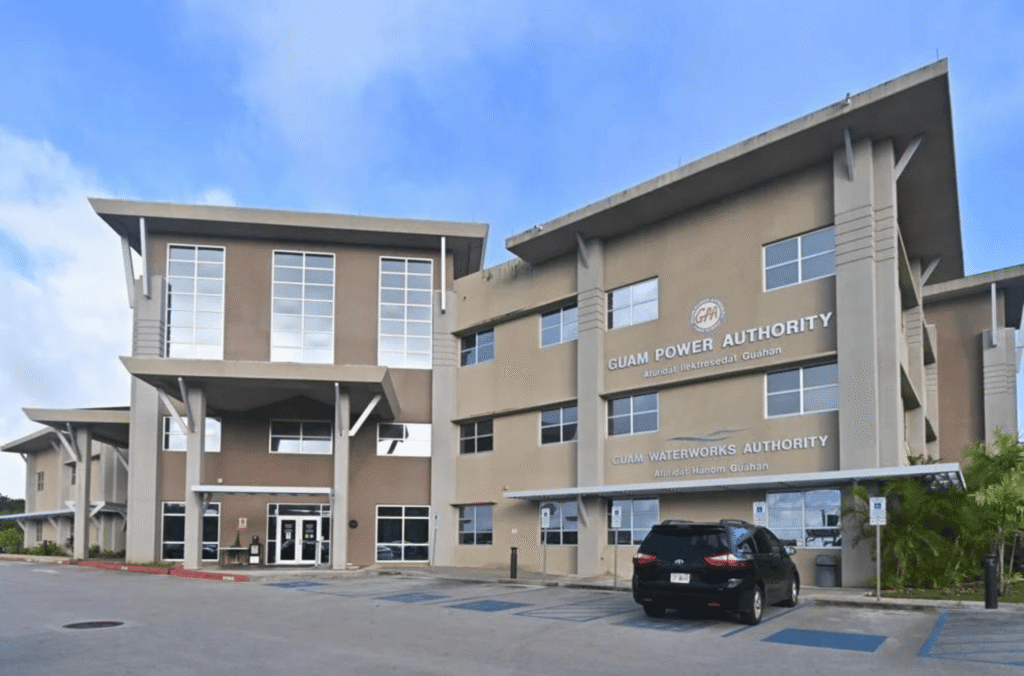
HAGÅTÑA (The Guam Daily Post) — Attorney General Douglas Moylan is proposing legislation that would abolish the elected Consolidated Commission on Utilities, the governing board behind the Guam Power Authority and Guam Waterworks Authority, and instead authorize the governor to appoint a board of directors to oversee the utility agencies.
Moylan, who has called the CCU “ineffective,” and who has pushed for hearings to eliminate the commission, stated that absent an amendment to the Organic Act of Guam, the governor is “directly” responsible for the “proper” function of GPA and GWA, and not a part-time CCU. He has also submitted a legal opinion essentially stating that an elected CCU infringes on the governor’s authority.
“With the recent collapse of reliable power by GPA that will plague our people for more than a year now with ‘load shedding,’ the question of responsibility for this function directly affects each one of our welfare. The CCU’s failure has exposed our government/taxpayers not only to the inconveniences associated with no power, but to damages from constant electrical energizing of our homes and businesses. Lack of reliable power also directly endangers critical services that include health care, public safety and education,” Moylan stated.
“Moreover, the failure of GWA to provide reliable water service during times of emergency (and in conjunction with the CCU’s power ‘load shedding’), despite taxpayer funds having been invested into water well generators, likewise raises proper management legal issues,” the attorney general added.
The proposal is not intended to eliminate the Public Utilities Commission, the rate-setting body on Guam whose members are appointed by the governor.
Moylan’s statements were addressed to Sen. William Parkinson, who oversees the power utility. Parkinson told The Guam Daily Post that, while he is not sold on handing power over the utilities to the governor, he believes there needs to be a community conversation “on how we want to move forward with the management and leadership direction of our critical utility services.”
“I firmly believe that the strength and wisdom of our community can guide us toward a more just and effective approach to utility governance. The abolition of the Guam Consolidated Commission on Utilities through a voter referendum will let us shape a future where our institutions are stronger and more resilient,” Parkinson said.
The senator said the CCU was established with the “commendable” intention of providing regulatory oversight to utility agencies, but added that, over time, “we have witnessed a series of issues” that suggest a need for reform.
“It is our responsibility as engaged citizens to reassess and recalibrate our institutions to ensure they serve our community’s best interests,” Parkinson added.
The CCU was established in 2002 through Public Law 26-76.
The commission and the utilities have had to face some significant challenges in recent years. The Cabras 3 and 4 power plant suffered a catastrophic explosion in late 2015, taking out about 80 megawatts of capacity and plunging the island into rotating outages for a time. Additional generation – temporary at the time – was brought into Guam some months later to help stabilize the power grid, but the CCU and GPA already were looking at procuring new generation before the explosion, as part of efforts to become compliant with federal emissions regulations.
After several years of preparation and some controversy over the decision to build another fossil fuel power plant, a 25-year energy conversion agreement was finally signed in November 2019, between GPA and a consortium involving the Korea Electric Power Corp.
Touted to help mitigate rate increases through fuel efficiency and the ability to facilitate more renewable energy integration, the planned 198-megawatt power plant broke ground in Ukudu, Dededo, in 2022. The plant is also a major project in GPA’s consent decree with the U.S. Environmental Protection Agency regarding compliance with emissions regulations.
Destined to be the next main power source for Guam, the Ukudu plant was scheduled to come online by April 2024, but damage to storage tanks caused by Typhoon Mawar pushed back commissioning to January 2026.
Guam has been dealing with instances of load shedding in the wake of the typhoon as aged generators trip offline from time to time. However, GPA is now working to procure additional temporary power to augment the capacity on Guam, following approval from the CCU in late September.
GWA has been working to complete court-ordered projects and other capital improvement projects, which has resulted in rate increases over the years. The water utility also is nearing the end of negotiations with the U.S. Environmental Protection Agency for a consent decree related to GWA’s compliance with the Clean Water Act.
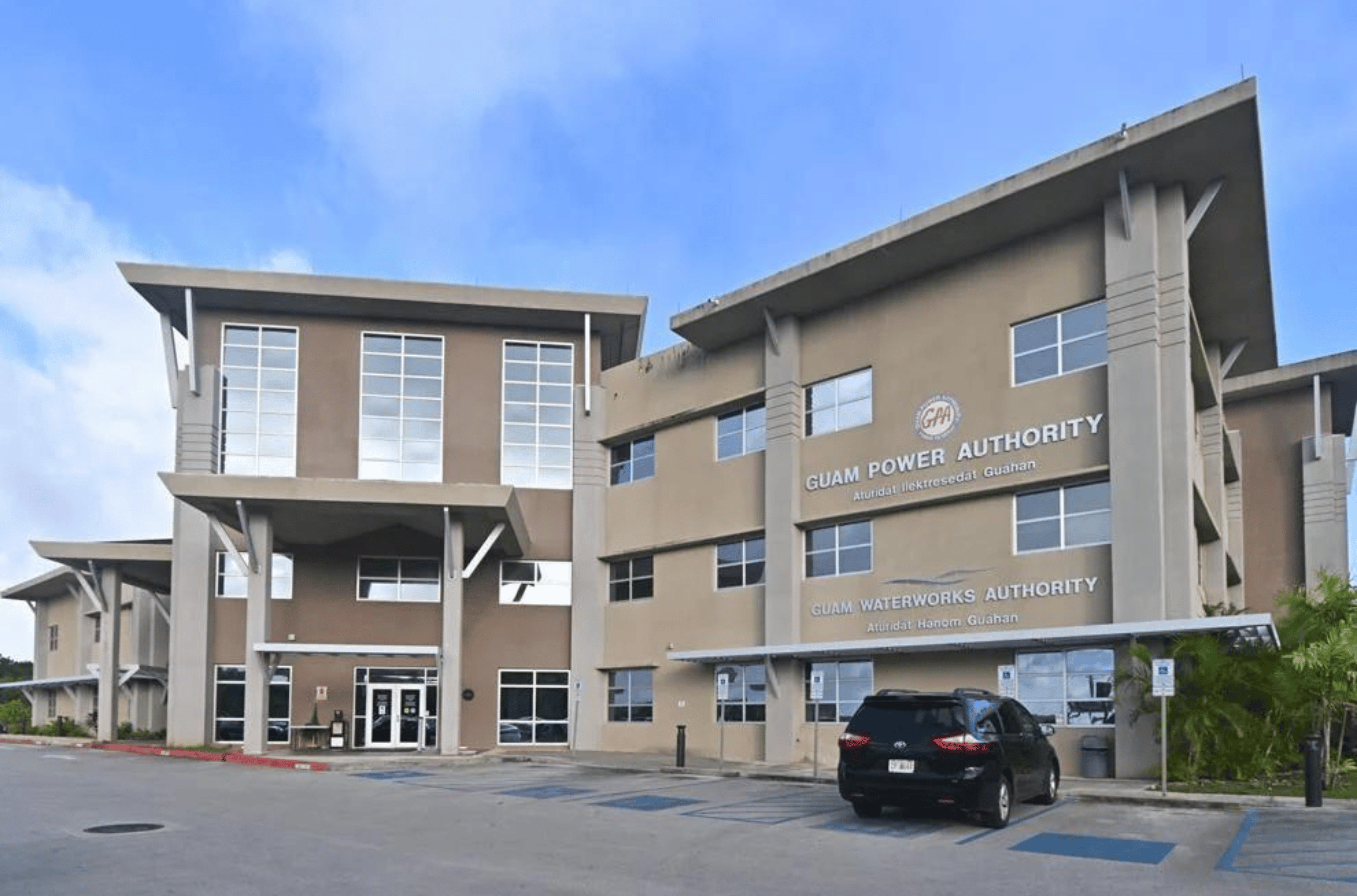
The Gloria B. Nelson Public Service Building is seen Tuesday, April 25, 2023, in Mangilao.
