





THE House of Representatives on Wednesday received from the Commonwealth Ports Authority and the Office of the Public Auditor their respective comments on House Bill 22-102, which would exempt public corporations and autonomous agencies from the 1% public auditor’s fee.
CPA supports the bill; OPA opposes it.
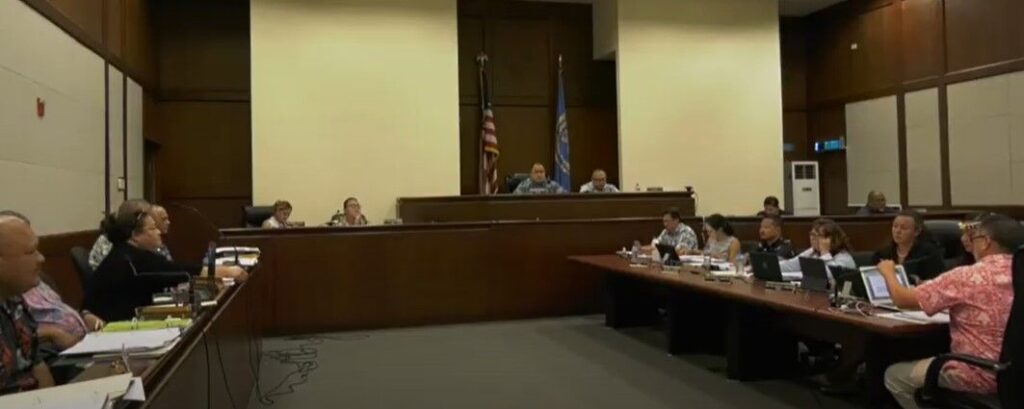
Before Speaker Edmund S. Villagomez introduced the bill during the House session at the Rota Courthouse in Sinapalo II at 10:30 a.m., House members listened to what CPA board member Pete P. Reyes had to say about the measure while Rep. Sheila Babauta read the written comment submitted by Public Auditor Kina B. Peter.
The speaker referred H.B. 22-102 to the House Ways and Means Committee and “because of time sensitivity,” he gave the committee a two-week deadline to act on the measure.
The bill proposes to amend Public Law 3-91 or the Commonwealth Auditing Act, striking out from the law the provision that requires public corporations and autonomous agencies to pay 1% of their respective budgets to the general fund for OPA.
CPA at risk of losing federal funds
In his oral testimony, Reyes, who chairs the CPA board’s Seaport Committee, said that as early as September 2015, CPA had been raising concerns about the “inequity” imposed on the agency which is independently audited.
CPA and the Commonwealth Utilities Corp. have not been paying the 1% OPA fee.
Reyes reminded the House that CNMI ports “heavily rely on federal funds in order to operate.”
Federal grant requirements prohibit CPA from paying more than the value of services it receives, he said.
Requiring CPA to pay the 1% fee would violate grant requirements.
Without federal grants, “the people of the CNMI will be faced with the very real possibility that their airports will be closed and unable to operate,” Reyes said.
He said airports and seaports are the gateways to economic development in any jurisdiction. “That is why the passage of the bill is critical,” he added.
Reyes provided each House member a copy of a letter from the Federal Aviation Administration, which stated that the public auditor’s fee would be considered “revenue diversion.”
The FAA reminded CPA that airport revenues must be used for the operation, maintenance and capital improvements of the airport, Reyes said.
“The bill is fair,” he added. “It provides OPA a path forward by allowing it to charge a reasonable fee for services actually rendered. Should OPA one day provide services to CPA, CPA would gladly pay OPA the reasonable value of the service.”
Charlene Manglona, Rota ports manager, said the island has very limited resources, and its ports are in dire need of and are dependent on federal funds.
She asked the House to “please pass the bill.”
She added, “Our airport depends on federal funds, and our people depend on the airport. We know we cannot depend on the local government for funding.”
OPA’s concerns
Rep. Sheila Babauta then read the public auditor’s letter.
“It is with disappointment that I make written comments instead of appearing personally before this legislative body,” Public Auditor Kina B. Peter said.
“Unfortunately, the Office of the Public Auditor received no notice of this important legislation appearing on the agenda in Rota.”
She said travel arrangements to Rota were impossible at this late hour, so she hoped her letter “will adequately communicate the importance of your full attention to the underlying issues raised in H.B. 22-102.”
She said, to date, the estimated past due amounts from all autonomous agencies total approximately $40 million.
CUC alone, she added, makes up about $20 million of the total amount due.
The outstanding balance does not go to OPA’s account, she said; it goes to the general fund and is available for appropriation by the House.
For example, she said, the $20 million that CUC owes the general fund could be used as offset for the CNMI government’s utility bills.
Peter urged the House members to consider the future financial situation of the CNMI and how much of a difference $40 million could make to the general fund.
She also reminded lawmakers that OPA is a statutorily designated independent agency of the Commonwealth government.
In order to remain independent and free from political interference through the appropriations process, the CNMI created a funding mechanism to ensure that OPA’s budgetary needs are met.
The law requires that OPA be funded by 1% of all locally generated funds.
However, in reality, OPA’s funding from 1% of allotments of public corporations and autonomous agencies “has been at risk because nearly all such agencies regularly ignore the law of the Commonwealth,” she said.
Peter said H.B. 22-102, as written, “rewards these public entities’ disregard of the law, forgives a massive debt owed to the CNMI government general fund, and will impact the ability of OPA to function independently as required by law.”
As a direct result of autonomous agencies’ failure to pay their annual share of the required 1% funding to OPA, Peter said the agency has faced significant downsizing.
From five audit managers in 2004, OPA only has one currently, she added.
There used to be 14 audit staff members, two attorneys and five investigators, but today, OPA has only seven audit staffers, one attorney and four investigators.
She said H.B. 22-102 would not hold the autonomous agencies and public corporations accountable for their non-compliance and it would directly threaten OPA’s ability to fulfill its constitutional and legislative mandates.
Peter said OPA is requesting the House to consider potential consequences of waiving this debt and reducing its budget.
She noted that the CNMI government has been receiving an “unprecedented amount” of federal money — referring to Covid-19 relief funds — and the demands for OPA’s services have never been higher.
“We will not be able to adequately meet our mandate of detecting fraud, waste, and abuse of funds if we have to reduce our budget,” Peter said.
Peter submitted her resignation to Gov. Ralph DLG Torres on May 12 and it will take effect on July 8, 2022. She said she has decided “to pursue another job opportunity.”
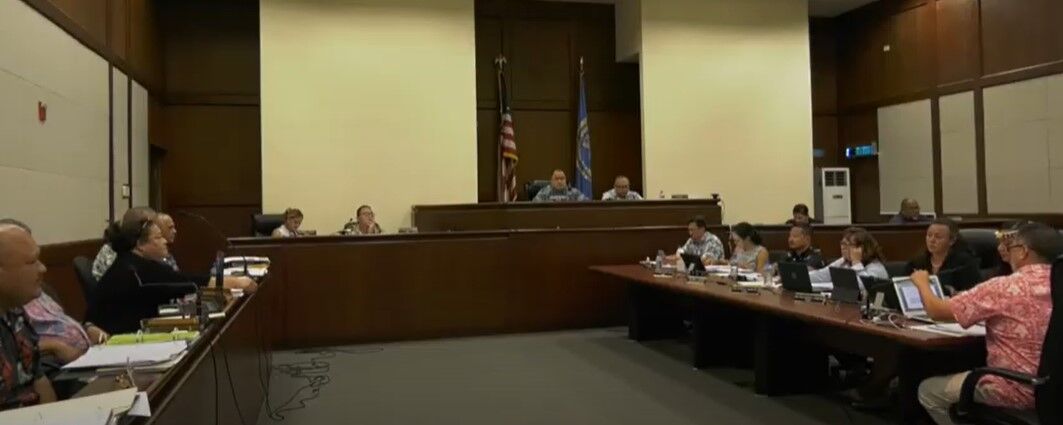
The House of Representatives holds a session at the Rota courthouse on Wednesday.
