






HAGÅTÑA (The Guam Daily Post) — With an average of 75 children per social worker at the case management unit within Child Protective Services at the Department of Public Health and Social Services, the caseloads for these workers sum up to be about two to three times more than the average for child welfare workers in the U.S., and five times more than what’s recommended by the Child Welfare League of America.
According to Patricia Mafnas, the acting human services program administrator at the Bureau of Social Services Administration, there are currently eight social workers in the case management unit, and with CWLA recommending that caseloads not exceed 15 children per social worker, the unit will need 40 social workers in total to achieve that standard.
But Guam isn’t alone in needing more social workers. Mafnas said Monday, during an information briefing on the recruitment of foster parents hosted by the legislative committee on health, that social workers are in short supply nationwide. A child welfare worker in the U.S. averages a caseload of between 24 and 31 children, according to Mafnas.
BOSSA is working to recruit 15 social workers, including two social services supervisors for its intake and case management units, and 14 community program aides to assist with shelters.
“Of course, I’d like to get to see CPS get to its recommended number of caseloads, and I feel like the court would probably love that too so that they can get the permanency plans or whatever other investigations before them sooner. We’ll continue to work on that together. I know that was the sole subject of one of the oversight hearings we had, was the recruitment of social workers. And it is a shortage everywhere, but we really have to work on it,” Speaker Therese Terlaje, chair of the health of committee, said Monday.
The legislative committee on health called for the information briefing in light of the island’s increasing need for foster homes.
Last month, the speaker called on the governor’s office to declare a state of emergency for CPS, noting at the time that more than 600 children were under the custody of child protective services and more than 2,000 were the subject of CPS referrals. Terlaje said she confirmed that CPS was still severely understaffed, while it was becoming increasingly more difficult to find foster homes for children.
Shortly after Monday’s hearing began, the speaker said 667 children were reported to be under CPS custody, while there were 73 licensed foster homes on Guam. She said she believed that data was based on 2023 numbers.
“There were, I think 50 (children) at that time staying at different shelters, and 2,211 children (the) subject of CPS referrals, meaning these are pending investigation or pending placement. … That’s of course an alarming number based on the number of foster homes we have. So, if we need to find homes for any number of those, and we are maxed out already, I have described it as a crisis. I think it’s a crisis and I think we should treat it as one,” Terlaje said Monday.
Mafnas provided some updated numbers to The Guam Daily Post in an article published before the hearing. She said 750 children are under CPS custody, many of whom are kept with their extended families, while there are 90 foster homes currently.
However, Mafnas also told the Post that not every child under CPS can be placed with family members and Guam does need more foster homes. If a child can’t be placed with a family member or foster home, there is the shelter, Mafnas said.
At Monday’s hearing, Mafnas stated that 34 children are currently at the I Guma Mina’ase Sister Brigid Foster Home, the youngest of which is one year old for the boys and three years old for the girls. Another 16 children are found in other shelters, she added.
According to Pamela Brewster, supervisor for home evaluation and placement services, the goal of foster care is to return a child to their parents or primary caretaker once they’ve stabilized. If parents cannot provide a safe home within a reasonable time, a permanent home may be sought with relatives or individuals who have become that child’s family through adoption or guardianship, Brewster said. Adding that in some cases, children remain in long-term foster care until they reach 18 years old.
Married couples, domestic partners and single persons, including single parents, can apply to become foster parents. Applicants also need to be at least 18 years old, residents of Guam, U.S. citizens or permanent resident aliens, pass background checks, possess reasonable steady and sufficient income to maintain an adequate living standard, be in good physical health and the home must comply with acceptable standards of housing and sanitation requirements.
DPHSS outreach efforts for foster family recruitment include talk radio, engagement with faith-based organizations, public bulletin boards, and a potential future memorandum of understanding with the Guam Economic Development Agency for a media outreach campaign.
Harvest House is a faith-based nonprofit foster care organization in Guam, and its executive director, Bethany Taylor, said Monday that 22 foster families were recruited last year through Harvest House informational meetings held once a month with CPS.
Jared Baldwin, executive pastor at Harvest Baptist Church and a founding board member of Harvest House, said most foster families are “people just getting by” but “have a big heart.” Referencing his own experience with becoming a foster parent, Baldwin said the process does take time and consideration, and it’s “tragic” when foster parents fall out of providing the service because they lack support.
“We really have found that if we can provide some of these support things. We can’t do it all, … but we recognize we have certain lanes that are naturally good for us right now. … And some of those things help keep those foster families on track so they don’t get discouraged, so they don’t say, ‘You know what, we just need a break,’ and they never get back in,” Baldwin said.

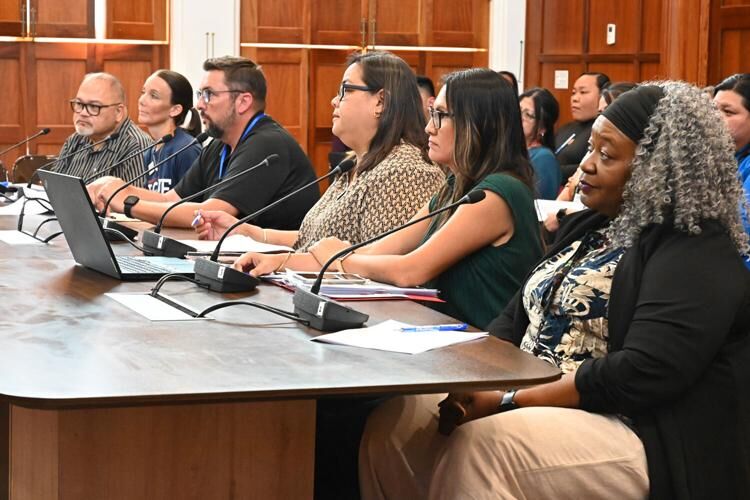
Representatives from the Department of Public Health and Social Services and Harvest House testify on the recruitment of foster parents on Monday, March 25, 2024, at the Guam Congress Building in Hagåtña.
