



HAGÅTÑA (The Guam Daily Post) — It has now been four weeks since Typhoon Mawar barreled past the island, and recovery and response remain ongoing. Service has been restored to about 95% of water customers, while nearly 80% of power customers have seen service restored, the utilities have reported.
However, power customers in certain pockets of the island now find themselves subject to rotating outages as the Guam Power Authority continues to make repairs to a major transmission line.
GPA has targeted 95% power recovery by June 26, with full recovery expected shortly after.
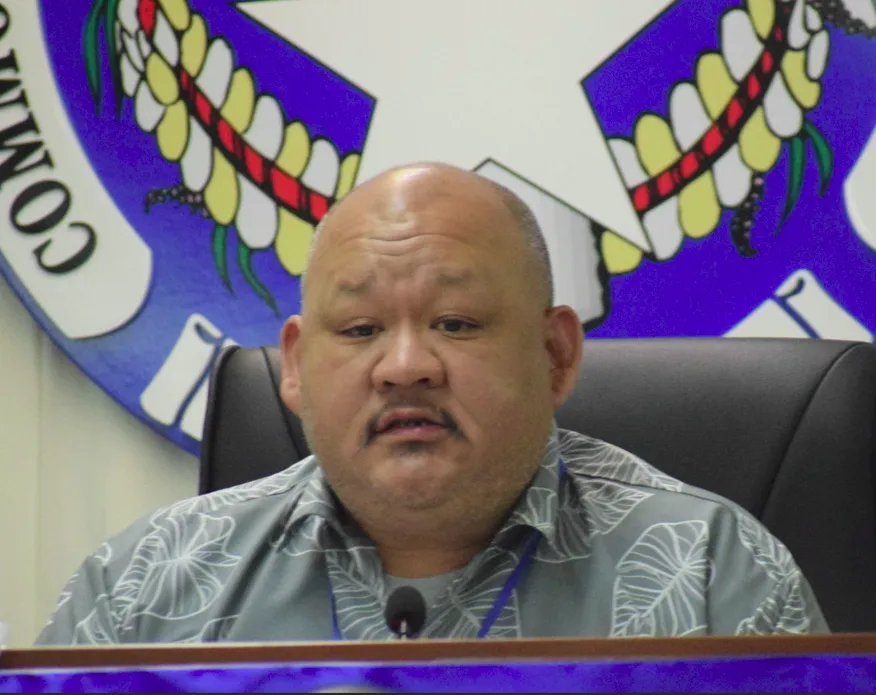
But when utility restorations are complete, according to Consolidated Commission on Utilities member Simon Sanchez, the question officials will be asking themselves and the community will be what price they would be willing to pay to further mitigate damage and recovery time.
“When we looked at undergrounding (power on) all of Guam for the last 20 years … it was in the billions,” Sanchez told The Guam Daily Post. “We said the people of Guam don’t have billions of dollars. We have enough money to switch everything to concrete poles … and they (withstood) Mawar. The number of poles down after Mawar is significantly lower than the number of poles down after (Typhoon) Pongsona.”
Fewer downed poles results in faster recovery, but hardening of the system didn’t happen overnight, he noted.
The utilities are working to analyze Mawar’s aftermath so they can later present recommendations on further hardening, Sanchez said.
And while more people now have power and water service restored post-typhoon compared to 20 years ago with Pongsona, the commissioner acknowledged there are still “too many people without service.”
“And I think the entire community would want us to recover much faster than four to five weeks. But that has to be studied. It has to be costed out. And then we have to have a conversation with our community about our willingness to insure, or self-insure, especially when ratepayers have to pay. Then there’s the role of the Department of Defense in their contribution to the hardening of the infrastructure, since they’re a huge customer of the infrastructure,” Sanchez said.
“It’s a real community effort that has to come out. But, … until restoration is done, how can you paint a complete picture? And we need a complete picture of our recovery in order to move forward,” the commissioner added.
Rear Adm. Benjamin Nicholson, the outgoing commander of Joint Region Marianas, spoke a bit about the collaboration that needs to happen to harden infrastructure on Guam.
‘Intertwined’
“I think we have to work together to see what’s the best way. Here on Guam, almost more so than any other place, the civilian and military infrastructure is very much intertwined,” Nicholson said last week.
“Water has been an issue, trying to get all of the water restored. There are some military-operated water wells in the northern portion of the island, and there’s a reservoir in the southern portion of the island that’s military-operated as well. Those have tie-ins to the commercial water system. And we have been pushing water from those military wells and the military reservoir into the commercial system,” the rear admiral added.
Power infrastructure also is intertwined, he said.
“The ability for the island infrastructure to provide stable power is very important for the Department of Defense. So, wherever that can be hardened, that’s very good. In this case, many of the large power transmission poles stood up. … It’s the older wooden poles that had some of the difficulty. The storm did damage some of the lines. So there has to be some thought as to how that can be done better,” Nicholson said, adding that Naval Base Guam had problems with downed power poles, but that was mostly due to the base having numerous wooden poles.
Nicholson noted that a major issue following Mawar was the disruption in telecommunications. The failure in telecommunications was based mostly on power failures, the rear admiral said.
“There was only a few actual (telecom) sites that were damaged themselves,” Nicholson said. “It was mostly the power outages that power those sites that was a problem. And so, taking a look collectively on where are those sites, where can they be done better, where can the power be run a little bit better? Some of the cellphone towers on the bases, they had some issues there, too. So we need to look at all of that to make sure that telecommunications is good for everyone.”

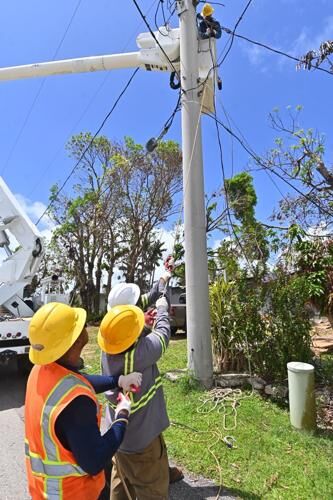
A Guam Power Authority crew uses a rope to pull replacement residential power lines Monday, June 19, 2023, in Chalan Pago.
