






HAGÅTÑA (The Guam Daily Post) — The Guam Environmental Protection Agency is in the process of developing interim action levels for the banned insecticide dieldrin in the island’s drinking water.
The proposed action levels include a notification level, which will mandate public notification whenever dieldrin concentrations are detected at 0.002 micrograms per liter at production wells, and a response level, which will mandate a “do not drink without treatment” advisory when concentrations reach 0.2 micrograms per liter.
Guam EPA has to issue a public notice regarding the proposed interim action levels and then hold a public hearing and gather input before the proposal can be brought to the board for final action, according to discussions during a Dec. 14 agency board meeting.
Dieldrin was discontinued in the U.S. for most agricultural uses in the 1970s and for all uses in 1987, along with a similar insecticide, aldrin.
The latter readily converts into the former under most environmental conditions and in the body, so it’s only dieldrin that’s seen in Guam’s water, according to a presentation made during the Dec. 14 meeting.
The presentation added that the U.S. Environmental Protection Agency recognizes that dieldrin and aldrin may have adverse effects on people’s health but has not set legally enforceable maximum contaminant levels for the chemicals. Common frequency and levels of dieldrin in the U.S. were not found to cause a public health concern and exposure to the chemicals is not nationally widespread, the presentation stated.
Risk
However, dieldrin and aldrin are classified by U.S. EPA as probable human carcinogens. The Dec. 14 presentation stated that cancer risk was found to be 1 in 1 million with dieldrin concentrations at 0.002 micrograms per liter and 1 in 10,000 at 0.2 micrograms per liter, based on studies on mice.
The presentation added that 80 Guam Waterworks Authority entry points had dieldrin sample results over 0.01 micrograms per liter.
Production wells with the highest concentrations of dieldrin were identified as Y-15, D-17 and M-4. These wells had above 0.2 micrograms per liter of the chemical.
Y-15 is near Andersen Air Force Base, D-17 is across the Northern Region Community Health Center and M-4 is near Marbo Cave, according to statements made at the Dec. 14 Guam EPA board meeting.
A carbon filter, such as a granulated activated carbon (GAC) system, can be used as additional treatment for dieldrin in water, the meeting discussions indicated.
GWA does have a few GAC systems online due to per- and polyfluoroalkyl substances, also known as PFAS. However, as of press time Friday, The Guam Daily Post had not yet asked GWA if these are also used to treat dieldrin or if it uses other ways to treat or filter the chemical.
This also isn’t the first time that dieldrin has been found in GWA water wells.
According to a 2012 inspection and sanitary survey report from U.S. EPA, dieldrin had been found in at least 88 wells since 1996, with the highest concentration observed up to the time of the report being 1.6 micrograms per liter.
‘Should be gone’
But what’s curious today is where the dieldrin is coming from.
Capt. Brian Bearden, the Water Division director at Guam EPA, indicated on Dec. 14 that dieldrin shouldn’t last too long in the environment, stating that some studies showed the chemical should disappear within 20 to 25 years if left in the soil and exposed.
“That’s why it’s a little puzzling to us why we’re still seeing it, but it’s not unusual. Other states have seen the same thing. It’s probably the fact that a lot of the stuff is underneath concrete slabs of homes and buildings. … We have kind of a working hypothesis that the reason why we’re seeing an increase right now is because of the demolition of a lot of older buildings that’s happening around the island as things are redeveloped,” Bearden said during the Guam EPA board meeting.
“It’s probably exposing this dieldrin that’s been protected for all these decades underneath that concrete. … And especially for the civilian work, which isn’t monitored, it may be being hauled to hard fills where it’s becoming exposed to rainfall and being washed down to the aquifer. There’s also development happening on the military bases, but that’s usually a little bit better monitored,” he added.
Bearden stated that different Guam EPA branches will have to mobilize to determine why dieldrin levels are currently increasing.
“We want to try to get to it before it gets to the consumer (level) and get this back to nothing. Because, as I mentioned, it should be gone out of the environment by now based on laboratory studies and environmental studies done elsewhere,” Bearden added.
U.S. Naval Base Guam and Andersen Air Force Base do not currently report dieldrin results, but 2007 results from the Navy did show concentrations above 0.01 micrograms per liter at seven entry points, according to discussions during the Dec. 14 Guam EPA board meeting.
Guam EPA is currently conducting an investigation into where the dieldrin is coming from. There are known associations with dieldrin being formerly used at defense sites and associations with civilian developments from the 1970s through the 1980s, according to the presentation on Dec. 14. Guam EPA is also looking at demolitions and redevelopments and hard fill sites.

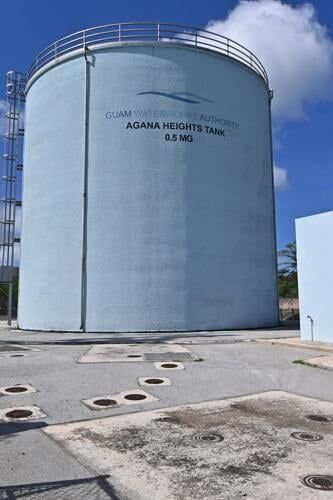
A Guam Waterworks Authority water tank on Wednesday, Dec. 20, 2023, in Agana Heights. The Guam Environmental Protection Agency is working to establish interim action levels for dieldrin, a banned insecticide, when it’s found in drinking water.
