





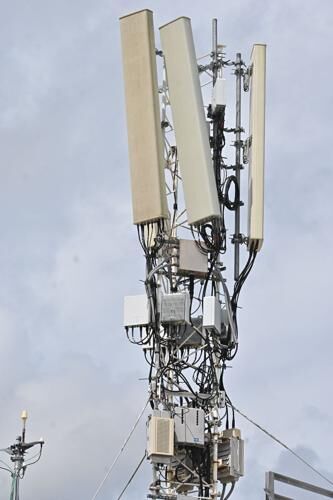

Communication equipment is seen outside the GTA Teleguam headquarters in Tamuning on Monday, June 26, 2023.
HAGÅTÑA (The Guam Daily Post) — Getting faster and cheaper home and office internet to Guam residents is the goal of $156 million in broadband infrastructure funding the federal government is providing to Guam.
The funding announcement was made last week by the Department of Commerce National Telecommunications and Information Administration. Broadband funding comes as part of the Biden Administration’s 2021 Bipartisan Infrastructure Deal, but was highlighted Tuesday by local leaders.
Over the next six months, a proposal with all the details and plans of how to get Guam residents up to those faster, cheaper internet speeds will be ironed out and submitted to the Commerce Department, said Tyrone Taitano, coordinator of the governor’s Office of Infrastructure Policy
A five-year action plan also will have to be submitted. All of the money is geared toward fixed internet services, Taitano said, meaning no cell service upgrades and no 5G data speed investments are expected.
He couldn’t say Tuesday what kind of network infrastructure will be needed to get the island closer to high-speed internet for all, as his office has been awaiting final word on how much money would be handed down before developing a concrete plan. At one point, the number proposed for Guam was at minimum $25 million, he said, which would have allowed significantly fewer improvements.
“There’s only so much you can do with $25 million,” he said. “There’s a lot more you can do with $156 million.”
In fact, Guam is getting more money from the feds than some states, including North Dakota and Rhode Island, according to the National Telecommunications and Information Administration website.
Taitano told The Guam Daily Post his office successfully made the case to the federal government that all of Guam qualifies as an underserved broadband area, as long latency times — delays in network connection — were caused simply by the island’s distance to web servers in the states.
Contracts possible
The government of Guam, which historically has left the development of broadband infrastructure to the private sector, will now have to consult with local internet service providers about how to take the next steps, Taitano said. The job of his office is to develop the plan to do that, and then hand the contract off to someone else.
“The idea is to build a solution and then the subaward would go to the person best equipped to actually build that solution. Now, we’re a long way from getting to that point,” he said.
There are a number of different ways $156 million worth of infrastructure could be constructed, Taitano said.
“It could be an award to the (internet service providers), who build it into their own system,” he told the Post.
According to Taitano, that has been the traditional way Guam has built up network capacity.
“Or it could be a subaward to somebody who will build it for publicly owned broadband infrastructure, or it could go to a government agency to build it themselves,” he added.
Though GovGuam isn’t now in the business of owning and maintaining network infrastructure, the publicly owned model is building traction in areas including California, Taitano said. The government builds a “middle” connection to get cables closer to people’s homes in rural or isolated areas, “and then a local internet supplier takes what’s called ‘the last mile’ directly to people’s homes.”
Taitano said he hopes bringing network connections closer to people who don’t have it also will drive costs down.
Additional funding expected
Widespread internet investment is a new venture from the federal government, Taitano said, and more money will be announced as part of a bipartisan infrastructure deal. In the coming years, more funding will be provided for things such as free Wi-Fi hotspots, access to computers and digital literacy, as well as an “affordable connectivity benefit program,” a subsidy that would go toward people’s internet service bills at a rate of $30 a month, Taitano said.
“This once-in-a-generation funding is a game changer for Guam,” Gov. Lou Leon Guerrero said in a statement issued by her office. “We long recognized the need for improved broadband infrastructure on the island, and this funding will allow us to make significant progress in bridging the digital divide and providing equal access to opportunities for our residents.”
Lt. Gov. Josh Tenorio added that the Covid-19 pandemic and Typhoon Mawar highlighted “the critical importance of reliable high-speed internet for remote work, telehealth, and distance learning.”
