

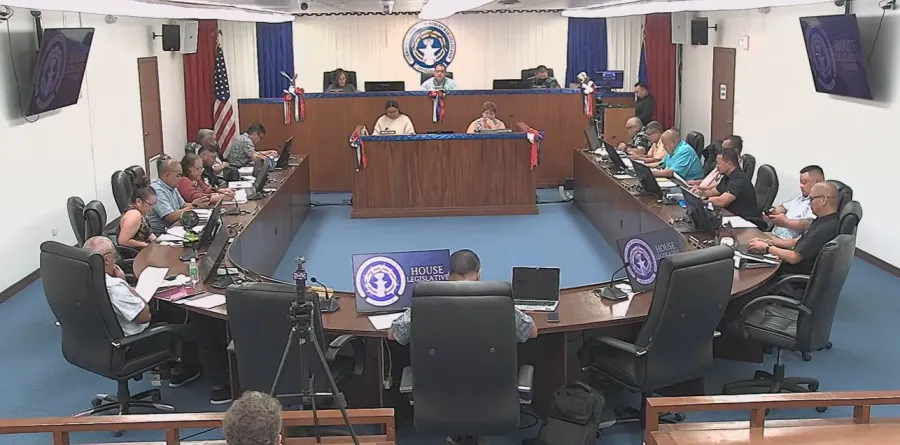


The Senate leadership held a closed-door meeting after the discussion with the two CUC officials.
Rota Independent Sen. Juan M. Ayuyu, who chairs the committee, said the Senate leadership is likely to endorse the passage of legislation that will give Gov. Benigno R. Fitial, who is currently in Manila for medical reasons, more reprogramming authority to solve CUC’s fiscal problems.
Fitial’s executive order that empowers him to reprogram funds for CUC’s fuel payments is just temporary.
Ayuyu said a reprogramming bill when enacted into law will widen the governor’s pool of resources.
The Legislature is now discussing appropriations for fiscal year 2011 which is currently estimated at over $132 million — down by $16 million from the current continuing budget resolution of $148 million.
“He’s [the governor] asking for another reprogramming authority. That is the whole reason why we’re having the leadership meeting,” Ayuyu said.
Threats of rotating blackouts or load shedding surfaced anew this month with CUC claiming it didn’t have enough funds to buy fuel from Mobil Oil Mariana Islands.
The governor then used his reprogramming authority to release an initial $300,000 to CUC. The government owed CUC $3.8 million.
As of Monday, the balance was $2.3 million but this is expected to be settled this week through funds identified from the Department of Public Lands.
CUC needs at least $1.2 million a week for fuel to run its diesel-powered engines.
Ayuyu said the Senate made it very clear to CUC not to give preferential treatment to the government if it’s delinquent in its bills.
Aside from fuel, Ayuyu said the Senate is also concerned about CUC’s ability to timely comply with the federal stipulated orders because it may further strain its resources.
“CUC is doing its best but we need to face this issue,” said Ayuyu.
The $140,000 fine that EPA meted to CUC was for failing to properly submit a plan in reorganizing its wastewater plants, collection systems and public drinking water systems into federal environmental standards.
In a statement, EPA said the plan was supposed to be submitted as early as Sept. 2009.
“As CUC has acknowledged, this plan establishes the management and organizational foundation CUC will need to achieve and maintain compliance with the Safe Drinking Water Act and Clean Water Act,” said Alexis Strauss, water division director for EPA’s Pacific Southwest region.
“EPA will continue to oversee CUC’s implementation of these required improvements to bring long-needed environmental and public health gains to the islands,” he added.
CUC is required to develop a wastewater and drinking water master plan; development of financial plans; and the construction of water and wastewater infrastructure.
It is also required to comply with its water discharge permits for the Agingan and Sadog Tasi wastewater plants and to implement changes to prevent sewer overflows.
“It similarly requires CUC to achieve compliance in its drinking water systems, which currently present a health risk to the public. A second order requires CUC to prevent oil spills at its power plants and pipeline, to comply with oil spill regulations, prepare to respond to oil spills, and provide appropriate cleanup for past and future oil spills. Failure to meet requirements of either order could subject CUC to further penalties,” EPA said.
