




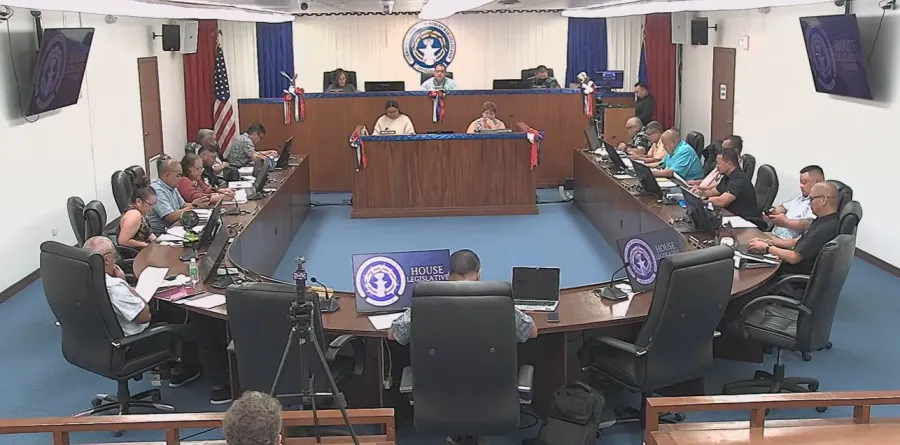


“I was one of those issuing tickets and I cited a bunch of people,” Rep. Tina Sablan said in an interview on Friday.
As waste reduction and recycling coordinator of the Division of Environmental Quality, Sablan was among the 20 litter control officers certified in Sept. 2006.
Early this month, DEQ admitted that it didn’t record any citations from these officers in fiscal year 2008.
Sablan, Ind.-Saipan, noted that the minimum fine set by Public Law 6-37 is $200.
“One of the things we did when we were doing training was to understand why there wasn’t more enforcement — we were training a lot of people and a lot of people had been certified to issue tickets but there was a concern from the officers that the fine was too much,” she said. “Officers have the discretion not to issue the ticket but just give a warning. Because the fine was so high and times were tough, officers preferred to give a warning.”
Sablan said lowering the minimum fine to $25 may result in more enforcement.
“I was told that the way Palau cracked down on betelnut spitting in public areas was to lower the fine to, I think, $5 or $10, and they did this massive sting operation at public events — officers issued tickets left and right. They didn’t feel too bad. It’s just a $5 fine, but it was enough of a hassle and kind of a wake-up call for the people to learn from that, and not to do it again, and after three months the problem was pretty much gone.”
Sablan said the fine for speeding on Saipan is $25.
“So why should chucking out a can be more penalized than speeding, which is dangerous and reckless?”
The certified litter control officers are personnel of DEQ, Coastal Resources Management, the Department of Land and Natural Resources, the Department of Public Works, the Saipan Mayor’s Office and the Marianas Visitors Authority.
“These are agencies that have people constantly moving around the island,” Sablan said. “They’re driving everywhere and if they see somebody then they might as well issue tickets. What turned out to be the reality is that their primary jobs, of course, come first. And so if they’re on the road on the way to somewhere else and if they see someone littering but they don’t have time, they’re not going to issue the ticket because it’s time consuming. That is something I discovered. You just don’t issue a ticket and you’re done with it. You’ve to go back [to your office], compile the report and you’ve to make copies and give them to all these different agencies.”
Sablan said based on her experience, the anti-littering law “should be a full-time responsibility for one agency to focus on.”
She believes DPS should be that agency.
“They do the training — any of their officers can enforce it, but they will need additional resources and we’ve suggested a seed money of $25,000 which will be a revolving fund,” she said.
DPS officers are already working around the clock, she added, unlike litter control officers from the other agencies who punch out at 5 p.m. and are off on weekends.
To address the issue of resources, Sablan said “one of the suggestions was that there should be like a portion of whatever fines [collected] that goes toward enforcement.”
She said she will introduce legislation to amend the anti-littering law and make it “more enforceable.”
