





LAWMAKERS are also questioning the legality of the administration’s decision to reduce the budget allocation for each legislator by 16.3 percent.
Based on the issuance of third quarter allotments, each lawmaker received $32,537 or 16.3 percent lower than the previous quarterly allotment of $38,750.
Lawmakers are entitled to receive $155,000 annually for their office and related expenses. Each also gets a $39,000 annual salary.
The list of accounts for the third quarter came from the Office of Budget Management and was transmitted to the Legislature last April 8. The document was signed for Gov. Juan N. Babauta by Joaquin C. Blanco, the administration’s technical financial analyst and was prepared by budget analyst Benita F. Sablan.
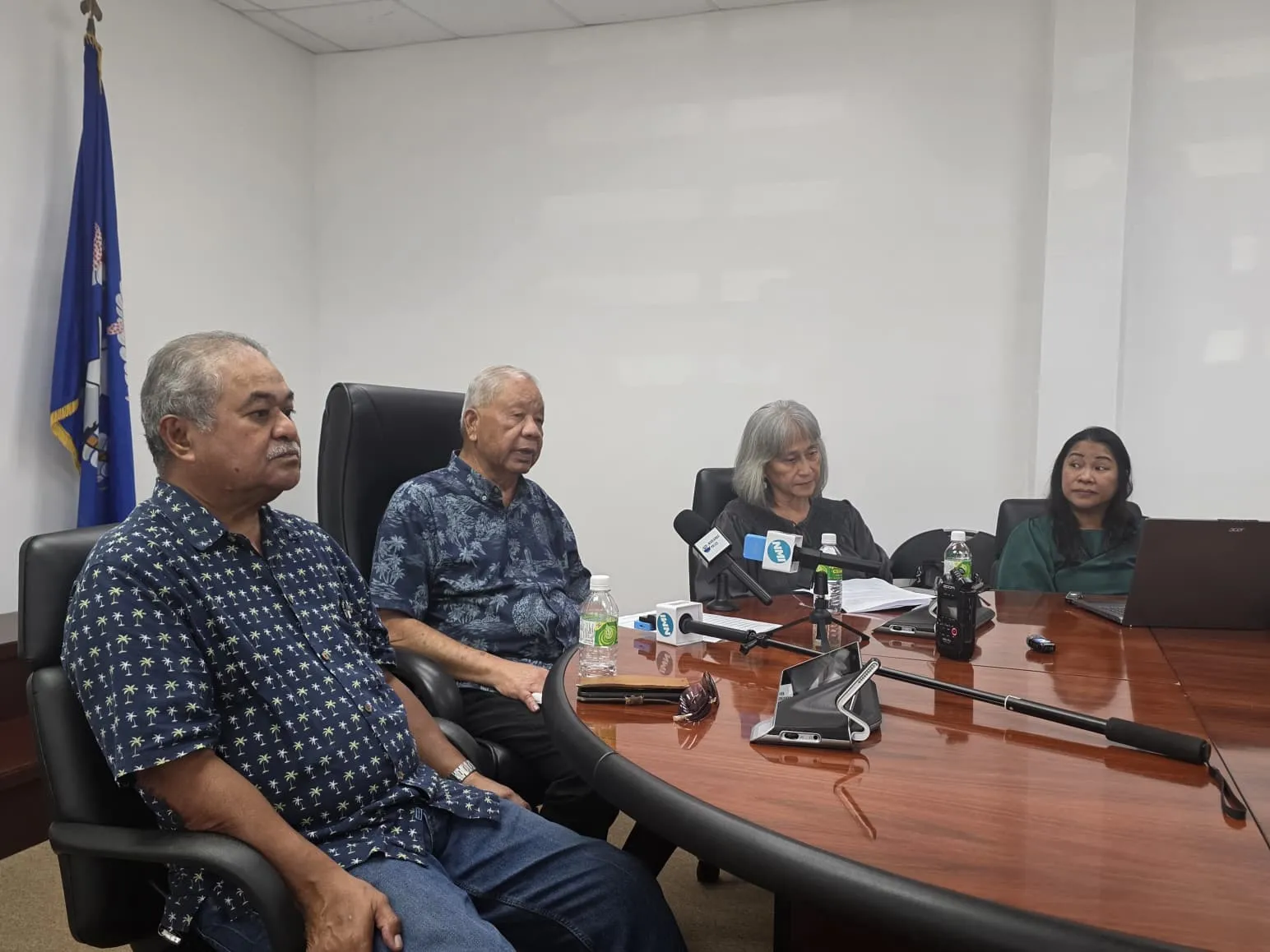
House Speaker Heinz S. Hofchneider, R-Saipan, Reps. Benjamin B. Seman, R-Saipan, Herman T. Palacios, R-Saipan, and Sen. Thomas P. Villagomez, R-Saipan, said the executive branch should not encroach on the budget of a separate branch of government.
While the executive branch is authorized by the Constitution to reduce the allotment of its departments and other instrumentalities, Hofschneider said he does not know if this authority extends to the legislative and judicial branches of government.
The speaker also questioned if it was ethical for the executive branch to cut the Legislature and the judiciary’s budget while it hires people whose salaries are above the cap.
“What is troubling is that they cut the budgets of both branches…so they can hire people and compensate them beyond the cap provided by the Legislature or by law. This is highly questionable,” the speaker said.
Seman, chairman of the House Committee on Health and Welfare, questioned the legality of the cut. He said the reduction in the budget allocation for the Legislature “is plainly defective in several ways.”
“The legislative branch is independent of the other two branches and vice versa. Any action by one branch to circumvent, intrude or paralyze the operations of one branch of the government is a violation of the doctrine of separation of powers,” he said.
He said the constitutional provision mandating a $155,000 budget allocation for each lawmaker takes supremacy over any statute or law that mandates the reduction of the budget.
The administration last month issued two memoranda on the need to cut each agency’s budget by 8.02 percent. Under section 604 (c) of P.L. 3-68, if there is a $200,000 or 3 percent or more decrease in revenue, the administration is authorized to “transmit a special budget message proposing to reduce the reserve for the fiscal year.”
The section also mandates that the reduction should equally apply to all government agencies.
Seman said P.L. 3-68 became effective in 1983 during the time that there was still no individual budget allocation for each member of the Legislature. In 1985, a constitutional amendment was ratified to create a separate budget for the Legislature.
Thus, Seman said, section 16 (b) of the amended Constitution should be followed and not P.L. 3-68.
Seman also argued that under Section 16(e) of the Constitution, the individual budget allocation for lawmakers is mandated to increase starting in 1998.
Villagomez echoed Seman’s position and said that even P.L. 11-41, the existing budgetary act, “reinforced the constitutional provision that each member shall have the sole spending authority on specific accounts.”
Hofschneider said that the March 11 memorandum on the 8.02 percent reduction of budget that came from Lt. Gov. Diego T. Benavente did not cover the Legislature.
“Procedurally, they have not complied with what is required and the memo that was provided to the Office of the Speaker is for all intents and purposes written for the department heads and agencies of the executive branch and not as a notification to the Legislature that an anticipated austerity measure is to be implemented by the Legislature,” he said.
Seman also warned that the reduction of the Legislature’s budget “might impair the obligations of contracts,” which is “prohibited by the U.S. Constitution.”
“So in effect, if each of the legislator has already encumbered obligations (based on their uncut budget allocation), and a reduction is in force, it will impair the legal obligation of legislators,” he said.
Hofschneider and Palacios also questioned the administration’s move to exempt the Public School System from the budget cuts.
Hofschneider said the proportionate cut mandated by P.L. 3-68 means that the cut should apply to all agencies and instrumentalities. Doing it otherwise would mean that other branches and agencies would carry the added burden supposed to be equally shouldered by an agency that was exempted from the cut.
“If you exclude a large percentage of the annual appropriation to apply the cut, then it is a disproportionate cut and the burden on the two branches of government would be higher than what it should realistically apply to. So there’s a flaw,” he said.
The speaker said that if the governor intends to help PSS, the administration “can resort to reprogramming and moving money they realized through the austerity program and the proportionate cuts.”
Palacios said assuming that the authority vested in the governor under P.L. 3-68 is constitutional, “which I think is not,” the executive branch “still violates the very law that it uses because it exempts PSS from the cut, while P.L. 3-68 mandates that it should be proportional.”
Hofschneider, Seman, Palacios and Villagomez, however, agreed that the Legislature should “chip in” through the reduction of its budget but at their own discretion and not imposed by a separate branch.
Senate President Paul A. Manglona, R-Rota, said senators had already brought the issue to OMB. “We are waiting for OMB’s reply,” he said.
Babauta and Benavante declined to comment yesterday, but said they would come up with an official position soon.
