







By Emmanuel T. Erediano
[email protected]
Variety News Staff
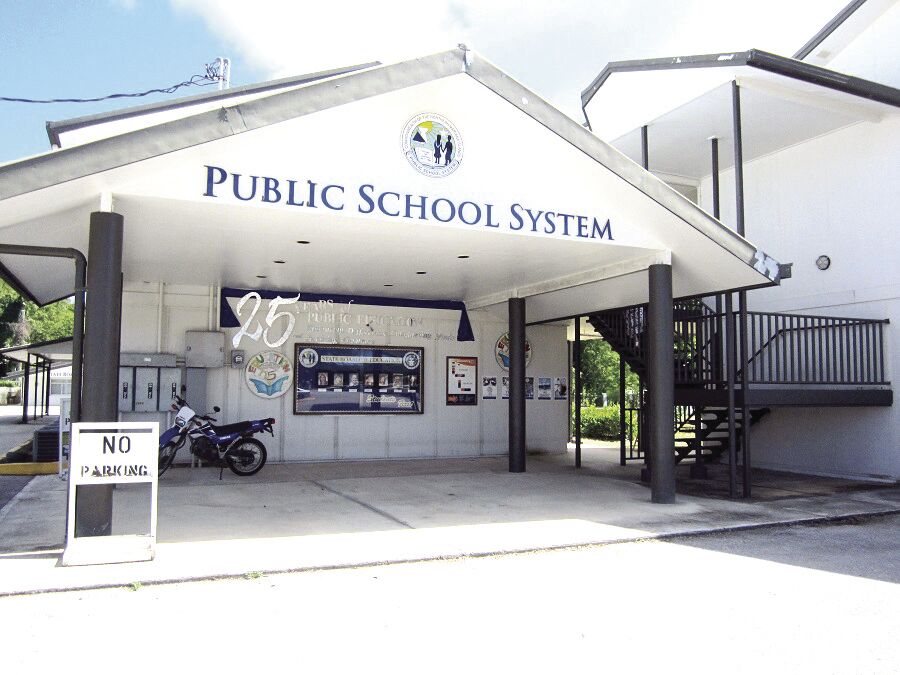
GOVERNOR David M. Apatang on Wednesday vetoed House Bill 24-33, which proposes to statutorily define 25% of general revenues for the Public School System.
Authored by Rep. Roman C. Benavente, H.B. 24-33 aims to prevent misunderstandings, legal disputes, and unintended constitutional changes by clearly defining “general revenues” as equivalent to “total resources available for appropriation,” meaning the portion of total resources not classified as special revenues or otherwise earmarked, obligated, or restricted by law.
The bill states that under current budget law and prevailing constitutional interpretation, the Public School System’s minimum guaranteed annual budget would be approximately $27 million, or 25% of $111 million.
In his veto message to House Speaker Edmund S. Villagomez and Senate President Karl King-Nabors, Apatang said the measure defines general revenue as “all budgetary resources legally available for appropriation in a given fiscal year, less those revenues defined as special revenues, and less debt service and mandatory payments to the NMI Settlement Fund.”
On the advice of Attorney General Edward Manibusan, the governor said he must veto the bill as unconstitutional.
“H.B. 24-33 misapplies the constitutional meaning of general revenue and unconstitutionally deprives the Public School System of its constitutionally established minimum budget,” Apatang said. “It is an attempt to supersede the [CNMI] Supreme Court decision.”
The governor explained that the inclusion of debt service and mandatory payments in the bill contradicts the constitutional definition of “general revenues” as established by the CNMI Supreme Court. He noted that revenue available for appropriation comprises two categories: general revenue and special revenue. General revenue includes all funds minus special revenue, while special revenue is dedicated to a particular purpose and placed in a separate fund, provided there is a nexus between the revenue source and its intended use.
Citing the attorney general’s advice, Apatang said only special revenue may be excluded from the 25% calculation for the Public School System. Special revenue set aside for a particular purpose must satisfy the requirement of a nexus between the revenue source and its appropriation. He added that if the Legislature suspends an earmarked fund, the special funds become general revenue.
The governor also said the bill ignores the CNMI Supreme Court’s definition of general revenues by subtracting “debt service and mandatory payments to the Settlement Fund,” which contradicts the established meaning and common understanding of such payments.
“Revenue is incoming money acquired by the government through various means, such as taxation and fees. Debt and mandatory payments are outgoing funds used to cover ongoing obligations. Nothing in the CNMI Constitution or the Supreme Court ruling allows debt and mandatory payments to be subtracted when determining the general revenue pot for calculating the 25% floor applied to the Public School System budget,” Apatang said.
He said that if the Legislature wishes to revise the constitutional floor guaranteed to the Public School System budget, the proper procedure would be a legislative initiative to put the issue before voters, as was done in 2014 when the floor was raised from 15% to 25 percent through House Legislative Initiative 18-12, which was authored by Benavente.
Emmanuel “Arnold” Erediano has a bachelor of science degree in Journalism. He started his career as police beat reporter. Loves to cook. Eats death threats for breakfast.
