

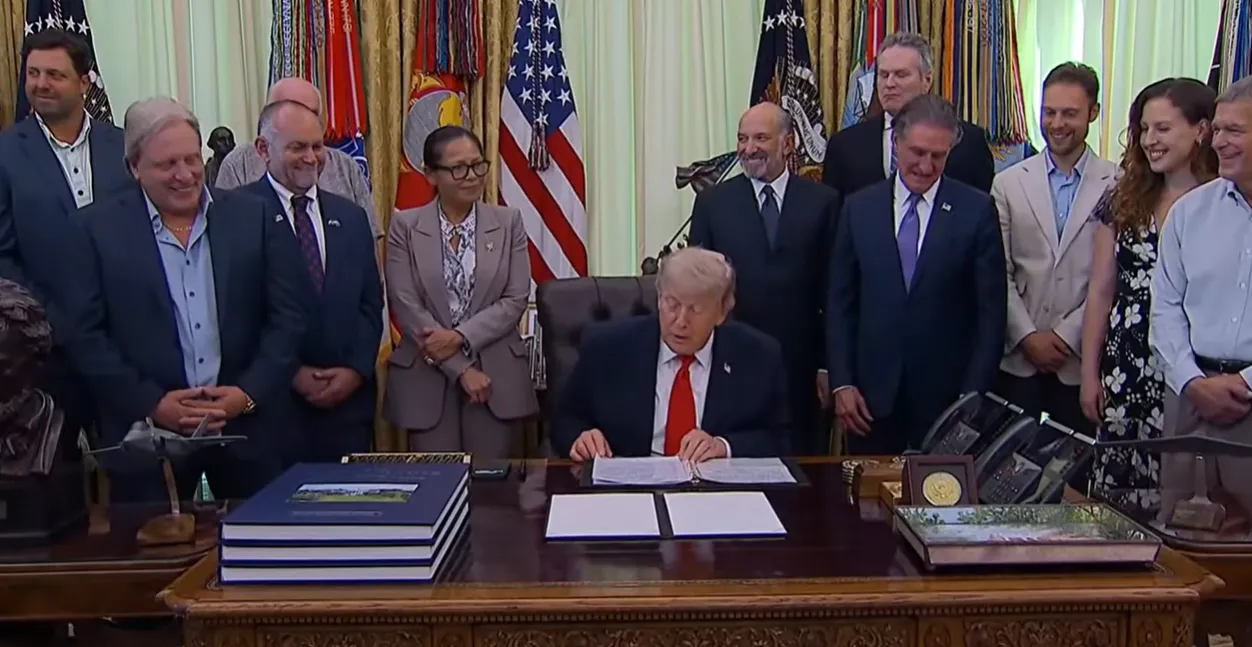




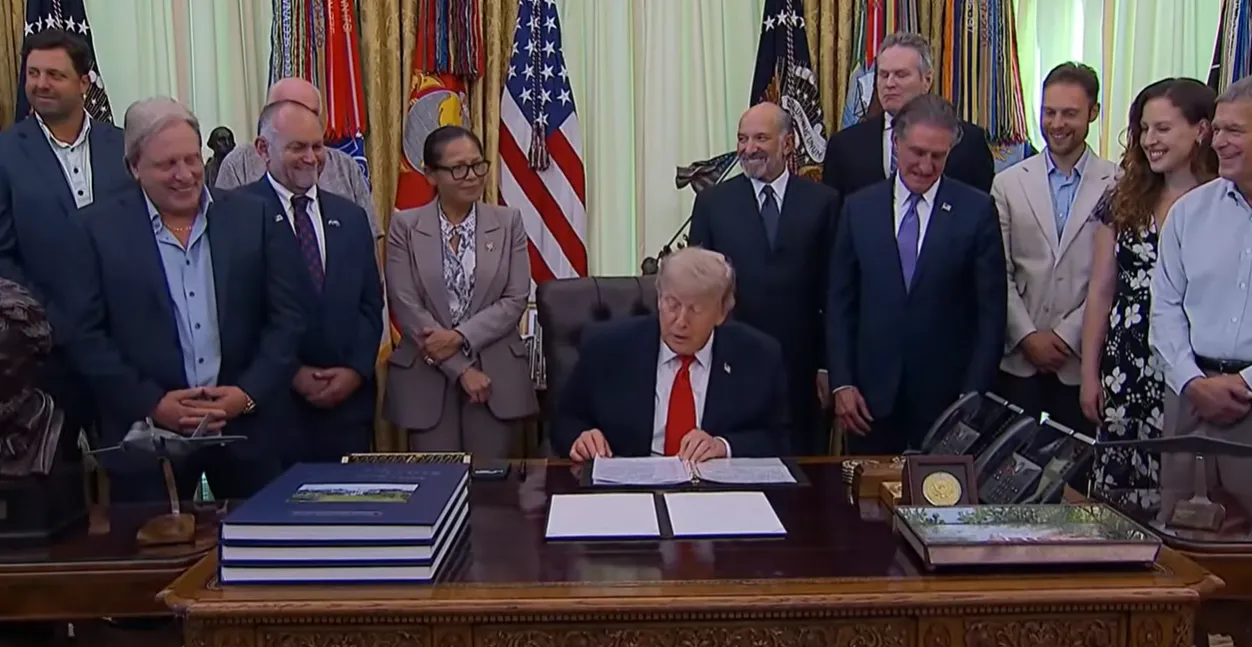
WASHINGTON, D.C. (Office of the CNMI Congressional Delegate) — Delegate Kimberlyn King-Hinds joined President Donald J. Trump at the White House Thursday for the signing of a presidential proclamation addressing commercial fishing access in parts of the Pacific, including specified waters within the Islands Unit of the Mariana Trench Marine National Monument.
The proclamation modifies prior monument restrictions to allow commercial fishing in specified areas, consistent with applicable federal fishery management plans and regulations. Commercial fishing under the proclamation remains subject to the Magnuson-Stevens Fishery Conservation and Management Act and other federal laws protecting marine mammals, endangered species, habitats, and ocean resources. The proclamation also limits commercial fishing within the monument boundaries to United States flagged vessels, with limited permits available for foreign flagged vessels only to transport fish harvested by United States fishermen.
King-Hinds said the proclamation needs to be accompanied by strong local engagement and careful stewardship of the waters surrounding the Northern Mariana Islands.
“The CNMI respects the Mariana Trench Marine National Monument and the environmental importance of the waters around our islands,” said Congresswoman King-Hinds. “At the same time, the people who live closest to these waters should have a meaningful voice in how they are managed. This proclamation creates a path for American fishing activity under existing federal law, with science-based management and conservation requirements still in place.”
King-Hinds said the action also reflects a broader need for federal policy in the Pacific to better account for the people, economies, and communities directly affected by decisions made in Washington.
“For the CNMI, ocean policy is local policy,” King-Hinds said. “It affects food security, small businesses, working families, cultural practices, and the future of our islands. Any implementation of this proclamation should include local fishermen, the Commonwealth government, federal scientists, environmental stakeholders, and the broader CNMI community.”
King-Hinds said responsible implementation could also create opportunities for local industry tied to American fishing activity, including vessel services, fuel, cold storage, fish handling, transportation, maintenance, and seafood-related small businesses.
“This is also about making sure the CNMI is positioned to benefit from activity in our own region,” King-Hinds said. “If American fishing activity grows in these waters, our goal should be to connect that activity to local jobs, local businesses, port activity, seafood infrastructure, and long-term food security for the Commonwealth.”
The proclamation builds on the Administration’s stated goal of strengthening American seafood production and working fishing communities. King-Hinds said her focus will be to make sure any future activity is carried out responsibly and with full attention to local conditions.
“I am grateful to President Trump and his Administration for their openness to hearing from the CNMI as federal agencies move forward with implementation,” King-Hinds said. “This proclamation affects waters in our region, and the next steps should be transparent, careful, grounded in science, and respectful of the people and resources of the Northern Mariana Islands.”
King-Hinds said her office will remain engaged with the White House, federal agencies, local leaders, fishermen, scientists, and environmental organizations as the proclamation moves toward implementation.
“I thank President Trump for inviting me to the White House and for giving the CNMI an opportunity to engage directly with his Administration,” King-Hinds said. “Today’s proclamation was important, and so was the opportunity to raise the broader challenges facing our islands, including our economy, workforce, infrastructure, and cost of living. I also expressed my appreciation for the federal assistance provided in response to Super Typhoon Sinlaku. As our community continues to recover, my responsibility is to keep bringing those concerns forward and to make sure federal policy reflects the realities facing the people of the Northern Mariana Islands.”
