





By Bryan Manabat
[email protected]
Variety News Staff
THE Commonwealth Public Utilities Commission is putting the Commonwealth Utilities Corp. on notice after determining that CUC has failed for years to comply with a CNMI law requiring annual reconciliation and partial payout of customer net-metering credits.
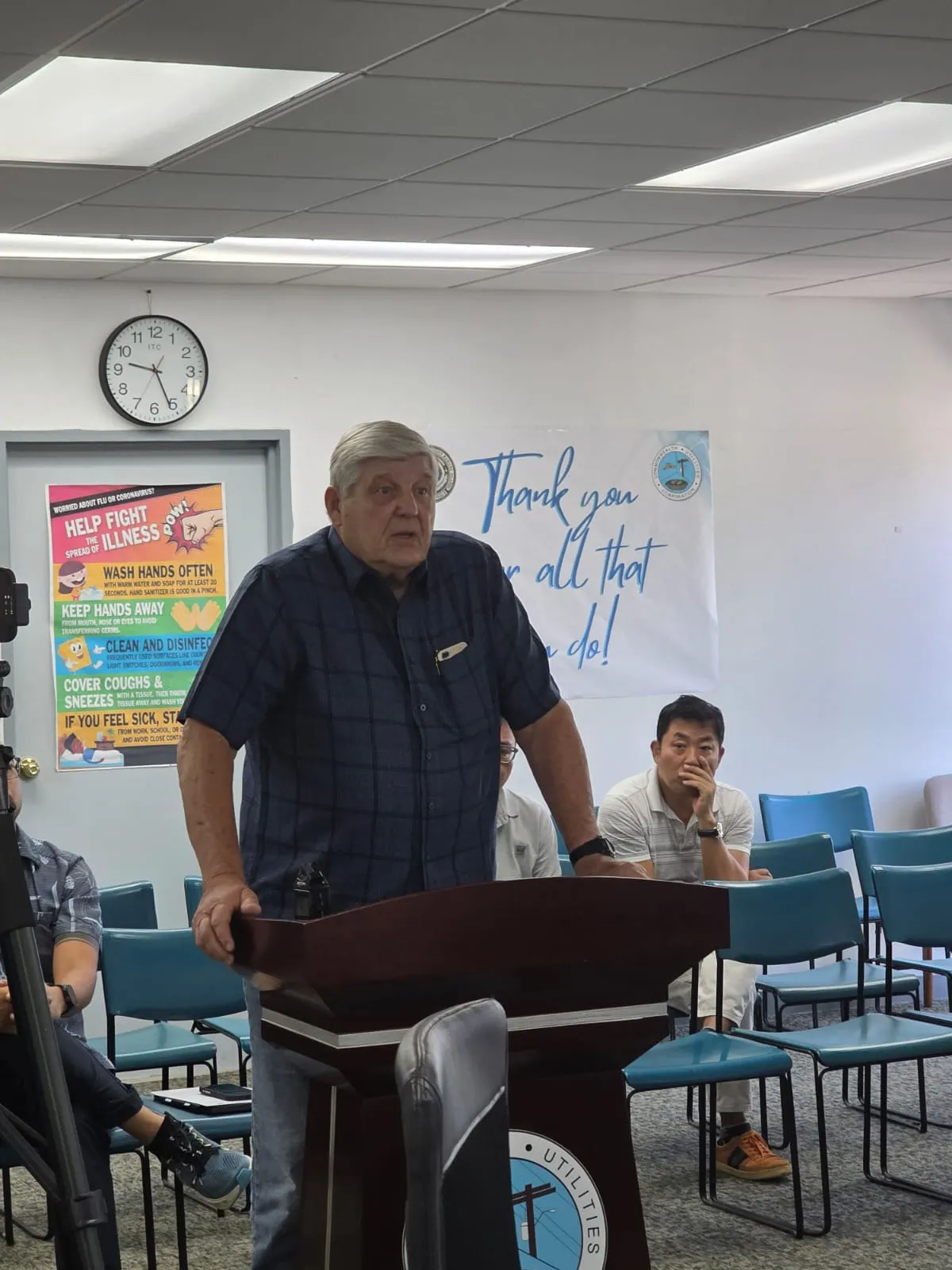
During the CUC board’s Jan. 8 meeting, CPUC Chair James Sirok said the commission expects CUC to complete the overdue reconciliations within three months and is prepared to impose penalties if the utility misses that deadline.
Under 4 CMC § 8539, CUC is required to reconcile each net-metering customer’s credits at the end of every year and pay out 50% of the value of those credits. Sirok said CUC only recently acknowledged that the requirement had not been followed.
“CUC discovered a couple of months ago that this wasn’t being done, and we’ve asked that it be done,” Sirok told the board. He said CUC Executive Director Gary Watson initially estimated the work could take six months, but the commission directed him to complete it within three.
“All of the members of the commission have indicated that this is a priority, and we’re going to hold CUC to that three-month deadline,” Sirok said. “If it’s not done, we will then consider issuing penalties.”
He added that customers “should expect what they’re entitled to under the law,” and that the utility should not “disobey the mandate of the law.”
In January 2024, Betty Terlaje, who was serving as CUC’s acting executive director at the time, expressed support for suspending the net-metering law, saying it “was not written correctly” and that CUC “was never asked for input on the original net-metering bill.”
FAC review underway
Sirok also addressed the long-standing fuel adjustment charge, noting that CUC and CPUC consultants are reconciling data and developing a new formula to replace the stabilization order currently in place.
He said the revised formula is expected to be more transparent and easier for the public to understand, while still allowing CUC to recover its fuel costs.
Diesel prices appear to be declining, Sirok said, and he reminded the board that CUC is authorized to reduce the fuel adjustment charge when fuel costs fall, though it cannot increase the charge without commission approval.
He added that a planned large-scale solar project — now delayed by procurement protests — could eventually reduce fuel costs but remains several years away.
Rate case moves forward
Sirok said CUC recently submitted the remaining supplemental information required for its rate case filing, allowing CPUC to begin the formal review process.
The rate case is expected to take about four months and will include public hearings on Saipan, Tinian, and Rota. A hearing administrator has been appointed to manage the proceedings.
If the process stays on schedule — and if consultants reach a stipulation that avoids a full evidentiary hearing — Sirok said new rates could take effect as early as June 1.
FAC stabilization order and reconciliation
The CUC board plans to petition CPUC to lift the current FAC stabilization order to better align electricity rates with actual fuel costs and global oil price trends.
Last March, CPUC froze any increases to the FAC, holding the rate at the January 2025 level of 21.119 cents per kilowatt-hour. As a result, the FAC remains unchanged through January 2026.
According to CUC consultants Robert Young and Dan Jackson of Economists.com, a recent 13-year review of FAC data shows the utility has under-collected about $9 million in fuel costs, creating long-term financial pressure.
CUC previously petitioned CPUC to stabilize the FAC rate until the reconciliation — conducted by Economists.com — was completed.
CUC board members also agreed to petition CPUC to include an estimated $25 million in Aggreko rental-generation costs in the FAC reconciliation, which consultants say should be recognized as fuel-related expenses.
The CPUC will hold a business meeting on Jan. 15, during which commissioners are expected to take up the FAC rate reconciliation and CUC’s petition for an FAC rate adjustment.
