




By Walter Ulloa
For Variety
HAGÅTÑA (The Guam Daily Post) — With Super Typhoon Sinlaku leaving a trail of destruction across the Commonwealth of the Northern Mariana Islands, two companies are turning to cryptocurrency to help fill the gap where federal aid has fallen short.
Nebula DeFi, a Nebula DeFi web3 technology firm based in Atlanta, and Zon Global Marianas, a CNMI-based tech company, announced a partnership to launch the Marianas Token, known as $MARI, a digital cryptocurrency that will channel a portion of its trading activity into typhoon relief and long-term economic development for the islands.
Early unofficial estimates suggest Sinlaku may have caused about $1.5 billion to $2 billion in damage to a territory with an annual GDP of roughly $1.3 billion, deepening hardship for a region where 38% of residents already live below the poverty line, according to 2024 U.S. Census Bureau and World Bank data. The CNMI has faced this pattern before: Typhoon Yutu struck in 2018, causing more than $1 billion in damage, with recovery also hampered by insufficient federal support.
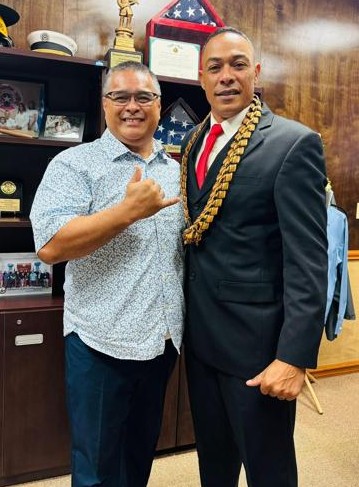
David Atalig, former CNMI secretary of finance and the project’s on-the-ground lead, said the $MARI initiative was already months in the making before Sinlaku struck.
“This project had nothing to do with any relief efforts. It was strictly to help the Commonwealth community,” Atalig told The Guam Daily Post. “When Sinlaku happened, it became, ‘Hey, how can we now use this to help our community even more and have a true, real test case that, to the crypto world, we’re talking worldwide?'”
Under the plan, the first 90 days after launch will serve as a dedicated relief window, with a designated share of proceeds flowing to recovery efforts through the Marianas Foundation, a nonprofit Atalig helped establish in December. He serves as its initial president and also as vice president of Zon Global Marianas.
“It will be important for our recovery and relief efforts, but it is so much more than that,” Atalig said. “For the people of this island we love, it means access to a modern financial system for the first time, regardless of whether they have a bank account.”
Jason Rindahl, CEO of Nebula DeFi, said the company’s experiential token model was built to avoid the pitfalls that have sunk most digital currencies. He said sustainability comes from trading volume rather than one-time fundraising.
“The number of failed cryptocurrencies is closer to 100% than it is to 99%,” Rindahl told the Post. “Everything that we do in our strategy is based on trading volume.”
Under the structure, 2% of all trading revenue will flow to the Marianas Foundation, which distributes it to community programs and recovery efforts. A public, foundation-owned digital wallet gives anyone full visibility into how funds move.
“The MARI Token is (decentralized finance) in its purest form, breaking down borders to rebuild communities and generate lasting value for everyone in the ecosystem,” Rindahl said in a press release. “We hope this initiative can become a model for how innovative technologies can serve island economies and underserved regions around the world.”
Beyond relief, the project targets broader economic goals. Planned features include a point-of-sale system for local merchants using QR code payments, a cash-to-cryptocurrency conversion pathway requiring no bank account, and a token rewards program offering discounts and exclusive access to events, modeled on traditional loyalty card programs.
Rindahl said the vision extends further.
“We haven’t even talked about tokenizing tourism there, fractionalizing the different crops that you guys can grow and create,” he said. “There are all kinds of other opportunities from a tokenization strategy that can be economic drivers for the entire economy there.”
The project has drawn support from Dennis James C. Mendiola, lieutenant governor of the CNMI, who said in a statement the islands have long been underserved by traditional financial systems.
“The MARI Token represents a transformative opportunity to change that by bringing accessible, modern financial tools to our communities, merchants and visitors,” Mendiola said.
The effort is separate from a stablecoin project by Vin Armani of Marianas Rai Corp., which launched a government-backed digital currency through Tinian in 2025 but has faced legal and regulatory challenges. Atalig said the two are not rivals.
“Mr. Vin Armani is a friend of mine,” Atalig said. “In the future, as we get moving, we would love to work with him and his team.”
Atalig said the team plans to launch $MARI on June 1, though the project is still finalizing private funding for its liquidity pool ahead of that date. Its rollout aligns with growing federal clarity in the digital assets space. The GENIUS Act, signed in July 2025 and reported at the time by the Post, established the first federal regulatory framework for stablecoins, with additional legislation expected through Congress this summer.
“This is going to be a long-term community funding project that will help the islands,” Atalig said.
