



By Bryan Manabat
[email protected]
Variety News Staff
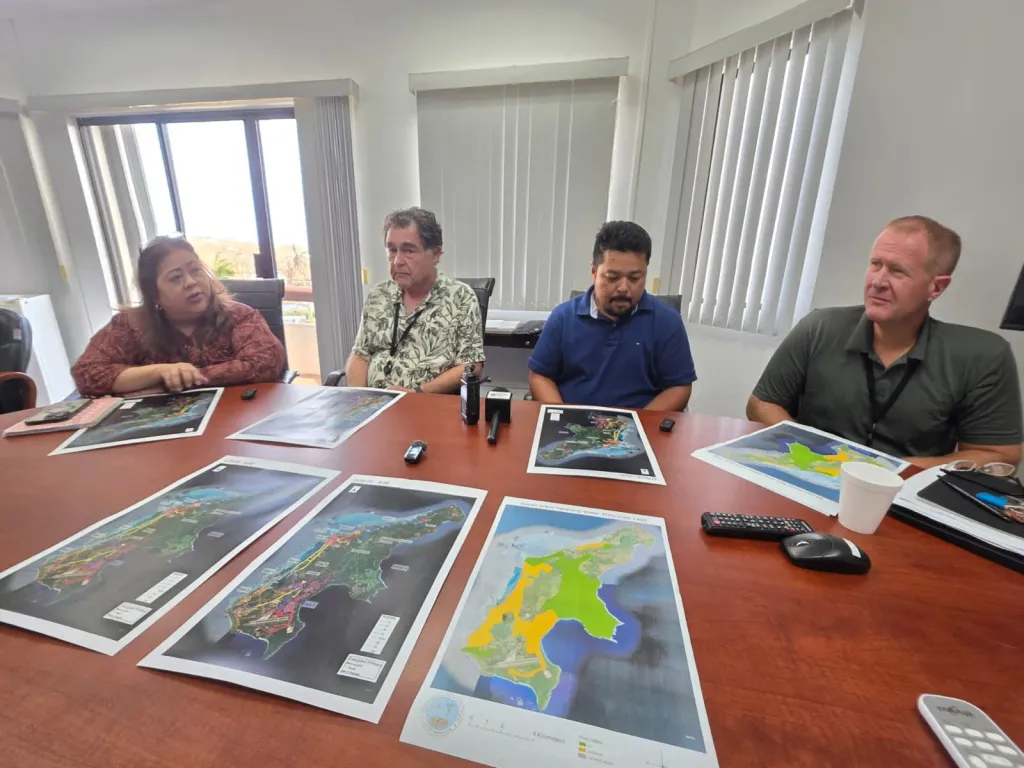
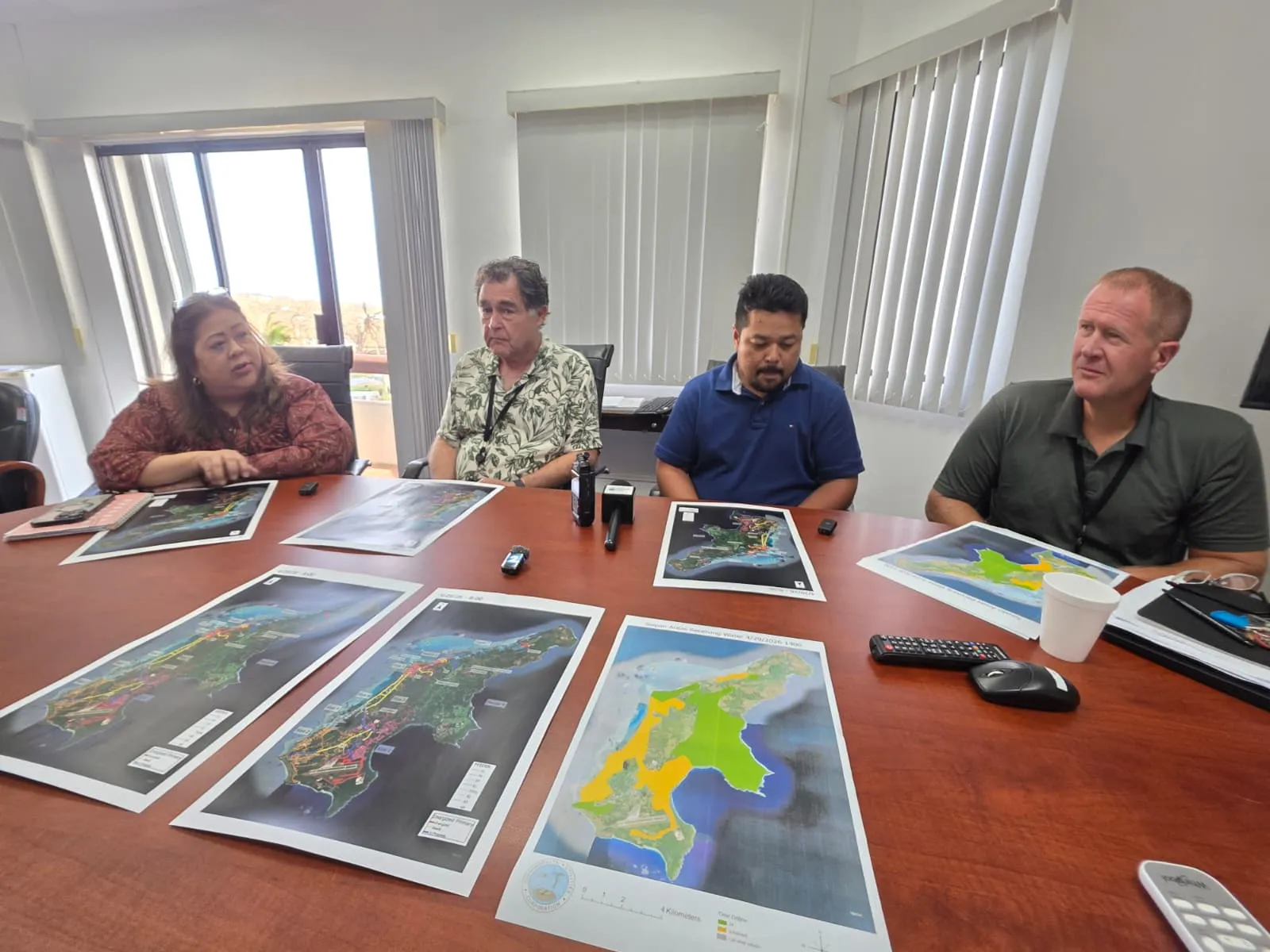
COMMONWEALTH Utilities Corporation Executive Director Kevin Watson on Wednesday outlined a 90-day goal to restore power across Saipan after Super Typhoon Sinlaku, while warning that the target is not a guarantee as crews continue to uncover new damage across the island’s electrical system.
Watson, joined by CUC Chief Financial Officer Betty Terlaje, electrical engineer Jonathan Camacho, and utility coordinator Joel Hoepner, said the corporation is working toward a three-month restoration window but cannot make firm promises.
“Ninety days is our goal,” he said. “We’re trying to get it done within that timeframe, about three months. But we can’t sit here and make that promise, as we continually run into issues, even with Power Plant 3.”
Major structural damage
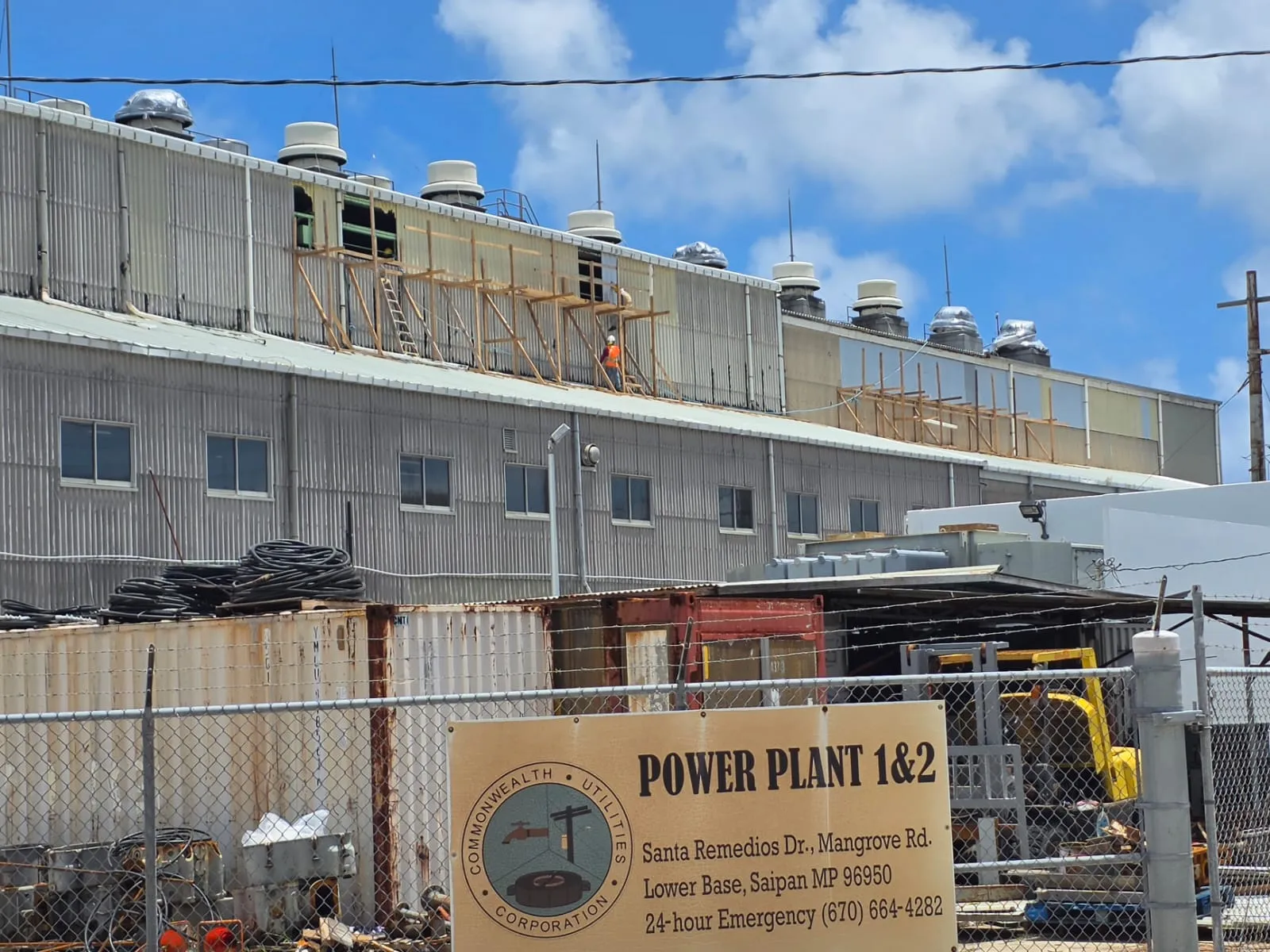
A key obstacle to meeting the 90-day target is the condition of Power Plant 1, which sustained extensive roof and wall damage during the storm, allowing water to flood engines and control systems. Watson said crews are still drying out the facility before a full assessment can be completed.
“Power Plant 1 got extensive damage to the roof and the walls that caused severe water damage to the engines and controls,” he said. “They’re using huge heaters and putting them in the engines to let hot air go in and dry it up.”
One engine is currently undergoing repairs and will be used to test whether the plant can safely return to service. Watson said even partial restoration at Power Plant 1 would mark a significant milestone, as it would allow CUC to integrate large temporary generation.
Temporary generation
CUC plans to synchronize Power Plant 1’s Engine 1 with a FEMA-supported Aggreko temporary generation system. Once online, the combined output would bring Saipan’s available capacity to roughly 18.5 megawatts — about 5.5 MW from Engine 1 and 12 to 13 MW from Aggreko.
“Once we get a baseline, we’ll be able to get Aggreko on,” Watson said. “We just need one engine to get Aggreko on.”
He emphasized that each step remains vulnerable to setbacks, and delays in one component can affect the entire restoration plan.
Power Plant 3 continues to trip
Watson pointed to Power Plant 3 as an example of the system’s ongoing fragility. The plant, which supports dozens of water wells, has been tripping almost daily due to environmental contamination.
“Because it rained last night, it caused it to trip from what a transformer salt spray was doing on our arresters,” he said. “When it rained, it made a connection with the salt, so it was arcing and tripped Power Plant 3.”
He said these recurring issues highlight why CUC cannot provide firm restoration dates.
Federal and regional support expands
Watson said CUC is receiving assistance from FEMA, the U.S. Army Corps of Engineers, and the Guam Power Authority, which are providing manpower, materials, and temporary generation.
Some of the larger FEMA units will require new fuel infrastructure, including a double-contained underground fuel line.
“That’s going to take a considerable amount of time,” Watson said. “We’re hopeful it will be ready by the time our transmission and distribution system is ready to accept the power.”
Rota fully restored; Tinian advancing with FEMA generators
Rota has achieved full power restoration, allowing CUC to redeploy crews to support recovery efforts on Tinian. Watson said the shift in manpower is helping accelerate restoration work there, where the local power plant sustained significant damage.
“Tinian is moving forward with FEMA generators and Army Corps support,” he said. “Rota is fully restored, so we’ve been able to move their teams to help Tinian.”
On Tinian, FEMA-provided generators and Army Corps personnel are working to replace lost generation capacity, while CUC crews clear lines, restring conductors, and prepare feeders for energization. The temporary units will serve as the island’s primary power source until permanent generation is restored.
Watson said the goal is to bring Tinian to a stable interim level of power while long-term solutions are developed.
Transmission and feeder progress
According to CUC’s April 29 situational report, Feeder 1 and Feeder 3 were energized from Power Plant 3 to the hospital on April 19 and remain online. Crews on Feeder 4 have cleared downed poles in Kagman and installed four new poles toward the governor’s office.
Work continues on Feeder 7 at the As Matuis water wells, while crews on Kiya 1 have completed restringing and reframing conductors toward the Isley wells. On Kiya 3, restoration at the S3 Lift Station is complete and awaiting energization.
FEMA’s debris task force has cleared access to Chalan Kiya Road, while crews have restrung conductors along Beach Road and Chalan Msgr. Guerrero to the Garapan Fishing Base. The Kiya Substation is awaiting installation of a FEMA backup generator, and Kiya 4 crews have cleared primary lines in Oleai, Falufala, and Susupe.
Long-term hardening still needed
Watson said the island must also consider long-term hardening measures, including replacing wooden poles with concrete structures and exploring partial undergrounding of lines. He said the ideal solution would involve relocating critical generation to higher ground.
“Ideally, we would just build a new plant on higher ground,” he said. “That conversation has been held with other government funding agencies, and that will still be an option going forward.”
A goal, not a promise
Watson reiterated that the 90-day timeline is a target, not a guarantee, as new challenges continue to emerge daily.
“There are many challenges that we face every day,” he said. “To give you an exact date or even an estimate is hard, because we don’t know when we’re going to get the generators.”
Despite the uncertainty, he praised CUC staff, federal partners, and the public, saying every day of work brings Saipan closer to restoration — even if the path remains unpredictable.
Bryan Manabat was a liberal arts student of Northern Marianas College where he also studied criminal justice. He is the recipient of the NMI Humanities Award as an Outstanding Teacher (Non-Classroom) in 2013, and has worked for the CNMI Motheread/Fatheread Literacy Program as lead facilitator.
