




By Bryan Manabat
[email protected]
Variety News Staff
FEDERAL Emergency Management Agency officials are on the ground in the CNMI assessing the widespread destruction left by Super Typhoon Sinlaku and preparing recommendations to President Donald Trump on whether the islands should be declared a major disaster area.
Such a declaration would unlock FEMA individual assistance and additional federal relief for thousands of residents affected by the storm’s 72‑hour onslaught from late Tuesday, April 14, through April 16.
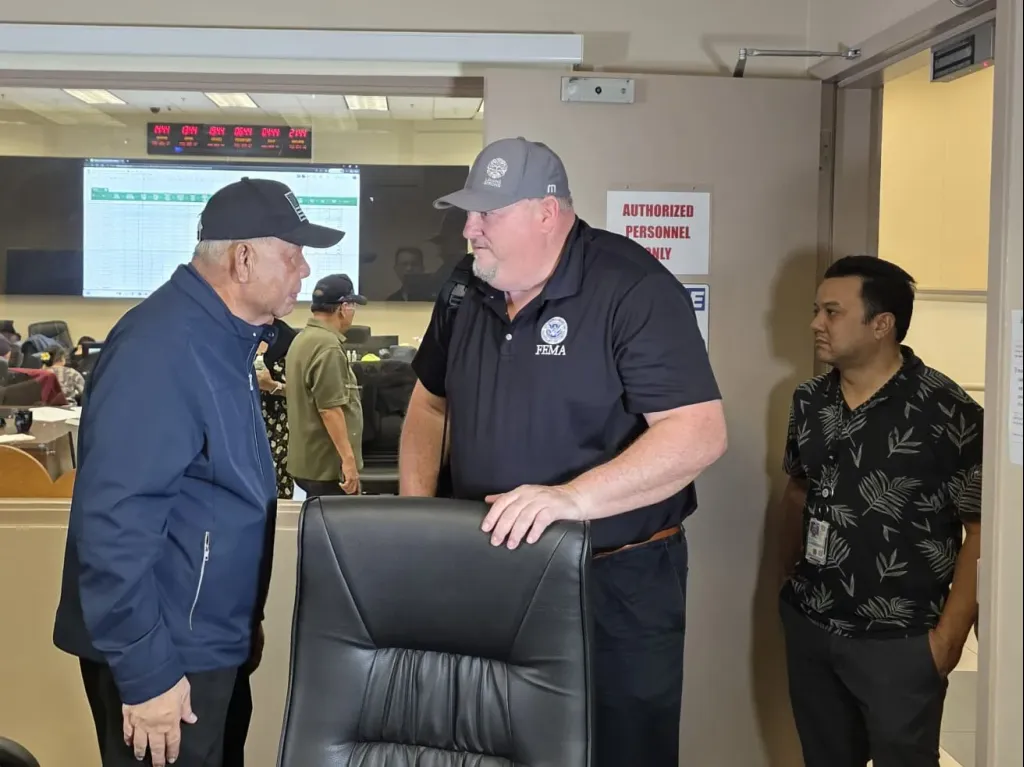
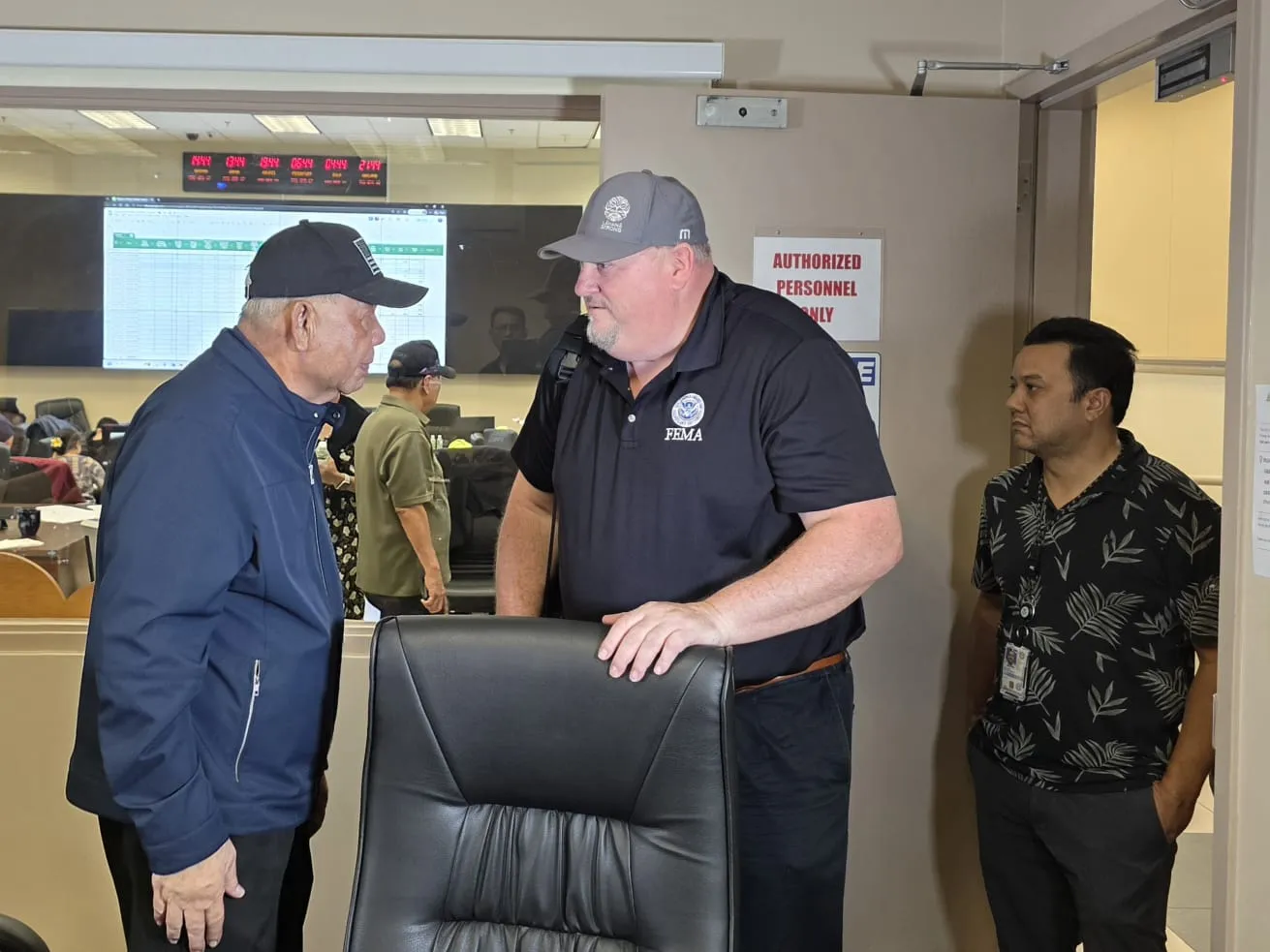
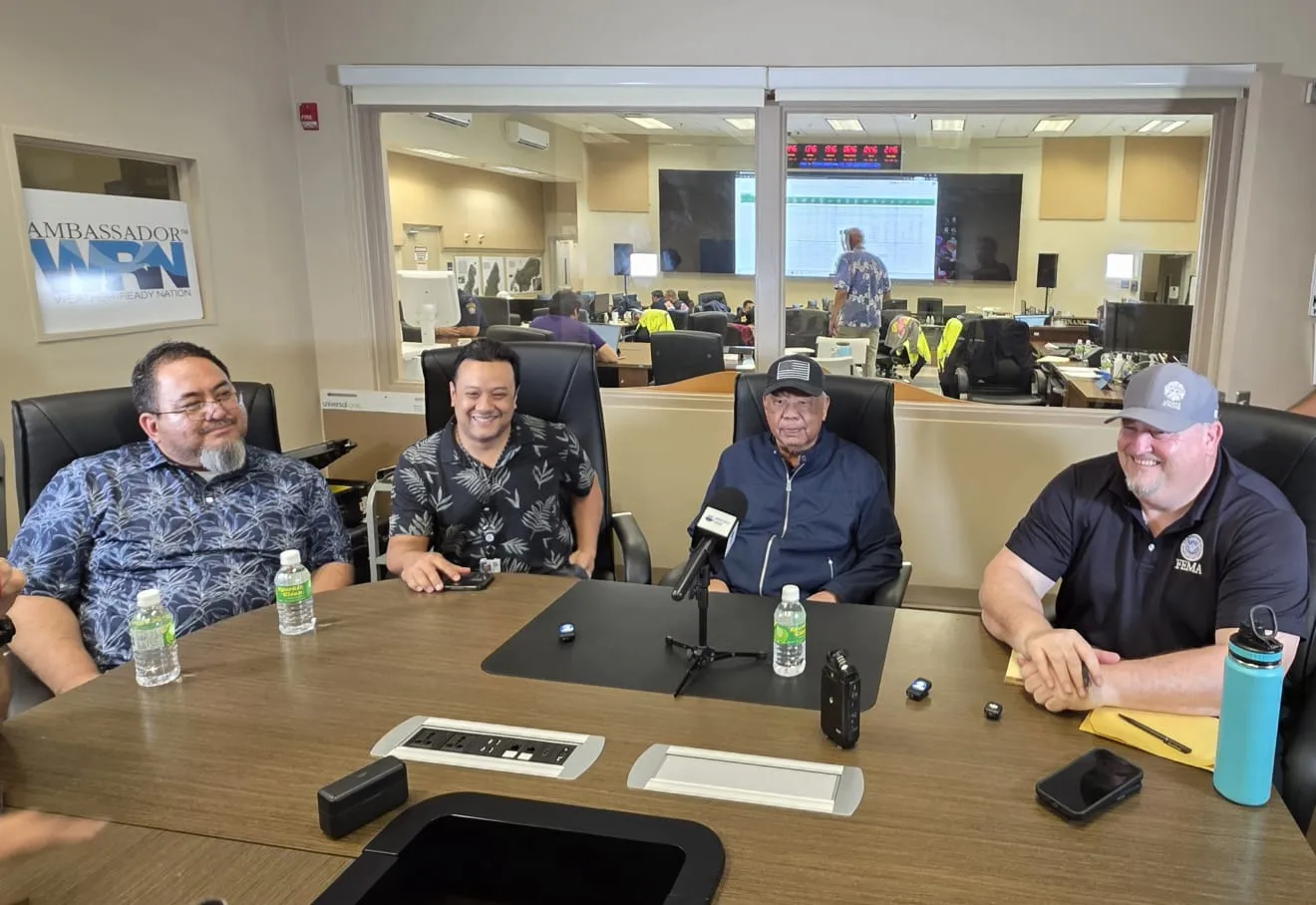
FEMA Region 9 Administrator Robert Fenton, who arrived in the CNMI to oversee the response, said the agency’s immediate focus remains on life‑safety operations while the broader damage evaluation continues. “Right now, we need to make sure we’re taking care of those immediate needs. We need to make sure people have food and water, that we have emergency power, that the medical… systems [are] going, that we get communications back up here, and we’ll do that as a team,” he said during a Friday afternoon press conference.
A storm unlike others
Fenton said Sinlaku’s impact was unusually severe, noting that while previous typhoons such as Yutu passed quickly, Sinlaku stalled over the islands. “The difficulty about this event was the sheer size of it, right? 500 miles in diameter, and we weren’t able to start moving things forward… This took 48–72 hours for it to move through.”
With 30 years at FEMA, Fenton said he has responded to nearly every major typhoon affecting Guam, the CNMI, and Micronesia since the late 1990s, including Paka and Yutu. He said he was encouraged to see that infrastructure hardened after past disasters — such as concrete poles and FEMA‑built housing — remained standing. “I was pleased to see…the concrete poles that we put in that are still up and…some of the housing that we put in here last time…withstood the winds.”
Gov. David M. Apatang said Fenton’s presence reflects a long‑standing partnership. “It’s unfortunate that we only see him back here when we have issues like this, but Bob [has] been our friend… through so many, many disasters here in the Commonwealth.”
Apatang also thanked President Donald Trump for expediting the emergency declaration, which allows FEMA to move quickly on life‑saving and life‑sustaining operations while the major disaster request is being prepared.
FEMA’s immediate response
Fenton described a layered supply chain stretching from the U.S. mainland to Hawaii, Guam, and the CNMI. “We’re setting up a supply chain that goes from the mainland to Hawaii to Guam, and there’s plane loads of people and equipment and supplies moving by air and by ship.”
Key elements include:
• Pre‑landfall deployments. FEMA teams were initially staged on Guam, then pushed north as Sinlaku’s track shifted.
• Air operations. The U.S. Air Force used helicopters to check airport operability on Saipan, Rota, and Tinian; Coast Guard C‑130s began flying in responders.
• Maritime support. Supplies are moving by ship from Hawaii, expected to reach Guam in about eight days before being transshipped to the CNMI by barge.
Fenton said FEMA is supported by the Department of Defense, Coast Guard, and “a number of ships in the area” capable of providing helicopters and lift capacity. While acknowledging that “it’s never as fast as everyone wants,” he said the goal is to move resources at “the fastest pace we can that’s safe for everyone.”
Top priorities
Fenton and CNMI officials emphasized that the immediate priority is restoring water, emergency power, and communications.
• Water
“I’ve gotten some of the briefs that the system has been impacted… The good news is that we’ve done a lot of planning with CNMI over the years. We’re well aware of their water system, the wells. We know what generators actually power their wells… Some of those might have been damaged on this event, but we will make sure that… those critical facilities… come back operational as quick as we can.”
Large volumes of bottled water are being moved into the region. “We have teams set up to go to Tinian and Rota…they’ll stay there with them and help them bring those resources in.”
• Power
The U.S. Army Corps of Engineers’ 249th Power Battalion is deploying generators to hospitals, wells, airports, and critical government sites. “We have generators set up already for some… in some cases, we had generators we purchased on previous events, so there’s redundant power here.”
More generators are arriving daily. “You’ll start seeing those generators coming over in the next today, tomorrow, the next day… It takes a little bit of time to do that.”
• Communications
“We know the tower went down, so we’ve already brought with us the stuff to get the tower back and operational,” Fenton said. Communications specialists and mobile emergency response systems are setting up temporary towers and antennas to restore emergency and public communications.
Emergency declaration in effect; major disaster request pending
Fenton said the emergency declaration already approved by the president gives FEMA full authority to meet immediate needs. “There’s an emergency declaration…that gives me all the authority I need to meet those immediate lifesaver requirements… That doesn’t prevent me or stop me from doing anything I need to do right now.”
The governor is preparing a request for a major disaster declaration. “Once I get a chance to assess it, my job is to give a recommendation to the President,” Fenton said.
He said FEMA individual assistance — which includes temporary housing, home repairs, and financial aid — will be available only after a major disaster declaration. In the meantime, FEMA is focusing on shelters, temporary housing, tarps, and rapid roof repairs using tin and wood already in inventory.
He acknowledged frustration with long‑term reliance on FEMA tents and said the agency aims to avoid repeating that model. Lessons from 2018 and from Maui’s rapid temporary school construction are being applied.
Mental health and community resilience
Fenton said the storm’s long duration has taken a psychological toll. “I think there’s a mental factor to this…a mental health factor that we need to be aware of…the length of time, I think it’s significant.” FEMA plans to bring mental health specialists to support shelters and heavily impacted communities.
Fenton said the federal presence is growing rapidly. He arrived with an initial team of 14. Two more planes were expected to bring about 30 additional personnel.
A United flight the next day was expected to carry about 160 responders.
Helicopters have been landing with Air Force, Army, Navy, and other personnel.
The American Red Cross has more than 100 people on Guam preparing to support CNMI shelters.
“Right now in theater, meaning between Guam and the CNMI, I have about 500 personnel… and that will continue to increase.”
Local response
Governor Apatang said water remains the Commonwealth’s most urgent need. “Water actually is a priority number one…because we don’t want to have any… epidemic out there, especially our people in the shelter.”
Fuel shortages are slowing generator operations. “Everybody’s running around looking for diesel right now…trying to get the service station open so we can get our people…a chance to fill up their vehicles or generators or whatever,” he said.
The CNMI is also requesting additional labor support. “We requested for additional help on [labor]. The Department of Labor is working on a letter.”
Cleanup is underway across all three islands. “We instructed our people to start cleaning up, go out and start removing debris…the mayor’s office especially is very active,” he said.
Shelter operations may be extended. “We’re looking also at extending the length of people staying at the shelter…that’s also what we’re looking at.”
Apatang urged unity. “Let’s work together out there in the community, stay safe… We’re good in that, so let’s just work together and we’ll be okay. We can recover from this.”
Bryan Manabat was a liberal arts student of Northern Marianas College where he also studied criminal justice. He is the recipient of the NMI Humanities Award as an Outstanding Teacher (Non-Classroom) in 2013, and has worked for the CNMI Motheread/Fatheread Literacy Program as lead facilitator.
