



By Bryan Manabat
[email protected]
Variety News Staff
SAMARITAN’S Purse, the international Christian disaster relief organization that first entered the Northern Marianas after Typhoon Yutu in 2018, has mounted one of its largest Pacific deployments to date following the devastation caused by Super Typhoon Sinlaku, airlifting more than 120 tons of emergency supplies and operating a full Emergency Field Hospital on Saipan.
The organization said its ability to respond quickly in April 2026 was rooted in long-standing partnerships with CNMI churches, local governments and health officials — relationships forged during Yutu and strengthened through years of continued ministry in the islands.
Track record in the Marianas
Samaritan’s Purse became widely known in the CNMI after Typhoon Yutu, when it delivered more than 80 tons of relief supplies across three airlifts and served more than 7,600 families on Saipan and Tinian. The organization distributed thousands of tarps, solar lights, water filtration systems, generators, extension cords, insect repellent and multilingual Bibles. Its mobile medical team partnered with the Commonwealth Healthcare Corporation to provide influenza immunizations and tetanus shots to vulnerable communities.
In the years that followed, Samaritan’s Purse helped reconstruct Cornerstone Christian Church, which had been flattened during Yutu, and supported the 2020 Marianas Festival of Hope led by Franklin Graham. Its Operation Christmas Child project delivered nearly 11,000 shoebox gifts to children across the CNMI in 2019 and 2020.
The organization now counts 32 ministry partners on Saipan and Tinian.
“Because of the relationships we built in 2018 and strengthened through the following years of ministry, our team was able to respond even more effectively when Typhoon Sinlaku struck,” the Samaritan’s Purse team said.
Airlifts, water and medical support
After Sinlaku made landfall, Samaritan’s Purse transported a Tier 1 Outpatient Emergency Field Hospital, two reverse osmosis water purification systems and other critical supplies to the CNMI. At the peak of operations, approximately 64 Disaster Assistance Response Team members were on the ground.
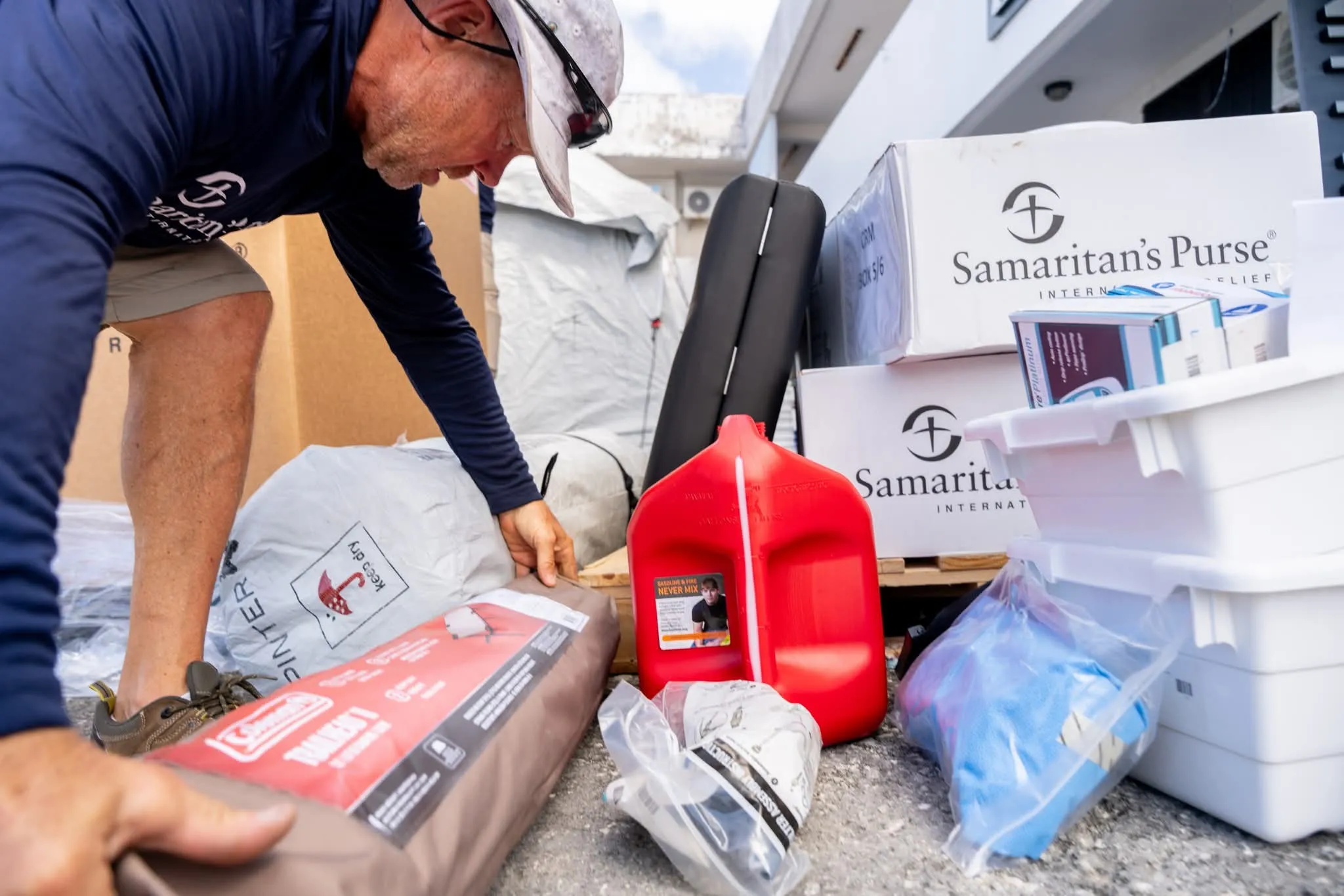
The organization has distributed more than 500 generators, over 1,500 blankets, nearly 23,700 jerry cans, more than 1,000 mosquito nets, close to 10,000 solar lights, more than 10,400 tarp pieces and hundreds of brooms and shovels. Teams also established Water Access Points equipped with 1,000-liter water storage bladders to support sustained community use.
Samaritan’s Purse said deployment decisions are based on on-the-ground assessments and coordination with local authorities, health officials, faith-based partners and other humanitarian organizations.
“From the very beginning of this response, we were in conversation with government agencies and NGOs to ensure that all community needs within our scope of work were met,” the team said.
Equity and access across islands
The organization emphasized that it works closely with local authorities, churches and healthcare partners to identify vulnerable communities, including elderly residents, homebound individuals and people living in remote areas. During the Sinlaku response, teams provided aid to the Center for Living Independently, a special-needs facility on Saipan.
“Our teams work to serve all those who request assistance and whose needs fall within the scope of our work,” Samaritan’s Purse said.
Water, sanitation and hygiene operations
The Samaritan’s Purse water, sanitation and hygiene team — known as the WASH team — produced between 7,000 and 50,000 liters of clean water per day, depending on operational conditions, totaling more than 45,000 liters to date. All water sites were tested and approved by the Environmental Protection Agency. Operations are now being transitioned to local partners, which have received training and materials to maintain production.
Medical operations and community care
Medical care has been a major component of the response. The Emergency Field Hospital has operated seven days a week and recorded more than 1,300 patient visits, addressing minor injuries and disruptions to chronic care. Mobile Medical Units have reached more than 750 patients in remote areas and among residents unable to leave their homes.
In a separate interview Wednesday, Samaritan’s Purse hospital director Lauren Ralston said the team brought a Tier 1 outpatient medical facility “to supplement the emergency room at CHCC,” along with a mobile medical unit conducting clinics throughout Saipan.
“They’re able to go into homes and provide basic medical care for free, as well as medication refills and prescriptions,” Ralston said. She added that the mobile team, working closely with CHCC’s public health division, reached its 1,000th patient during the early phase of the response — a milestone reflecting the scale of community need.
Ralston said the medical staff includes three doctors — two assigned to the field hospital and one to the mobile unit — along with two physician assistants, five nurses and two paramedics.
“Our team is scaling down a little bit right now, so that number is fluid depending on the stage of the response,” she said.
She described the most common cases as minor wounds caused by storm debris, heat rashes linked to the loss of air conditioning, and medication replacement for residents whose prescriptions were lost when their homes were damaged.
“Anything from a basic blood pressure or blood sugar check to wound care or suture removal,” she said.
More serious cases are triaged to CHCC.
“Since we’re right across the street, anyone requiring extra care can go to the emergency room for X-rays or additional treatment,” Ralston said.
Ralston also emphasized that citizenship or immigration status plays no role in determining who receives care.
“Absolutely not,” she said. “We will see anybody who comes into our hospital. It is not important to us. Regardless of citizenship, regardless of where you came from or how long you’ve been here, we will take care of you.”
On Tinian, Samaritan’s Purse provided Clinic Restart Modules — tents, generators and medical supplies — to help local clinics resume operations.
Ralston said the reception from residents has been overwhelmingly positive.
“We’ve been blown away by the community’s response,” she said. “Working closely with the clinics and the hospital, seeing how this community cares for each other, it inspires us. It uplifts our mission to bring help in Jesus’ name.”
She added that partnerships with local churches have been essential.
“They know the community well, and long after we’re gone, those church partners will remain here and continue pouring into the people they’ve been serving.”
Coordination, accountability and long-term recovery
Samaritan’s Purse said it has coordinated with government agencies, military partners and NGOs through structured meetings and liaison channels to avoid duplication of services. Teams track all distributions, locations and activities throughout the response.
The organization maintains pre-positioned emergency supplies in its warehouse through donor support.
“We are thankful for all who have given to this response in Saipan and Tinian,” the team said, noting that it could not provide percentage breakdowns of funding.
As utilities and local systems come back online, Samaritan’s Purse is preparing to close out its emergency operations. The organization plans to donate its Emergency Field Hospital to CHCC for continued use and will remain in contact with its 32 ministry partners on Saipan and Tinian.
Bryan Manabat was a liberal arts student of Northern Marianas College where he also studied criminal justice. He is the recipient of the NMI Humanities Award as an Outstanding Teacher (Non-Classroom) in 2013, and has worked for the CNMI Motheread/Fatheread Literacy Program as lead facilitator.
