




By Bryan Manabat
[email protected]
Variety News Staff
THE Leona M. and Harry B. Helmsley Charitable Trust envisions a CNMI where residents can access high-quality healthcare without leaving home — supported by a locally trained workforce and modern medical infrastructure.
“I’m a firm believer in keeping care local and emphasizing that care is local, and that your ZIP code should not determine your healthcare outcomes,” Helmsley trustee Walter Panzirer said during a virtual briefing with local media on Northern Marianas College’s announcement of a $2.3 million grant for its nursing program. “People heal when they’re close to their support network — when they’re close to their family, their friends, their loved ones. Anytime we’re able to create a program that keeps healthcare local and helps people stay home, it’s better for the individual because they’re surrounded by those they love.”
For Helmsley, the CNMI is not a one-off project but part of a long-term commitment to rural health equity and to “growing your own” healthcare workforce, he added.
Strategic investment
The new $2.3 million Helmsley grant — on top of a previous $6.4 million investment for an MRI machine at the Commonwealth Healthcare Corporation — will modernize NMC’s nursing program and strengthen the local healthcare workforce pipeline.
The 36-month grant, which runs from February 2026 through January 2029, will:
• Modernize NMC’s nursing curriculum to a concept-based model;
• Develop a state-of-the-art simulation skills laboratory with high-fidelity mannequins and advanced equipment; and
• Support allied health pathways, including hemodialysis technician and community health worker certificate programs
NMC President Dr. Galvin Deleon Guerrero described the grant as a system-level intervention.
“This reflects not just an investment in Northern Marianas College, but a deep and broad-based investment in improving the healthcare system here in the CNMI,” he said, noting Helmsley’s earlier support for the MRI and its continued backing of lab equipment and curriculum improvements.
The goal, he said, is not only licensing success but community service. Graduates “are not only going to graduate and pass the NCLEX, but most importantly, they are going to meet the pressing healthcare needs of our community.”
Head of NMC’s nursing program Rosa Aldan said the grant represents a dramatic turning point in how nurses are trained on Saipan.
She recalled how, in the aftermath of typhoons, faculty improvised skills training with whatever materials were available.
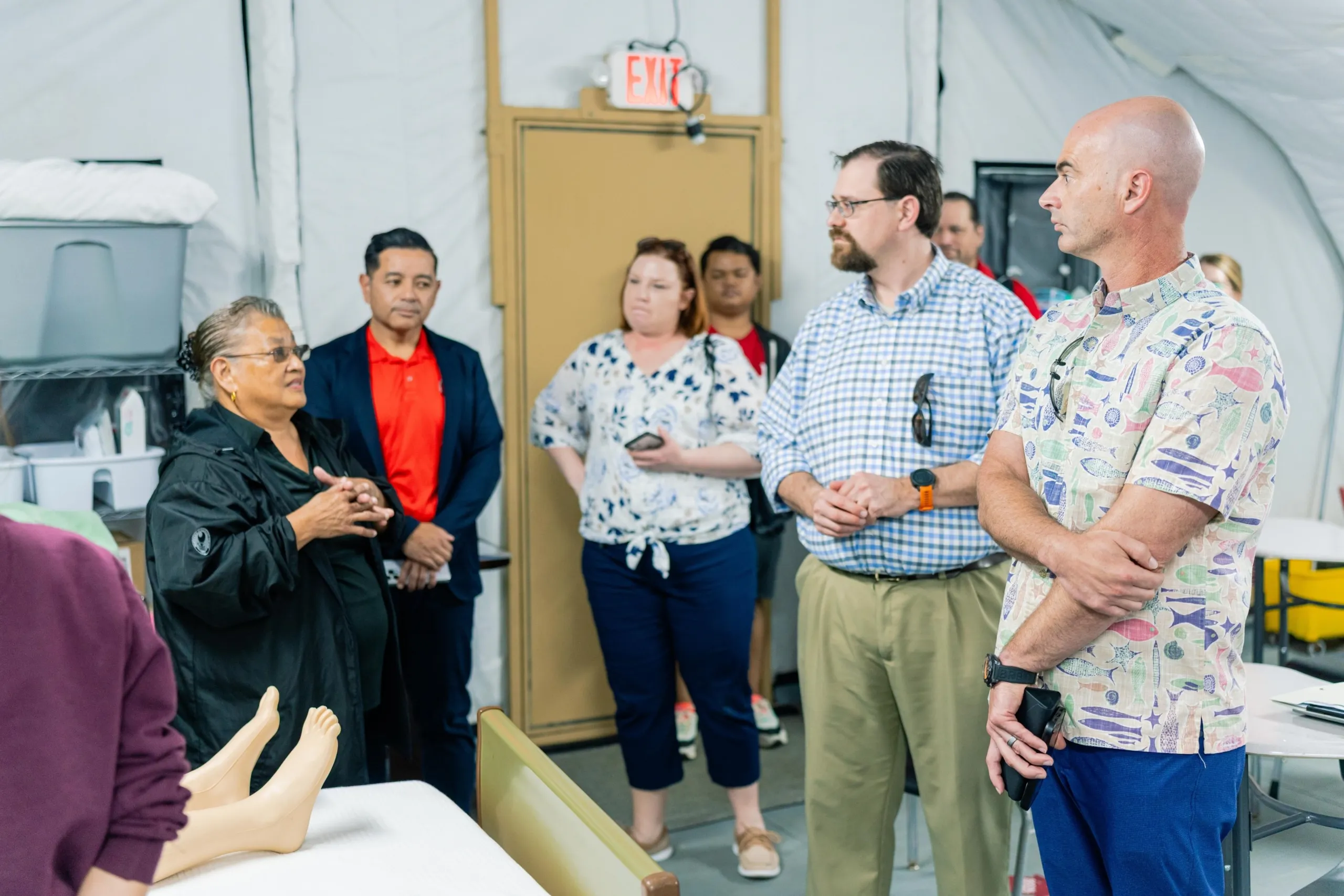
“In the past, our students were learning in tents, and our faculty had to be creative to run the skills lab,” Aldan said. “One faculty member used pool noodles to demonstrate and practice injections. Another used oranges as padding to simulate muscle for injection practice.”
Currently, NMC relies on basic mannequins, task trainers, and online videos, but Aldan said the new funding will allow the program to reach the standards seen at major mainland institutions.
“With this generous grant award, we can now purchase the necessary learning models, high-level mannequins, and equipment for a simulation lab that incorporates computers and advanced programs,” she said. “This will allow students to practice and apply what they learn in lecture in a simulated environment.”
Simulation labs, she added, provide a safe space where students can make and correct mistakes before encountering real patients.
“Simulation labs are now a standard learning environment where students can feel comfortable making mistakes, correcting them, and then applying their knowledge and skills in real hospital settings with real patients,” Aldan said.
The grant will also fund professional development so faculty can master the new technologies and curriculum.
“Even for us as faculty, there’s learning involved,” Aldan said. “This grant allows us to invest in professional development and move our curriculum into a concept-based model, which is now the standard in nursing education. It helps students develop critical thinking and decision-making skills needed in today’s technology-driven healthcare environment.”
Panzirer underscored how transformative the upgrade will be.
“These mannequins and technologies are pretty much standard at most higher education institutions,” he said. “Once installed, this will be the same type of learning environment you’d find at many Bachelor of Science in Nursing programs, at least from a technology standpoint.”
Capacity, demand, and the path to a BSN
Behind the technology upgrade lies a capacity challenge: demand far exceeds available slots.
NMC’s nursing program is currently a two-year associate degree program that typically admits 25 to 30 students per cohort each year. According to Aldan and Deleon Guerrero, the program receives more than 100 applicants annually, in addition to a large pool of pre-nursing students.
Capacity is constrained by the number of faculty and available clinical sites, with CHCC remaining the primary hospital placement.
“The maximum number we can admit is 30, and even that is pushing it,” Aldan said. “Faculty both lecture and supervise clinicals. We’ve tried 40 before, and it was overwhelming. Even when you want to provide quality education, there’s only so much you can do with too few faculty and limited clinical sites.”
Deleon Guerrero said part of the Helmsley grant supports curriculum review and planning, which will help the college map out future expansion.
“A portion of the grant will fund curriculum review and upgrading, which will help us identify staffing needs if we pursue a bachelor’s program,” he said. “Once we have a new facility, new lab equipment, and an updated curriculum, we’ll have a clearer path to increasing capacity and moving toward a Bachelor of Science in Nursing.”
Aldan said the nursing team is already looking ahead.
“We’re really excited to bring our nursing program to the next level,” she said. “With this new technology and innovation, we can envision eventually adding a Bachelor of Science in Nursing program and bringing our program fully up to speed.”
She also pointed to allied health certificate programs as a near-term solution to support CHCC and private clinics, particularly as changes to the CW program loom in 2029. Training both registered nurses and allied health professionals locally, she said, will help the healthcare system manage workforce needs while long-term RN capacity is built.
Reaching Rota, Tinian, and beyond
NMC’s nursing ambitions extend beyond Saipan. When asked how students and patients on Rota and Tinian would be included — given high travel costs and referral challenges — Deleon Guerrero cited both facilities planning and online instruction.
He said long-term plans include student housing for learners from Tinian, Rota, Micronesia, and even international students. In the meantime, the college has expanded online delivery of prerequisite and related courses, creating a pipeline for outer-island students to advance toward the nursing program.
“It’s definitely part of our planning and vision,” he said. “It’s a step-by-step process, but it’s something we’re actively working toward.”
A long-term partnership
For Helmsley, these investments mark only the beginning.
Panzirer said the trust expanded to include the Northern Marianas, American Samoa, and Hawaii only after a deep dive into local conditions and extensive stakeholder engagement.
“We don’t expand often,” he said. “When we do, we’re here for the long haul. We’re not a flash in the pan. As long as we can financially support these communities, we will continue to do so and help address healthcare challenges.”
He confirmed that additional grants for the CNMI are already in progress and that he and his team plan to return regularly.
“I love coming to the Northern Marianas,” he said. “I’ve been to all three — Saipan, Tinian, and Rota — and I have a special place in my heart for all of them. I’ll definitely be back, and my team will too.”
For NMC and its nursing program, that sustained partnership could mark the difference between a small, oversubscribed associate degree and a fully developed, four-year pipeline of nurses and allied health workers — trained, as Panzirer put it, to “world-class” standards without ever having to leave home.
Bryan Manabat was a liberal arts student of Northern Marianas College where he also studied criminal justice. He is the recipient of the NMI Humanities Award as an Outstanding Teacher (Non-Classroom) in 2013, and has worked for the CNMI Motheread/Fatheread Literacy Program as lead facilitator.
